Tuesday, June 9, 2015

An Alternate Reality #6: Alphaville


Pseudo-science is the new religion; self-proclaimed intellectualism, our saving grace...deceitful politicians, our gods. Our actions are monitored, our thoughts and expressions harnessed. It's a nice, safe world, with equality for all, or so the high-brows tell us. Orwell warned us of its advent, and today, more than ever, this variation of suppression anchors our reality. 

The prediction wasn't exclusive to "1984". It resurfaced in a French, detective-movie sequel entitled "Alphaville": aka, "A Strange Case of Lemmy Caution", as offered by avant-garde director, Jean-Luc Godard.


Caution (ersatz, Agent 003), is played by Eddie Constantine, who had portrayed the character (based on Peter Cheyney's literary creation) in prior hard-boiled yarns dating back to '53. However, "Alphaville" differs from its predecessors in its surreal, science-fiction context (even though Jess Franco's "Attack of the Robots", with Constantine, initiated the blend three years prior).

In "Alphaville'"s parallel '65 (or some year thereabout), computer technology has swung into full gear. Professor Wernher Von Braun (formerly known as Leonard Nosferatu and played by horror-veteran, Howard Vernon) has constructed the ultimate Big Brother surveillance device, the Alpha 60: a forerunner to the Forbin Project, HAL 2000 and Ultron. The devilish IBM creation possesses an implied omniscient consciousness, its deep, reverberating voice acting as both a judgmental interjection to Caution's actions and an overriding commentator to events.


Caution (pretending to be journalist, Ivan Johnson) initially pursues a fellow secret agent, Henri Dickson (Akim Tamiroff), into Alphaville's doleful heart. Intrigued and suspicious, Caution snaps pictures as part of his investigative progresses (in essence, documenting the past, which is frowned upon in this strange, new world). Along the way, he gains the incentive to derail the Professor and his monstrous machine.

Alphaville is, indeed, a peculiar place. Though the plot appears to unfold in Paris, Alphaville is a conglomerate of many cities and countries: modern in design and dosed in foreboding shadows and disquieting customs. 


When you check into a hotel, you're assigned a pretty woman, who asks if you'd like to sleep. Her salacious implication is tempting, but can she (or any of Alphaville's robotic citizens) be trusted? Caution knows well enough to reject his seductress' mechanical advances and wastes no time to engage in a fight with a stranger who, for whatever odd reason, has been sent to do him in. After the brawl, Caution sits and converses with Alpha 60: an intercom voice that conducts a brief but invasive exchange. The surreal pace has been set.

Caution then meets Von Braun's daughter, Natasha, played by the charismatic Anna Katrina. At first he's wary of her (since she claims the authorities assigned her to him, with the belief he's there to enjoy "Festival"). However, Caution falls in love with her, and she seems to reciprocate, though claims unfamiliarity with the forbidden feeling. 


From there, the two engage in a series of abstract scenarios, which further reveal Alphaville's dystopian underbelly, including the existence of "dictionaries" in lieu of Bibles, wherein the contents are consistently changed to fit the latest propagandist spurts: a homage to Orwell's Newspeak. In addition, neon Einstein equations flash throughout the city, promoting the notion that science, not sentimentality, is the worthy guide. A seedy hotel harbors love-starved souls, broken by the city's mundane cycle, including the now suicidal Dickson; and there's a cold, calculating realm called Grand Omega Minus, where we learn people are brainwashed and dispatched to the Outer Countries ("galaxies", as they're called) to instigate revolts and general dissent.

One of the film's most unsettling scenes depicts a group of men being executed at an indoor swimming pool: their crime, a display of emotion. (This includes a gent arrested for weeping over his wife's death.) After the men are shot, bathing beauties follow them into the pool, ritualistically stabbing them and commemorating their deaths with water ballets: a form of meticulous but empty pageantry. 


Such scenes symbolize much of Alphaville's inherent flaw. Like Jack Finney's "Body Snatchers", emotion is considered a shameful hindrance. Even minor moments of levity are at best staged and crude: a socialized, totalitarian imprisonment, where no one stands out from the pack and therefore, no one ever matters, beyond acting as another cog in the bland body politic. 

In influence, "Alphaville" foreshadows Patrick McGoohan's "The Prisoner", where actions are monitored and freedom scorned. Additionally, the story depicts Caution as a Ditko avenger (and therefore, a forerunner to "Watchmen'"s Rorschach), defining individualism and justice when the powers-that-be choose cruel conformity. Like Philip K. Dick's Rick Deckard, Caution also sees the wrong in using others as puppets, but unlike the android hunter, never doubts his motive: liberation must reign for all!


On many levels, the pursuit of liberty is presented as a dangerous quest in "Alphaville", but despite the film's pessimistic tone, hopeful moments arise from Caution and Von Braun's relationship. Such are represented through ethereal lighting and moments of soothing, contemplative thought. To supplement this, Caution's resistance to Alpha 60 champions the human condition, his unpretentious nature sparking a rebellion, which leads to a disturbing but enlightening climax. 

Much has been discussed about "Alphaville" over the decades, and its various parts lend themselves to vast interpretations. Still, its primary theme tells us to resist dictatorial command, no matter how sophisticated or magnanimous it may seem. It's a lesson we must follow in our own reality. Indeed, if only more of us would emulate Caution's cause, we might regain the humanity we've allowed our governing bodies to seize under the pretense of equality for all. 

Sunday, June 7, 2015

Collectible Time #26: AMT Man from U.N.C.L.E. Spy Car and Polar Lights/Aurora Batmobile

Thanks to Z&Z Hobbies, I landed two additional model kits...vehicular reissues, this time.

AMT has repackaged its '67 1/25 scale "Man From U.N.C.L.E." Piranha Spy Car as simply a "super spy car", but those in-the-know will relish its origin. 


As you can see from the box illustration, it's sure a beauty; even when presented as generic, it still invokes reveries of espionage and derring-do, as should any legendary spy adventure, which the Robert Vaughn/David McCallum series certainly does. (It's also a cool lead-in to the big-budget, Guy Ritchie remake.)


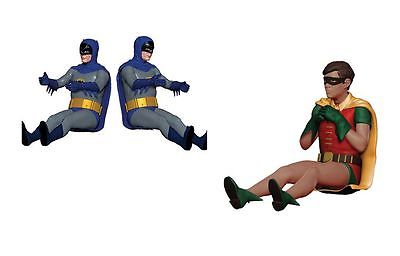
To befriend the Piranha, I also purchased Polar Lights' reissue of the Aurora 1/32 scale Batmobile, which includes Batman/Robin figures, both in styrene and retooled, resin form! Hey, in my opinion, one can't have enough of this fine vehicle (see "Collectible Time #15 - Dec '14, if you don't believe me), particularly if the Caped Crusaders are included.


For what it's worth, the packaging alone is worth the price on this one: so cool, so sleek...yep, an ideal match for the iconic car that good ol' Adam West drove. 

Friday, June 5, 2015

Collection Recommendation #2: Batman/Robin & Green Hornet/Kato sequel; plus, the Two-Way Crimes of Two-Face


Got the hardback compilation of Kevin Smith/Ralph Garman's "Batman Meets the Green Hornet" sequel. With stunning artwork by Ty Templeton and Tony Avina (and cover artworks by Alex Ross), this DC/Dynamite crossover is even grander than the first official outing of the dynamic duos (excluding the earlier Green Hornet/Kato window cameo, of course). 

The dialogue is straight out to the Batman '60s series, and the interaction between Batman/Bruce Wayne and Green Hornet/Brit Reid is so accurate you'll actually hear the voices of Adam West and Van Williams in your head. The same goes for the distinct dialogues of Burt Ward and Bruce Lee. 


Colonel Gumm is back, but has elevated himself to General. Roger C. Carmel's likeness isn't used; instead we discover that Gumm disfigured himself in a glue mishap while in prison. His head is now permanently cloaked by a hardened, pink substance (making him a sort of Black Mask of his time). 


He's teamed with Cesar Romero's Joker, and the words that roll from the Clown Prince of Crime's tongue (courtesy of the obligatory balloon captions) couldn't be more spot-on. 


The story occurs after the Batman '66 movie, and in it own right, would have made a most satisfying, theatrical feature. Great stuff!!!


To add further fervor to my Caped Crusader indulgence, I also purchased the "Batman '66 Lost Episode: The Two-Way Crimes of Two-Face". 

The proposed episode was to have introduced Harvey Dent to the series, but it was then decided that Two-Face's origin might be too intense for kids, so the False Face entry stood in lieu. The concept here is based on an outline by Harlan Ellison, which in its own right places this endeavor in a fascinating, if-only context.

Ellison's outline is, in fact, included in the edition and as you'll see, is well envisioned by superhero specialist, Len Wein. It's also superbly illustrated by Jose Luis Garcia-Lopez, with an eye-popping Alex Ross cover. Unfortunately, Dent's likeness isn't Clint Eastwood, whom West had supposedly suggested for the role. (I guess we're granted a generic take for much the same reason Carmel's likeness isn't used for Gumm.)


On the whole, this is a particularly intriguing installment in the ongoing comic series, brimming as much of characterization as zip. It also comes with some swell Garcia-Lopez extras. 

Indeed, if you wish to peer into that curious realm of what-could-have-been (which for all intents and purposes, now prevails), these colorful Bat-editions are guaranteed to deliver!!! 

Tuesday, June 2, 2015

Monster Team-up Reflection #23: Tales of Dracula


In the tradition of "House of the Wolf Man" and "Frankenstein vs the Creature from Blood Cove" comes a new, black-and-white, indie opus, which masterfully captures the crossover joys of "House of Frankenstein" and "House of Dracula"..."Tales of Dracula"!!! 


With a story conceived by director Joe DeMuro, Jessica DeMuro and Thomas Edward Rice (with official screenplay by Dwight Kemper and Mickey Ray), "Tales" is an intended first chapter in what should become on ongoing saga. It's also a veritable treat for horror fans, sprinkled with Universal and Hammer components in the way it presents character names and settings. 

The story is introduced by Von (not Van) Helsing, played with cool sophistication by Mickey Ray. The prelude is really a "Tales of Frankenstein" salute, and from there the film adapts its "House of Frank" structure, its various parts merging until an abrupt cliffhanger leaves us craving more. 


Before Von Helsing arrives in Romania, we're treated to a Larry Talbot character named Creighton Reed (wolf buffs will get it), portrayed with heartfelt delight by Tom Delillo, who casts a resemblance to Lon Chaney Jr. (with maybe a dash of Raymond Burr, as well). Reed meets a kindly man named Daniel (Dave Merrell), whose daughter, Ilona (Greta Vokova) has just departed on a woodland sojourn to the local inn. Reed is to follow her trail, with the intent of eventually locating the Chateau Frankenstein, where he hopes its resident doctor will cure him of lycanthropy: a plot device lifted from "Frankenstein Meets the Wolf Man".


Dr. Victoria Frankenstein (Courtney Bennett) isn't very interested in helping, however. In her Strickfaden-sparked lab, she injects her grandfather's lumbering Monster (Joe DeMuro) with vampire blood to make him permanently invincible. (For those in the know, this was an abandoned plot device for Al Adamson's "Frank vs Drac".) At any rate, she gains the chance to fulfill her experiment when Ilona is slain during her trek. However, it's not the werewolf who nails her, but rather Dracula, played by Wayne W. Johnson, of "Star Trek New Voyages" fame, who wants to transform her into his blood-sucking bride. 


It must be noted that Johnson is a most formidable Count, with long hair and mesmerizing eyes. He's also an aristocratic snob and doesn't take well to Frankenstein using Ilona's altered blood to strengthen the Monster. This leads to a confrontation between the ghastly titans, capped by Von Helsing's stalwart appearance, while furry Reed yet roams in the backdrop.

Colorful supporting characters help round out the action: Dwight Kemper as the comedic innkeeper; Cassandra Hayes as his feisty daughter; and Stanley Babola and Anthony Yajko as intense priests.


Also, in keeping with the Universal sequel tradition, "Tales" is both contemporary yet Old World, with no distinct time line identified. It also offers atmospheric cinematography by Mike Rudolph and to-die-for make-up by veteran Ron Chamberlain, who injects subtle alterations to the classic designs of Jack Pierce. (Even the big, CGI bat is fascinating to behold.)

Unlike "House of the Wolf Man", which pays prime homage to PRC and Monogram films, and "Frank vs Creature", which fits more into the "Frank Meets Space Monster" and "Horror of Party Beach" mode, "Tales" is a non-stop monster-rally done precisely in Universal's style, with elements of "Assignment: Terror", "Drac, Prisoner of Frank", "Lady Frankenstein", "Jesse James Meets Frank's Daughter"... stirred in to heighten the mood. 


My only objection is that the film doesn't actually conclude in a satisfying way, which I suppose is fine as long as we get a sequel...and this one damn well deserves one. 

Let's keep our fingers crossed that the next chapter premieres soon. If folks are willing to purchase the DVD (now available from Alpha Home Video at oldies.com), I bet there's more than a good chance such will occur. 

Monday, June 1, 2015

RIP BETSY PALMER

RIP Betsy Palmer...


I felt compelled to acknowledge Ms. Palmer's passing,which I just learned of this morning. I was friends with her secretary, Marilyn Gavran, for many years. Betsy was a fine, versatile actress and Marilyn a most gracious soul. I'm certain their paths will now cross in some fine, celestial place. God bless them both. 

Hannibal Season 3 Commences...


Though it seemed NBC was set to axe "Hannibal", the show has endured with a new season premiering the first week of June...but how much longer will it last? I, for one, do hope the series extends beyond the third season and that if bumbling NBC eventually tosses it, the likes of Amazon, Netflix or A&E will be come to the rescue.

Because the series has haunted me so, I've decided to establish a post for my reflections. (Should have done so for "Bates Motel" this past season, but hey, there's always next time around, right?)


Anyway, as I'm sure many of you will attest, "Hannibal" is an extraordinary concoction: a complex, thinking person's plunge into splatter and the macabre, which also dares to probe moral issues. Mads Mikkelsen is superb as the calm but chilling Dr. Lecter, and the supporting cast, which includes Hugh Dancy, Laurence Fishburne and Gillian Anderson, is equally enthralling. 

Anyway, here's wishing the best to the new season and (with bloodied fingers crossed) a long, gruesome life to the devilish saga. Bon appetit!

Thursday, May 28, 2015

Flask of Eyes Characterization #4: Which Witch Is Magda?


In my various travels, and my intended attempts to peddle "Flask of Eyes", people have inquired about the story's insightful witch, Magda: which witch or witches in literature and/or cinema inspired her? Most folks are confident they can guess from whom the influence best stems, and some are, in fact, at least quasi-correct in their inferences. 

First off, the character was named after a coworker, who wished her name used for one my story leads. "Flask" was in its infancy at the time, but the real-life Magda is far too lovely to resemble a witch, or at least the type most of us associate with the term.


In this regard, Margaret Hamilton of "Wizard of Oz" became a most obvious inspiration for the character. Hamilton's Wicked Witch of the West isn't only a pop-cultural icon, but she sports an appealing shade of green, which I wished to apply to my own mystical entity. 

In a similar way, I suppose Billie Hayes' Witchie-poo, of "H.R. Pufnstuf" fame, also contributed to Madga's look. Even though Witchie-poo isn't green, the two have crossover appeal. After all, Hayes and Hamilton did appear together in "Paul Lynde's Halloween Special" in '76. Remember that one?


In other respects, EC's Old Witch (a companion host to the more noted Crypt Keeper) lingered somewhere in the back of my mind when I composed "Flask". There's something about the Old Witch's bulging-eye stare that I couldn't quite shake when my fingers tapped the keyboard. 


When it came to Magda's quirky, prophetic attributes, two famed trios crept into the mix: those from Shakespeare's "Macbeth" and the Stygian variations in "Clash of the Titans '81". 


In another childhood-based way, I owe much to the Aurora Salem Witch model kit. Though my least favorite among the series' monsters, it was nonetheless an item I often stared at (and tinkered with) as a kid. In truth, this sculpture holds a long-haul key to Magda's traditional witch design, and that brew she's stirring ...well, let's just say that Benjamin's genesis can certainly be traced to it. 


The most fascinating (and intuitive) attribution by a "Flask" reader is that actress Maria Ouspenskaya was an inspiration. Now, I must point out, the Ouspenskaya character my friend, Jim, had in mind isn't a witch, but rather a gypsy: Maleva, to be exact, who's prominently featured in the Universal classics, "The Wolf Man" and "Frankenstein Meets...".


This acknowledgement jives, for I do believe that on at least a subconscious level, the Ouspenskaya's character dictated much of Magda's maternal nature. Magda doesn't interact directly with the story's werewolf, "Lon Jr.", which would have made the link more evident, but all the same, Maleva's gracious disposition is very much akin to Magda's. 

Yeah, the theory is quite astute, and if you don't believe me, take a taste of "Flask" and see for yourself! Magda, for one, would be most pleased!


(A little reminder: "Flask" is still available for purchase in paperback and e-book form through Amazon, Barnes & Noble and Damnation Books, as well as other fine, on-line sources in the U.S. and abroad!)