Showing posts with label alternate reality. Show all posts

Friday, August 20, 2021

An Alternate Reality: I saw Reminiscence...

Reminscence is a new dystopian movie, written and directed by Lisa (Westworld) Joy, starring superstar-for-good-reason Hugh (Wolverine) Jackman. It paints a soggy future (during the time of a nondescript war), where a Miami private eye uses (as a profitable sideline) an opiate-technology that lets folks relive parts of their past (mainly brighter days in light of the darker ones that have come to be). In actuality, Reminiscence is a somber variant of Kids in the Hall: Brain Candy, which borrows from Kathryn Bigelow's Strange Days, Douglas Trumbell's Brainstorm and the "memory" prose of Philip K. Dick to noir-esque, alternate-reality effect. 

For people to tap into the coveted past, Jackman's Nick Bannister straps his clients into his memory machinery (a brow brace and a quasi-isolation tank) and along the investigative trail, meets Mae, played by Rebecca Ferguson (Jackman's Greatest Showman costar). Mae's  long-legged allure and classic-movie mystique make Bannister fall in love with her, but alas, Mae vanishes one day without a trace, and Bannister's obsession with the knockout inspires him to comb their stockpiled memories to find her. (This goes against the advice of Bannister's caring assistant, Watts {Thandiwe Newton}, as Mae's path points to a criminal mastermind, Saint Joe {Daniel Wu} and a strong-arming fixer, Cyrus Booth {Cliff Curtis}, who are tied to estranged elitists.) 

The story's execution tugs at the heartstrings with all the lost-love pangs one might expect (and Ramin Djawadi's pulsating score propels its pathos, along with that old, Richard Rogers standby, "Where and When"), all contained within a beguiling and sprawling adventure. But this adventure isn't Homer's Odyssey, but rather a much more intimate voyage in line with Richard Matheson's Somewhere in Time, Nicholas Meyer's Time After Time and Rod Serling's Twilight Zone tale, "the Long Morrow". In this regard, Bannister's intent is as significant as if he were searching for a mountainous treasure in some far-away land, and his lady fair proves as difficult to grasp, since the path to regain her spirals into addiction. 
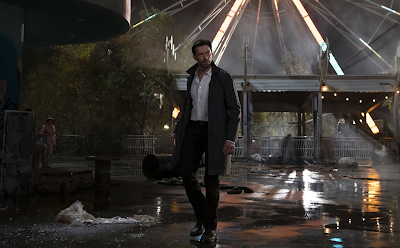
One could argue that Bannister's quest essays the ups and downs of nostalgia: its sweetness and woe. It explores why one would wish to reattach to a person, place or time, when improving the status quo (improving the moment at hand) would be more feasible and immediate. But then those who'd look to the present and/or future for an antidote to their emptiness aren't as prone to understand love. (The past, after all, is much easier to romanticize, no matter the flaws attached.) 


This philosophical, if not psychological, perspective gives Reminiscence its draw, but alas, the story is marred by an unneeded, climate-change motif. Its allegorical, water-has-risen garnishing may look nice and shimmering, but its controversial, we-told-ya-so redundancy taints the story's pathos, which should (could) have stood on its own.  

Despite this unfortunate chink, Reminiscence is a haunting experiment that challenges both body and soul: a human-condition, science-fiction product that works in direct defiance to the noisy splash that populates most high-profile, speculative filmmaking today. For those who like their escapism somber and deep, Reminiscence is without question one to seek. 

Thursday, August 12, 2021

An Alternate Reality: Marvel & Disney+ Ask What If?

What If...? is a new, animated Marvel Studios/Disney + series, based on the comic-book series of the same name. The show kicks off with "Captain Carter", Agent Peggy Carter, who became the First Avenger instead of Steve Rogers on some far-out, WWII parallel plane.  (So that then means Captain Britain came first, since Carter is British. Wow!) 

The nine-episode, anthology program will cover other Marvel variants, as well, including the Black Panther and Star-Lord (as one?); Yondu; Drax; Iron Man; Vision; Spider-man; the Hulk; Thor; Loki; Doctor Strange; Ant-Man (#1 & #2); the Wasp; Black Widow; Nick Fury; the Red Skull; Bucky Barnes; Thanos; the Collector; and the narrating Watcher (with others presently kept more-or-less concealed for the sake of Twilight Zone-ish surprise). A number of the characters will even be voiced by the actors who played them in the Avengers movies. For example, Hayley Atwell supplies Captain Carter's voice. 

Marvel (along with DC) is playing up the alternate-universe angle to the live-action extreme. It's no surprise, then, that the gimmick would spill over into super-superior animation, even if Marvel has been slack in recent years with the medium. (DC has been kicking butt with it, of course.) All the same, What If...?'s success could hit high, leading to more feature-length, animated, Marvel/Disney+  movies.

The first What If...? installment can be viewed now, with another episode set for next week. Sure, one has to pay to view, but when the concept is this revolutionary, what's a few dollars more to get in on the speculative fun? 

Saturday, February 6, 2021

An Alternate Reality: Fox's X-Men Cracked the Multiverse First

There's much talk of the alternate-reality/multiverse approach to both Marvel and DC mythologies: how their cinematic universes will open for a broad range of superhero crossovers. The intrigue is justified, but the idea isn't trailblazing or unusual among imagi-franchises. 

Twilight Zone, Outer Limits, Star Trek, Terminator, Planet of the Apes, Alien Nation, Fringe, Sliders, Cloverfield and (in perhaps a more subtle manner) Toho's kaiju have paved thought-provoking, parallel paths. However (unless one considers such small-screen endeavors as Gerard Christopher's Superboy or Lois and Clark), the forerunner on the live-action superhero-franchise front is Twentieth Century Fox's X-Men. 

The actual catalyst came with Days of Future Past, named after a comic-book saga, which in turn was named after a legendary concept album by the Moody Blues. 

In X-Men's Days, time travel invades, with Hugh Jackman's Wolverine leading the charge. The '70s morph as a result, with an assassination attempt on President Nixon and bad girl, Mystique turning good in the end.


Nothing was the same after those events, though the altered history presented doesn't erase what came before or what may exist along an infinite number of celestial trails. The setup also allowed its actors to exchange roles and backgrounds within Days' ensuing sequels/prequels: a gimmick that both Warner Brothers and Disney now employ without shame. 

Considering X-Men's track record, our diligent mutants have left the door wide open for amazing offshoots and outcomes. For example, a few years prior, audiences were treated to a rugged realm where Logan grew old in a character study that, though connected to previous chapters, embodied its own world, while still begging for a down-the-line link to intersecting pockets.

Logan gave us something so brash and idealized, in fact, that rumor now claims that Jackman's world-weary mutant may cameo in Doctor Strange in the Multiverse of Madness. Some say that Patrick Stewart's Charles Xavier might manifest, too. We've also heard about Ryan Reynolds' intended insertion as Stan the Man's cameo replacement. And then there's this whole double-Quicksilver thing which--ah, shoot, for the sake of squashing a major spoiler, I must go mum. (Watch WandaVision Episode #5 for that significant scoop.) 

I sure hope that many members of the Fox team do, indeed, show in the grand, mix-and-match Marvel Cinematic Universe plan. The alternate-reality scope of X-Men is too prolific not to nibble on, in particular with Disney now holding the anything-goes, rebooting reins. If made part of the  unfurling, zigzagging realities, X-Men holds the transforming tonic to be uplifting, sorrowful, thrilling and above all, surprising at the same and varying times: ideal flavoring for any MCU stew.  

Let's hope the House of the Mouse doesn't fumble the opportunist ball. The X-Men should rub elbows with such big-screen counterparts as the Avengers, Spidey and the Fantastic Four; and more than on specialized occasion, but on a hardy, indefinite basis. Fingers crossed that this tried-and-true band of uncanny irregulars ascends again into the coveted X-light. 

Saturday, July 4, 2020

An Alternate Reality: Panic in Year Zero!


In this up-and-down, seesawing, Covid-19 pandemic (now sequelized by acts of social extreme), panic is the lay of the land, but there are movies from decades past that predicted such activity to a distressing tee.  


"Panic in Year Zero!" (aka "End of the World"), directed by Oscar-winning thespian, Ray Milland, is a fine, 1962 alternate-history example of this, even if its premise rises from Cold War concerns and not a perplexing, politicized virus.   


John Morton and Jay Sims' script starts subtly enough, with Milland's Henry Baldwin preparing his wife, Ann (Jean Hagen) and their teenage children, Rick (Frankie Avalon) and Karen (Mary Mitchel) for a camping sojourn. However, as they depart Los Angeles, a mushroom cloud catches their eye and through an inevitable, radio broadcast, they learn that an adversarial force (the insinuated U.S.S.R.) has fired nuclear missiles upon the city, as well as other parts of the U.S and the Western Bloc.


The resolute Henry directs his family to gather food, gear and shelter (via a cozy, mountain cave), while avoiding and combating troublemakers. 


The prime antagonists are young hoodlums (Richard Bakalyan, Rex Holman, and Neil Nephew), who rough up Karen (per an implied rape), with further (though lesser) conflict stemming from an affable enough gun-store owner named Ed Johnson (Richard Garland) and his wife, Bobbie (Shary Marshall), whose prime vice is being in the wrong place at the wrong time. 


Other characters, such as the hoodlums' attractive abductee, Marilyn (Joan Freeman); a grouchy grocer (O.Z. Whitehead); and the cynical Dr. Strong (Willis Bouchey), further texture the family's plight, but it's the way the quartet rebounds from misfortune that guarantees one's interest, even if it's tipped by a naive conclusion regarding radioactivity.  


It's Henry who really makes the dramatic difference, and it goes beyond his ability to seek the most practical supplies and a great hideaway, for he knows how and when to use ruthless (and on occasion, unethical) tactics to override the snags. For unsavory opponents, his shotgun is loaded and aimed.


If redone today, "Panic" would reduce Henry to a craven negotiator or fanatic survivalist and place sole sympathy on the pillagers and ideological brutes. And yet even with that said, "Panic" (as it stands within its Cold War niche) would be identifiable to most sensible, modern viewers, much in the manner of "The Walking Dead". "Panic'"s calamity remains tangible, therefore, on all fronts (thanks in no small part to the ironic jive of Les Baxter's snappy but forbidding score). More so, the adventure references the human condition's varying range, weaving scenes comparable to those of Rod Serling's "Twilight Zone" classics, "The Shelter" and "The Monsters are Due on Maple Street".


"Panic'"s edgy ingredients make it as pertinent today as it was upon release: a fearsome, sociological gem that's prevailed through the decades to remind us that upheaval can summon a populace's best and worst traits, particularly if "zero" becomes the reset.  

Thursday, November 7, 2019

Man in the High Castle: The Conclusion Commences


The final season of Amazon's "The Man in the High Castle" is scheduled for Nov 15. Where it takes Philip K. Dick's concept in these concluding throes is yet to be seen (unless one is some lofty critic who's gotten an advanced view), but based on its previous chapters, a fitting finale looks likely.


With that said, (and pardon me for sounding like a broken record), I still find it troubling that some viewers overlook the series' reverberating point. They claim to cringe at the show's parallel-history depiction (the idea that Germany and Japan won WWII), and yet accept (vote for, time and again) the stifling confines that unfold along the enemies' lines: the destruction of freedom in the name of suffocating, government control. 


Freedom is a precious, if not flawed, but despite its endless hills and dales, it's worth sustaining. "Man in the High Castle" has driven this notion home with its absorbing allegory and chilling subplots, as Rebels and Reich do the freedom tug of war in succinct ways. (Oh,  how the current "Star Wars" string could pull from this saga's focus.) 


To ensure its profound execution, Season 5 reintroduces us to Alexa Davalos as Juliana Crain; Cary-Hiroyuki Taggawa as Tagomi (though perhaps more in memory than the long haul, if rumors are true), Joel de La Fuente as Inspector Kido; Brennan Brown as Robert Childan; Chelah Horsdal as Helen Smith; Rufus Sewell as the tenacious and lethal (at least in one troubling realm) John Smith; and of course, Stephen Root as the Man in the High Castle.


The ensemble has made this uncanny adventure identifiable, disturbing and deserving of awards it hasn't received, but its adapters also deserve applause for adhering to Dick's mythology and subsequent warning, with colliding memories to savor and contemplate. (Nothing ever just comes and goes in this saga without there being infinite ripples.)


I desired more than four seasons for "Man in the High Castle", but there's nothing wrong with ditching the run while one is ahead. The series' meaning will prevail beyond its departure, in spite of those who've watched yet choose not to see. 

Saturday, June 29, 2019

An Alternate Reality: I saw Yesterday...


"Yesterday" is a "Twilight Zone"/Beatles variant: for me, a tailor-made treat.

Directed by Danny "28 Days Later" Boyle and scripted by Richard "Mr. Bean" Curtis (from a concept co-conceived with Jack "the Simpsons" Barth), "Yesterday" centers on an aspiring, Clacton-On-Sea musician, Jack Malek (portrayed with everyman charm by Himesh Patel). During a global blackout, Malek gets hit by a bus (ouch!) and awakens to a world where no one has ever heard of the Fab Four (not to mention Coca-Cola and cigarettes). 


Though there are initial hints that a cultural alteration has occurred, it becomes ever more evident, when Malek performs "Yesterday" to his friends, who praise his moving composition. When he corrects them with attribution to Paul McCartney, they express ignorance. Malek then comes to terms with the gravity of the circumstance. 

In a desperate effort to share the Beatles' greatness with the oblivious masses, he performs their tunes to anyone who'll listen, but in so doing, receives accolades galore and reluctantly accepts credit for their work.


Malek's childhood friend, Ellie Appleton (Lily "Cinderella" James), a sweet-hearted teacher, lends support, falling ever deeper in love with the songster as he ascends the charts, with a little help from bumbling gofer Rocky (Joel "Game of Thrones" Fry), music producer Debra Hammer (Kate "Ghostbusters" McKinnon) and singer/songwriter Ed Sheeran, who plays himself.


Wonderment and guilt track Malek, but he comes to discover that there are others who remember as he does. This makes the surreal set-up all the stranger, but also gives tender closure to this alternate-reality, "magical, mystery tour". 


In addition to experiencing Patel's wonderful covers, what I adore about "Yesterday" is how the songs click with its intent. As others digest the Beatles' genius for the first time, we're reminded how their songs have touched our lives. From this, we realize how we may have taken such for granted, as if these caring creations were always meant to be. 


This, in turn, encourages us to consider other things that matter: loved ones, sunny days...all those special luck-of-the-draws that come our way. It's easy to complain why our lives aren't richer, but if the things we appreciate most were ever taken from us (if we never had the chance to seize them), think how poor we'd be.


"Yesterday", as it plays through Malek's awestruck eyes, captures this message with remarkable empathy. Malek's relationship with dear Appleton is but another compassionate case in point: an essential motif that ideally ties to the Beatles' legacy.

I'm grateful to "Yesterday" for its loving, resonating lesson: a great concept, great music...great entertainment.