Showing posts with label Matt Reeves. Show all posts

Thursday, March 3, 2022

I saw The Batman...

Writer/director Matt (Let Me In) Reeves' The Batman is a hefty and somber piece of cinema, a throwback to Christopher Nolan's Dark Knight trilogy, but with a Gotham-early-years angle, which includes a new kid on the block, the moody and brooding (James Dean-ish) Robert (Twilight) Pattison.

The Batman is also Batman: Year One (okay, more so Year Two, with allusions to Hush, Mask of the Phantasm and The Long Halloween), but with its own twist, as it also emphasizes the Riddler's entrance as the inquisitive, Bane/Zodiac-like, Edward Nashton (or is he?), portrayed by the ultra-edgy Paul (The Good Heart) Dano. Along the illicit way come big-time criminals, the Penguin, aka Oswald Cobblepott (aka Oz), played by the unrecognizable Collin (Daredevil) Farrell, and Carmine Falcone, played by John (Secret Window) Turturro. 

Through the Riddler's nudges (fierce and as one comes to learn, distinguished by clever duality), the story (co-composed by Peter {The Hunger Games} Craig) unveils perceived police corruption, but through this claim, the classic villain creates great, contradictory dilemma, leaving Bruce Wayne no choice but to crush his vexing adversary before more casualties occur. 

Zoe (Fury Road) Kravitz's Selina Kyle/Catwoman slinks into the mayhem to lend a helping claw: sexy, sweet and upon occasion, as enigmatic as the Riddler, with intriguing links to Cobblepot and in particular, Falcone. There's distinct chemistry between Pattison and Kravitz, which makes the mythic romance between Bat and Cat feel like something that's always been there and always will be. That's what faithful fans desire.  

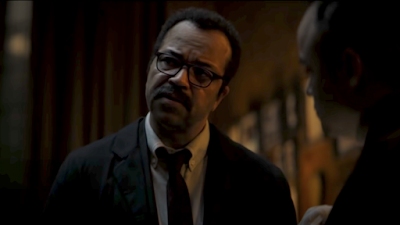
The same can be said of the bond between Wayne and Jeffrey (James Bond/Westworld) Wright's commendable James Gordon. The policeman is a conscientious agent who, like the rising Dark Knight, wants to nab the Riddler and the sooner, the better.

To solidify the movie's camaraderie, Andy (Planet of the Apes/Lord of the Rings) Serkis' Alfred Pennyworth gives Wayne the guiding light he needs to rise from out the dark to accomplish his mission. Serkis' portrayal is essayed much in the manner of Michael Caine's in the Dark Knight trilogy and Sean Pertwee's on Gotham: careful, parental and guru-like (ideal traits to mold an ideal vigilante). 

In light of the aforementioned attributes, it may appear that The Batman is a message movie. Perhaps it is, but then so are most police dramas, no matter the uniforms featured. These productions promote the need to make society just and noble when circumstances dare to crumble, and sometimes, as one discovers in Sidney Lumet's Serpico (and for that matter, Oliver Stone's JFK, which The Batman sometimes mirrors), they reveal an unexpected festering beneath their bases. The Batman is no exception to that respectable rule.  

Even with this said, The Batman's slant isn't as overtly conservative or philosophical as Nolan's epic chapters, but again the same somber tone prevails in its detective-noir context: always earnest, angry and crusade-ridden (rather like Reeves' Planet of the Apes entries, now that I think of it). That Reeves keeps the pensive ingredients in check solidifies the story's impact, and clocking in at three hours, it streams, punches and roars (thanks in large part to a cool, Batmobile prototype in a Pengy, Bullitt-fueled chase and Michael {Spider-man: No Way Home} Giacchino's death-marching, Ave Maria-laced score). It all builds razor-sharp tension from beginning to end.

For the sake of another Batman re-introduction, this one works: never too rehashed and never too reinvented. Well-rounded Caped Crusader fans will demand a "next year" sequel, which is unquestionably in the works, as its sinister, Arkham cameo joyously conveys.   

Thursday, July 13, 2017

An Alternate Reality #17: I saw the Apes at War...


Matt Reeves' retelling of “Battle for the Planet of the Apes” wasn’t through, as we now know, for “War for…” takes elements of the ’73, so-called "final chapter" to a new, belligerent level. As with the original-cycle entry, this parallel “Apes” chapter determines whether simians or humans will dominate Earth. This time, however, we don’t have Gary Oldman’s Dreyfus standing in lieu of Severn Darden's Kolp, but instead Woody Harrelson’s Colonel McCullough. And man, oh man, is the ol' Colonel ever a determined bastard.


Considering what’s at stake in director/writer Reeves' sequel (coauthored by Mark Bomback), one can’t fault the military man, any more than one can fault Caesar (Andy Serkis) for amplifying the adversity. As in real-life, this alternate-reality take of an established alternate-reality history, demonstrates how explosive opposing sides can be. Under the Colonel, however, the humans appear on the upswing, though perhaps not for long. An onslaught of desires, contempt and bloodshed awaits both ends, with an unexpected faction ultimately entering to turn the story on its head. 

“War”, in this respect, lives up to its title. Even in its gentlest parts (and oh, there are many and so lovingly blessed by Michael Giacchino's sweet score), it stays hard-hitting. It honorably lifts “Battle’”s most confrontational scenes, but also pays homage to "Apocalypse Now"; “To Hell and Back”; “Hacksaw Ridge"; "A Walk in the Sun"; plus any number of John Wayne pictures, war or western based. 


At "War'"s start, we learn that Caesar has molded his apes into a well-oiled, fighting machine. The noble chimp doesn't wish hostilities to rise, but nor does he want his followers to be left unprepared in the event of attack. No matter how hard he tries, though, his people gain casualties and unfortunately, those close to Caesar's heart fall victim to the enemy. 

Despite this, the prospect of peace isn't entirely off the table, and its symbolism comes via a human girl (Amiah Miller), whom the apes discover along the way. She comes to be named Nova (a gracious nod to Linda Harrison's shapely character). Caesar, thanks to Maurice (Karin Konoval)'s insistence, comes to care for the lass, just as he does those of his kind. He's a well rounded "emperor", after all: one with an open mind, a caring heart, but at the same time, one who acknowledges the risk in growing soft, regardless of Nova's contagious innocence. 


Alas, for all his noble intent, Caesar soon finds himself in the Colonel's clutches. The two have an opportunity to talk, negotiate, but due to the Colonel's contempt, the fires of animosity get stoked ever higher. 

This is by no means surprising. Whether one likes it or not, tensions regarding who-rules-what are unavoidable, with war generally the result. Though this idea might unsettle many a millennial, it does appear to be the film's predominate theme and is a common part of existence, no matter what the "reality". In other words, that a peaceful outcome appears unattainable in "War" is realistic and makes the circumstances more credible throughout. 


As fans know, this no-nonsense approach has become an "Apes" tradition and can be found, to some extent or another, in any of the adventures. The Colonel may be insanely hardheaded, but that he holds his ground only sharpens the tale's merciless sting. The Colonel's stance allows others, on either side of the coin, to test their mettle, even if their reasoning sometimes proves as faulty as their hearts prove courageous. 

Because of this, "War'"s greatest strength lies in its purposeful participants. Isn't characterization, after all, the ticket to any quality drama? If we can't identify with (or for villainy's sake, resent) characters, why bother engaging in their journey? "War" makes us care. 


Beyond dispute, Caesar and the Colonel set the standard for this, but they're not alone in their influence. The eccentric (if not occasionally Gollum-like) Bad Ape (Steve Zahn) becomes the movie's scene stealer, just as Serkis' famous character had become in Peter Jackson's Tolkien films: quirky, charismatic and for a brief time, enigmatic. When push comes to shove, however, he does prove to be an asset to Caesar, and more than any other character in the film, epitomizes its nervous optimism and continual grasp for a satisfying resolution, to the point where one wonders why Reeves didn't introduce him sooner into the saga. 


Regardless of its strength of characterization, many will still debate whether "War" is the franchise's most profound chapter: whether in comparison to Pierre Boulle's "Monkey Planet"; the original theatrical series; or its alternate offshoots. However, no matter what its rank in the grand scheme, "War" stays tight and focused throughout: an admirable quality for any imagi-tale.

I only wish more films could march to the same beat. Too much hollow talk, just like too much hollow action, only goes so far, but identifiable characters and scenarios can sustain a saga for decades. I imagine that's why "Apes" has never slipped from the culture's collective consciousness. It's why its latest chapter (along with the film's contained archetypal personalities and "God damn you all to hell" destruction) won't be its last, which leads me to declare with war-ravaged gusto--Hail Caesar! Hail Bad Ape, the Colonel, Maurice, dear Nova and all the rest! Hail forever and always the incomparable Planet of the Apes! We've already gained much from this franchise, but we've so much more yet to learn, as "War" so generously exemplifies. 

Sunday, July 13, 2014

An Alternate Reality #2: I saw the Apes at Dawn...


By its very nature, "Planet of the Apes" has always offered parallel possibilities to our own known reality and even from out its own initial five-movie mythology. 

When Cornelius and Zira (along with the tragic Milo) traveled back in time, their offspring (ultimately to adopt the name Caesar) rose to power in the alternate '90s, the implication was that he'd not only plant the seeds of ape dominance, but was possibly altering events to create a future unlike what we see in the '68 classic. The original series' "final chapter", "Battle for..." certainly insinuates this notion, and the acclaimed, but short-lived '74 television series further solidifies the idea (along with an animated counterpart which premiered roughly a year later).


Tim Burton's 2001 reboot also offers an alternate origin, but it was 2011's "Rise of..." (a loose retelling of the fourth film, "Conquest of...") that carried the concept through a steadier course. Now a sequel to that venture, "Dawn of..." has emerged, further enhancing the alternate track of possibilities. 

Directed by Matt ("Let Me In") Reeves, "Dawn" is in many respects derivative of "Battle", with apes and humans facing off to determine who will reign supreme. "Battle", however, deals with burgeoning human mutants (forerunners to those seen in "Beneath") and ultimately, calculated, militaristic maneuvers. "Dawn" is far more subtle, playing upon a genetic fluke (as outlined in "Rise") which has perpetuated the species divide, and despite valiant efforts from both sides, the situation nonetheless results in "Fort Apache" type bloodshed. 


Andy Serkis again portrays Roddy McDowall's legendary Caesar, and just as McDowall's version led a major simian mount in "Battle", so does Serkis', though from a slightly different vantage. Also, in "Dawn'"s case, the apes are considerably less evolved than those in the original movies, and in computerized form, often realistically bestial. Nevertheless, like their earlier incarnations, they are capable of keen thought, riding horses, and of course, speech.


That apes and humans can readily communicate naturally leads to interaction, but not all humans are inclined to believe that apes can reason. Dreyfus (Gary Oldman) sees them as a threat if crossed: his character subtly reminiscent of "Conquest/Battle'"s Governor Kolp (Severn Darden) and "Escape'"s Dr. Hasslein (Eric Braeden). In other respects, he's essentially a good man, whose stance is really forced upon him, for he can't help but sense the inevitability of ape control.


On the other hand, humans like Malcolm (Jason Clarke) and Ellie (Keri Russell) fully subscribe to species coexistence (and see no viable way around such if they want to access electricity for their camp), but how can they initiate a peaceful outcome when certain apes not only mirror, but accentuate Dreyfus' view? Caesar's "general", Koba (Toby Kebbell), for example, has no empathy for humans, due to the scientific torture they forced upon him and from this, becomes a chimpanzee counterpart to Claude Akins' Aldo ("Battle'"s most abrasive gorilla), and therefore, more friend than foe to Caesar.


Beyond this mounting friction, much of "Dawn" concentrates on Caesar's compassion for humans and his need to nurture his spouse, (Judy Greer), son (Nick Thurston) and cutely CGI'd newborn. He also furthers his position as leader by reinforcing bonds among trusted friends, such as the faithful orangutan, Maurice (Karin Konoval): an equivalent to Paul Williams' Virgil from "Battle". Such relationships let Serkis mold Caesar into a well rounded character, arguably on a par with McDowall's complex interpretation. 


Like its predecessors (or as evidenced in some of the finest "Alien Nation", "Star Trek" and "Twilight Zone" efforts), "Dawn'"s script (by Mark Bomback, Rick Jaffe and Amanda Silver) ripples of sociology and loads of irony. It doesn't parallel our existing society in the way the '68 film so deftly did in its time frame (due mainly to Rod Serling's insightful take on Pierre Boulle's text), but still manages to make us ponder our own current state of affairs and the ultimate shape of things to come. It also simultaneously suggests how we might interact with others on a global scale (an easier-said-than-done prospect), but also how we might survive within our more immediate confines (an admirable start, at the very least). 

"Dawn", however, unlike "Battle", doesn't insinuate a harmonious horizon, but at least implies a continuation of concern. For those of us who've followed the original series and its various offshoots over the decades, nothing could be more provocatively finer. Like that which has come before, let the alternate variations morph, circle, overlap and perpetually stimulate. That's the wonder of "Planet of the Apes", and it's most reassuring to know there are filmmakers yet bold enough to perpetuate the tradition.