Showing posts with label electronic music. Show all posts

Sunday, March 8, 2026

RHAD: GHOST MUSIC LIBRARY

RhaD is an intriguing, audio-voyeuristic artist, who pulls from the spirits in the walls, moving from place to place to document it all. 

RhaD's album, Ghost Music Library, epitomizes this idea, each title relaying the artist's rich, haunted gist: 

1) Empty Buildings

2) Funeral Wake

3) Hotel conversation

4) After life recordings

5) L'occhio nel labirinto 

6) Sunlight on the wave

7) Metaphysical 

8) Come closer

9) Cabinet of curiosities 

10) Dream Cycles

11) The cat in the drone box 

It must be noted that some tracks are more earth-bound than others. 

For example, "Empty Buildings" is soft, with a progression that's both sorrowful yet consoling, and in turn, ushers the mournful tonality of "Funeral Wake": again sad but relaxing, rolling as it does with bittersweet recollection, perhaps to be abandoned much like the aforementioned abodes. 

"Hotel Conversation" pushes the concept toward a mechanical state, recording all the voices, subversive and surreptitious, that comprise what one wishes to hear, if only to call one's own.   

The same can be said of "Sunlight on the wave," a contrasting lure that shines with euphonious danger, but then so does its pensive companion piece, "Come closer," which promotes tempting trails of another time, another age, wrapped in soothing static and wistful wails.

"L'occhio nel labirinto" feels the most grounded of the tracks, alluding to giallo scares planted along a winding labyrinth. Its road, its progression, paints a hardboiled detective on a search, but there's no guarantee he'll ever crack the truth.

"Cat in the the drone box" forges a comparable exploration or at least the sort of odyssey that toys with the brain, beckoning as would a precious commodity, but like a ball of yarn, the resonating refrain goes on and on.  

Other parts of the album are more transcendental. For one, "After life recordings" is an eerie document spooled from specters. At the outset, its provocation could be bad or good, but the more one listens, the more one accepts the coexistence. 

"Metaphysical" dangles the cosmic chains a few feet higher, with ubiquitous notes that poke and encage. Its an audio region between Heaven and Hell, but on this ambivalent page, only rueful Purgatory stays.  

"Dream Cycles" redirects one to still another incorporeal peak. Through its angelic-vs-demonic chirps, mellifluous tentacles drag one toward the fiery threat of no return. 

"Cabinet of curiosities" mates the album's duality. Some drawers unlock decorative journeys: one to Neverland, another to Wonderland ... yet another to Oz. One, however, mimics an idyllic, neighborhood stroll. Behind each tree, beneath each rock, visceral peculiarities flourish, rivaling those of any fantasy park.

One should consider Ghost Music Library essential and guiding, with moods that skid from highs to lows and lows to highs, all through earful observation. No matter the extreme, each track is a coveted gem in RhaD's ghostly dream: 

https://unexplainedsoundsgroup.bandcamp.com/album/ghost-music-library

Sunday, June 1, 2025

SONOLOGYGT: PLANETARIUM (MUSIC FOR SPACE TREKKING)

Sonologyst (an ambitious project of Raffaele Pezzella) has brewed an astral delight: an album entitled Planetarium

As with a traditional planetarium, this Sonologyst creation launches one into the solar system, not perhaps per distinct visuals, but through sounds that place one among the moon, the stars and beyond.

For added, authentic effect, Sonolgyst's specialized, reverberating tracks are emboldened with genuine, "data sonification files" taken straight from NASA: a unique, additive that ensures one's cerebral flight. 

The track titles invoke what's in store, guiding one along with utmost, cosmic clarity. They are as follows: 

1) 67p-Churyumov-Gerasimenko comet

2) Blue Neptune

3) TAU mission to Oort Cloud

4) Ultra Low Black Hole Frequencies

5) S-1981 S 13 Pan-Saturn's Moon

6) Venera 4V-1 No. 310

7) Plutonian Transmissions 

8) Jupiter's Moons

9) Kuiper Belt

10) 19h22m24.64 + 5s

11) Microphones on Mars

12) Uranus Plasma Waves

13) Earth Magnetic Waves

Planetarium is a powerful, ambient opus, available now for pre-order as a download and/or two-disc CD package (with the second disc containing the raw, NASA data). Don't miss out on the exploration!

https://sonologyst.bandcamp.com/album/planetarium

Monday, April 21, 2025

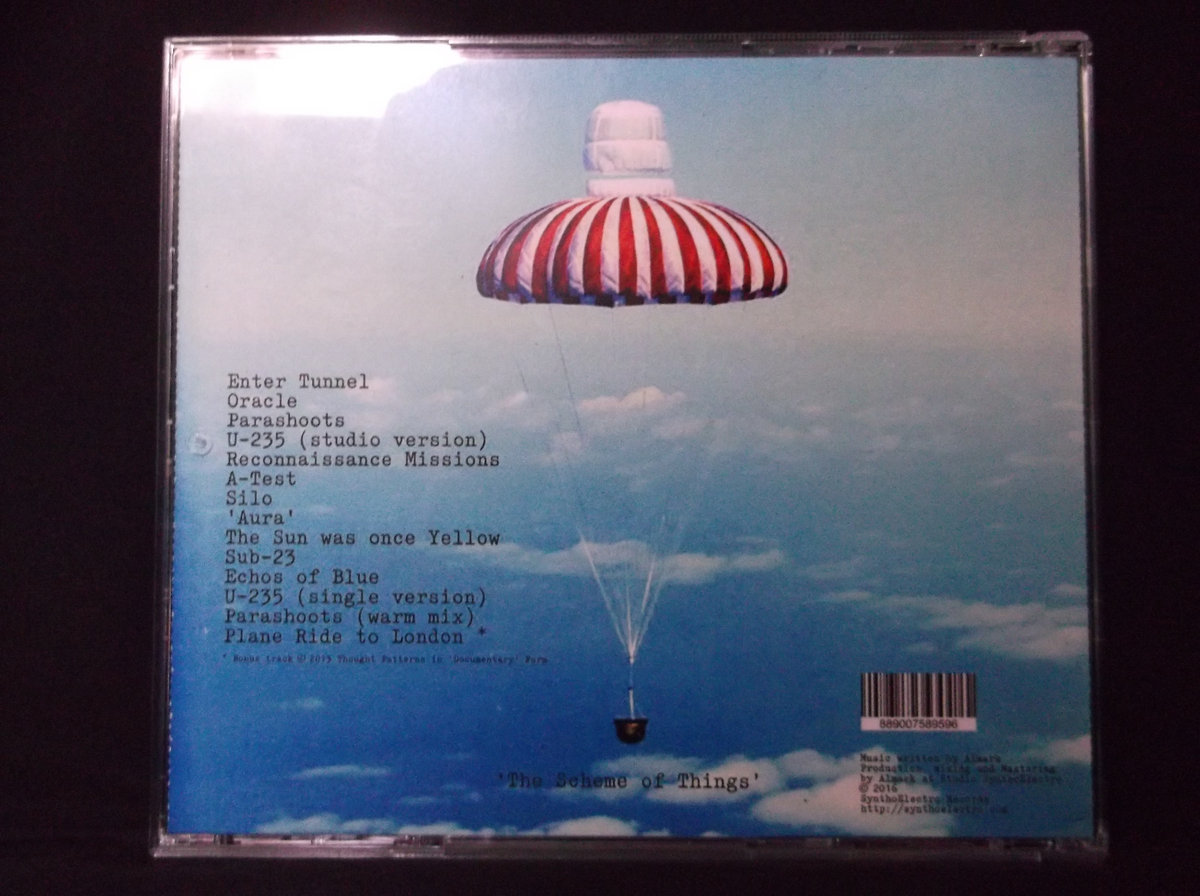
THE SCHEME OF THINGS, BY ALMARK

After delving into Almark Thaolan's 2013 release, -ADT-, I was directed to another of his older, finer works: The Scheme of Things. From the 2016, track titles, I decided what to envision, and so for me, the opus became a wartime/war-torn stratagem, inspired by Almark's penchant for hidden meaning. 

"Enter Tunnel" is the opening track, and an apt one at that, comparable to a Tangerine Dream selection. As such, it may have worked as an alternate placement for Michael Man/F. Paul Wilson's The Keep. It's catchy and foreshadowing, depicting an inward journey that heightens the senses, and among those senses, is fear.

"Oracle" holds a faster pace, drumming like a dance number, but with a New Age tingle that backs ancient and primal impulses. It's a brave, next step in a brash and dangerous campaign, and its offbeat, spellbinding charm is difficult to define, but once it enters one's ear, it doesn't let go. (Really, this one would work well as an opening-credits scroll for a chic, dystopic sojourn.)  

"Parashoots" slips into something dreamier, with its spiraling backdrop and visiting dialogue, which bleeds from an adolescent, schoolyard fancy. In this respect, it conveys a loss of innocence (or an abandonment of a long endeared pastime) and the futile desperation to maintain it. 

"U-235" twists the narrative onto a blithesome perch, but it's no less sorrowful in its undertone. It holds a John Carpenter avidity, the sort that might track Snake Plissken into urban hell. It also carries nuclear-equation/uranium-detailed utterances (in groove with its title), alluding to unavoidable calamity. 

"Reconnaissance Missions" drops the stride, its dialogue referencing a HMS P38, spy run. The beat is jittery yet compact and analytical: an instructional passage that also proves haughty for all its outward confidence.  

"A-Test" grabs the threading torch, using the famous, Emergency Broadcasting System edict, which summons nostalgia but also suspicion. A smacking, snapping, electronic current empowers its loop, stretching the surveying march: cool and breezy in a way, but like "Reconnaissance Missions," margined by threat. 

"Silo" inflates the warning, crawling into a dark, missile-laden compartment, with a juddering tap that signals attack. Something is set to kill, and because of this, "Silo" may be the album's most unsettling sample, with a scrupulous progression that tastes (sounds) like bittersweet candy. 

'' 'Aura' " lifts the disconcerting aspects higher, performing like a whistling rocket, hooked with a contemporary beat, building in eerie tiers, revitalizing the established, Tangerine Dream sweep (though caped by a soft, contemplative conclusion). The track's entirety totters between palpable gloom and inexplicable elation. 

"The Sun was once Yellow" is the album's rubberiest submission, bouncing off an angelic, wall of sound (much like the uncanny sighing heard in the original Invaders from Mars). It recalls a time before the terror and destruction, but cradled by a steadfast, militaristic march that refuses retreat. 

"Sub-23" is a boot-camp reflection to make one's subconscious all the stronger. It's a recalled preparation for fighting, for surviving, and by the track's end, one's belligerent focus is as fine-tuned as one can get.

"Echoes of Blue" holds a hurlyburly quality; not that it's fraught or tremulous, but rather that it creates a gradual apprehension. It connects to "The Sun was once Yellow," with an affecting voice that's odd yet terrestrial, dead yet alive, stirring the sort of harsh and surreal residue a soldier might face. 

Almark follows "Echoes of Blue" with two remixes, one a "single cut" of "U-235," with the original's uranium tutorial resumed and accelerated. Then there's the "warm mix" of "Parashoots," which carries the original's lament, also quickened.

The album closes with the luminous "Plane Ride to London," which projects the peacefulness that follows an ordeal. It denotes a time of healing, daring to discard what once was. It reminds one that, in the vast scheme of things, all one consumed in the fairness of love and war is a distant memory, perhaps to be forgotten, perhaps to be embellished, but all the same, little more than a fragment of a dark and dire past. 

Now prick up those ears and listen to one of Almark's expressed best:

https://synthoelectro.bandcamp.com/album/the-scheme-of-things 

And while the opportunity is at hand, enjoy the album's sublime videos:  

For " 'Aura' ": 

https://www.youtube.com/watch?v=g-Dqj9ScRT8

For "A-Test": 

https://www.youtube.com/watch?v=z8J5XYp4uhA

For "Oracle": 

https://www.youtube.com/watch?v=t2ZQiBzO9wI

For "Elcaro" ("Oracle" in clever, audio/visual reverse): 

https://www.youtube.com/watch?v=0AGHdEJKj5g&t=2s

Friday, April 18, 2025

-ATD- BY ALMARK

Almark Thaolen's music tends to ascend with suspicion, with a keen acknowledgment of the world around him, inspecting its benefits, flaws and projected hypocrisies. 

I recently delved into his grand opus, -ATD-, which made the rounds from 2013-2014. It captures all of the above and then some, in an imaginative rundown of mechanical sounds that flow from pure, "retro" stylings. (In other words, its audio development reaches back to look forward, its journey shuffled by collocating extremes.) 

"32-Bit" opens the opus: a vibrating piece that taps Bach's Toccata and Fugue in D Minor, though for a dystopic age. It's a preluding bit of doom (filtered through 1980s glitz), setting one before a succession of profound insight and romanticized chance. 

"Flip-Flop" is the next to emerge, emulating the voice of a two-faced politician. On occasion, it sparks a path of promise, a showering of golden-age optimism, but just as fast turns the tables with a lie, pressing one to question the self-evident hows and whys. 

"High Bias" is the subsequent, Big Brother tangent, where the media supplies each and every answer. Its sounds whip like a Devo-ish cipher on Valium, like keys tapped upon one's brain, lining one's mind with information that one never wants or needs, but what the heck. They claim the results do please.  

"Magnetic Poles" adds a cosmic quality to the latter's citation, subduing one from both antithetical ends. The notes jump and skip, rise and fall, directing one's thoughts in the most benumbing way. 

"Digital Mountains" evokes a possible refuge, though more fabricated than real. Almark's swagger is slow and cautious in this instance, tempting yet forbidding, creating a hope that's more hopeless than not. 

"Binary Fathoms" pulls a tad from the despair. Like "Digital Mountains," it's also slow and cautious, but more data-driven as it descends. It echoes like the whirring guts of a monstrous computer, thickened by corridors of intertwining circuitry. One pushes through it, lost but no less resolved. 


"Wow-and-Flutter" gets exotic, with its New Age, Middle Eastern groove. It seduces like a belly dancer, prancing atop the wavering sea. If only one could stay within its vast, buckling trance, but alas, one has no choice but to stream, returning where one was never meant to be.   

Perhaps, if one's lucky, "Captain Capstan" will intercede. His song is strong, but his ability to loosen one's shackles is at best shaky, his steps strewn and discordant. He grows spectral inside the dissension, and though a dial tone hopes to arbitrate, the great hero floats away.

Fortunately, "IC" fills his space, happy and eventful in its electronic cloak, racing one through the coordinated conduits, if not back to joy, then at least away from displeasure, so smooth and dreamy, so warm and creamy, until ...

"Tape Head" unspools. Its gloom is strong, forcing one toward square one, to re-question one's fate, as well as one's most innate beliefs, but the crescendo builds only commination, recording one's every miscalculated move.

In the hands of "-ATD-," one slips into the long-awaited metropolis, the brain center of all brain centers, where the wired eyes scrutinize, prod and demean. One kisses a fierce, opposing force, but the robotic noise, the simulated, wall of suffocation, denotes a precise judgment and with it, a dire departure.  

"Carrier FM" seals the predicament, invoking something old-school through its jazzy ride. It makes one want to dance, and one does so in one's mind, but only per bureaucratic approval, which imprints and re-records without completion. This old-school dance is forever, as is its modern subjugation.

Almark amends his tracks with diverting remixes of "Tape Head" (subtitled "rephrase," "dirty head mix" and "one half mix") "High Bias" (per "chirp mix") and "Wow-and Flutter" (per "tape speed mix"). The variances are subtle but defining: an entertaining way to reimagine the established, album arrangement.

Overall, -ATD- is an illuminating, electronic trip, played for sheer elucidation, though always bound to those damned, (un)foreseen things we never evade.

Experience -ATD- at 

https://synthoelectro.bandcamp.com/album/atd-4

and enjoy the masterful, nature-steered "Wow-and-Flutter" video at

https://www.youtube.com/watch?v=YjVim_zl7QI

https://vimeo.com/groups/496993/videos/95705539