Showing posts with label Nicolas Cage. Show all posts

Wednesday, July 10, 2024

I saw Dream Scenario

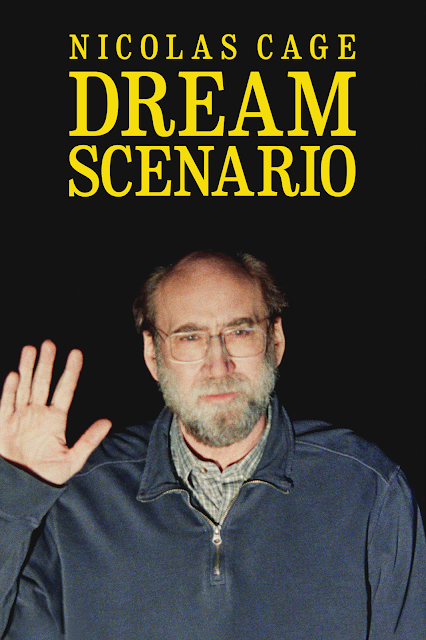
Dream Scenario, a film written/directed by Kristoffer (A Place We Call Reality) Borgli, and produced by imagi-maestros, Ari Aster and Lars Knudsen, is a tour de force for its lead, Nicolas Cage, who portrays Paul Matthews, a biology professor whose persona ends up entering people's dreams.

The concept is Twilight Zone-ish and at the start breezy, with a tonality akin to New York Stories' "Oedipus Wrecks," where Woody Allen is accosted by his flashed-from-existence mother, who intermittently reappears at the most inopportune  times. As the story progresses, Dream Scenario becomes a darker Zone, depicting a good man labeled as bad, due to no fault of his own. 

At the outset, Matthews is no more than a silent observer in people's dreams, as strange things happen to them. People who know Matthews tell him of his abrupt, nightly appearances, and he (and they) begin to acknowledge the strange, common denominator at play. This becomes even more baffling when strangers begin to recognize Matthews, claiming his likeness has also infiltrated their dreams, and from such, a phenomenon grows. Matthews become a celebrity, liked and enjoyed by most, even though the causes and effects of his manifestations are open for varied interpretations. 

After doomed tryst with a pretty, marketing assistant (Dylan Gelula), who's experienced repeated, amorous reveries of Matthews, his image thereafter enters people's dreams for the evident cause to harm them, making him a neo Freddy Krueger. As such, he becomes feared and hated to the point that he can go nowhere without being ridicule or assaulted. Even his long-time friend (Tim Meadows), the dean of the college where he works, distances himself from Matthews, which only breaks his spirit further. 

A public-relations CEO (Michael Cera) brainstorms ideas to remedy Matthew's dilemma, but the professor just wants to be let alone, to slip into obscurity, if not for himself, then for the sake of his beleaguered wife (Julianne Nicholson) and daughter (Jessica Clement). But his detractors turn Matthews into as a scape goat to cloak their misguided beliefs, which are in turn fueled by an uncaring, biased media. 

I couldn't help but feel for Matthews, for he falls into a category that besmirches many people today: guilt by association. Cultural critics and their offshoots aren't inclined to acknowledge the truth and therefore, they only worsen baseless prejudices. (To drive this home, there's a disturbing scene where an interviewed, college student defames Matthews for having misused his dream-manifestation powers, and her uninformed condemnation is accepted carte blanche by the others in her group study. This cancel-culture derision is palpable to the point of being much more nightmarish than any of the surreal scenarios in which Matthews appears.)

In the end, Matthews does find his way, though perhaps not as he preferred. Dream Scenario's careful delineation of his woeful journey is captivating and therefore, memorable. It's just too bad that most socio-cultural know-it-alls will bypass the movie, or if they do give it a shot, they'll fail to see their own ill-willed behavior in it. Nevertheless, Dream Scenario exists as a lesson well taught for those open-minded enough to accept it. 

Friday, April 14, 2023

I saw Renfield...

Universal Pictures' Renfield isn't so much a comedic spinoff highlighting Dracula's henchman as it's an essay on toxic relationships and along with such, the admirable audacity to sustain self-esteem and somewhere along the line, autonomy.

Director Chris McKay (who I must confess, unsettled me with his blasphemous The Lego Batman Movie; yeah, I know it's a cartoon satire, but The Caped Crusader should never be portrayed as a dogmatic boob, belittled by a soft-on-crime agenda) does a pretty decent job injecting his campy, pop-cultural nudges; though perhaps the credit should go to the flick's writers, Ryan Ridley and Robert Kirkman, who present a weary R.M. (Robert Montague) Renfield, portrayed by imagi-genre favorite, Nicholas Hoult, whose nerves are shot from arduous decades of service under The Count, proffered by the phenomenal Nicolas Cage.

As fate has it, Renfield saves the day when his "employer" wishes him to corral any number of folks for ultimate feasting, but instead saves them from a mobster attack, ushered by the mother/son team of Ella and Teddy Lobo, played by Shoreh Aghdashroo and Ben Schwartz, who wish to do in a meddling, traffic cop, Rebecca Quincy, rendered with cantankerous flair by Akwafina. From there, Renfield wins much favor, in particular from the grateful Quincy, who becomes a potential lady friend, enamored by his inferred spontaneity and disinterred skills, initially failing to recognize his actual, dismal station. 

After being showered in respect, Renfield seeks greater purpose, digging in ever deeper with a bad-relationship group for insight, but the results don't come without a hitch, considering The Count's supernatural disposition. As to how Renfield might sever ties with his satanic enslaver is the fable's hook, and through its underdog delineation, pathos and endurance (often staked with understandable fear and doubt) become its metaphoric angle.

The movie's exemplary performances play a huge part in why Renfield prospers. Hoult is easy to root for (and yes, he references Dwight Frye, though never to complete mimicry), and Akwafina's everywoman's audacity to make the beleaguered sap see his worth is worthy. (She cares, and because she does, so do we.) 

Cage is brilliant as Dracula, sometimes taking his Lugosi-like dominance over the top as he insinuates Conrad Veidt's The Man Who Laughs: a smart formula for the amusing monster. Cage also carries the traditional chill, which if offered in a serious retelling, would have worked as well (proof bleeds through in a flashback sequence, wherein Cage and Hoult replace Lugosi and Frye in Tod Browning's 1931 classic). And Cage's presence more than holds its own with George Hamilton's in Love at First Bite, David Niven's in Vampira (aka Old Dracula) and Leslie Nielsen's in Dracula: Dead and Loving it. (Additionally, Cage's interpretation is an ironic nod to his reluctant transformation in the humorous Vampire's Kiss. It's also worth noting that Cage acted as co-producer of the droll, Nosferatu homage, Shadow of the Vampire. Yes, he's had some worthy, fang-in-cheek practice, all right.) 

Renfield should sustain appeal over the long haul, but it's likely to ring loudest with those who endure disrespect for doing their best to get along or put food on the table, never receiving an iota of thanks or fulfillment in return. Renfield will be a soothing air of empathetic escape for that disgruntled lot, destined to be revisited and nestled when those livelong days tear a little too bloody close to the jugular.

Tuesday, April 7, 2020

I saw the Color Out of Space...


As most horror fans know, Richard "Hardware" Stanley's "Color Out of Space" isn't the first film version of the H.P. Lovecraft story. Prior to such, there was "Die, Monster, Die!" (1965) and "The Curse" (1987). However, the current consensus is that Stanley's edition is the most faithful in spirit, and if some don't see it that way, no harm done. They'll likely accept the movie's depraved psychedelia, anyway. 


Co-produced by Elijah Wood and adapted by Stanley and Scarlett Armanis, "Color Out of Space" introduces viewers to the plebeian Gardner family: Nathan, its caring dad (Nicolas Cage); Theresa, its melancholic mom (Joely Richardson); Lavinia, its earthy daughter (Madeleine Arthur); Benny, its older son (Brendan Meyer), and Jack, its younger son (Julian Hilliard). (Tommy Chong portrays the clan's spacey squatter, Ezra, while Elliot Knight performs as the film's heroic hydrologist/inspector, Ward Phillips. Completing the main cast is Q'orianka Kilcher as Mayor Tooma and Josh C. Waller as Sheriff Pierce.)


The Gardners' tragic tale commences after a meteor crashes near their home (not far from famous ol' Arkham, Massachusetts), emitting a color unlike any that Nathan has ever imagined or hoped to describe. Soon after the water turns oily, tomatoes grow extra large and animals melt into anguished, screaming monstrosities. 


Word spreads of the calamitous phenomenon, and all those who cross it are (in one way or the other) contaminated by it. Think of "The Lonesome Death of Jordy Verrill" meets "Swamp Thing", and you'll get a smidgen of what I mean, but what "Color Out of Space" holds is so much more extreme.


For the most part, the home-invasion set-up mirrors "Evil Dead'"s, which also holds Lovecraftian roots, though Stanely's film is nowhere near as flamboyant as Raimi's chapters. (One can also find traces of Stuart Gordon's acclaimed, inter-dimensional spree, "From Beyond" in the movie's more lurid parts, thanks to Steve Annis' powerful photography and Colin Stetson's surreal score.) "Color Out of Space" goes much further and farther than any Lovecraft film before, pushing the growth of Hell on Earth at full force, with all the mind-bending terror that one should expect. (It's really no wonder Richardson was cast, since she'd already taken a similar path in Paul W.S. Anderson's eerie "Event Horizon".) 


Cage carries much of the film and therefore, absorbs the brunt of the ascending torture, which only goes to reason, considering his headlining status. His performance is nuanced enough to make his disintegration stick, but the other performers are as identifiable, emoting torment and fear at every hair-raising turn. It's hard not to feel bad for these folks as they become evermore immersed in the mutating chaos. 


When all is said and done, "Color Out of Space" isn't so much about an alien invasion as it is the degradation of a family that crumbles under circumstances that it neither asked for or deserve. For anyone who's been vexed by life's basic disruptions, "Color Out of Space'"s allegorical seeds are certain to sprout commodious nightmares. For horror fans, that makes it worth a view--better yet, two or three.


Can't wait to see what Stanley brews for his next: "The Dunwich Horror", no less!

Thursday, July 26, 2018

I saw Teen Titans Go! To the Movies...


When Cartoon Network's "Teen Titans" and its sequel series, "Teen Titans Go!" premiered some years back, I enjoyed their colorful concepts, but their screeching-mouth, Playschool anime often made me cringe. For the sake of DC teen superheroes, I prefer “Young Justice” and "Justice League vs Teen Titans", where the designs and stagings are much more orthodox. 

Still, I'm loyal to DC and therefore, Teen Titans on the whole, so despite my suffocating schedule, I felt obliged to squeeze in a theatrical view of "Teen Titans Go! To the Movies".


The film, directed by Aaron Horvath and Peter Rida Michail, and written by Horvath and Michael Jelenic, resembles the cartoon programs upon which it's based, but it’s leagues sillier, often to the point of crass self-parody. Now, don’t misunderstand: This film isn’t some sanctimonious, hate-the-hero "Lego Batman" claptrap. It (like its television foundations) at least respects its characters' backgrounds, even if the ball of wax is splashed with a ton of garish gall, which includes a tad of time travel and lots of song and dance.


The story deals with Robin, the Boy Wonder (I've always presumed Dick Grayson in these cutesy cliques, but take your pick), Raven, Starfire, Cyborg, and Beast Boy hoping to mimic their mentors by starring in a big-budget, Hollywood production. They find the chance for cinematic prominence through the mind-manipulating Slade Wilson/Deathstroke and his shifty "sister" (shades of "Incredibles 2"), though it's hard to swallow why the teens fail to see the obvious charade? (Perhaps in this lies the tale's message and warning: If something looks to good to be true...)


To spice up the teens' ambitions, seasoned superheroes arbitrate. Among them, the stand-out cameo comes from Superman, voiced by Nicolas Cage: a versatile actor and comic-book connoisseur once chosen to portray the Man of Steel in a Tim Burton, live-action endeavor. (Thanks to this Teen Titans movie, how can one now say that Cage never officially played Kal-El in a full-fledged film?)  Unfortunately, Cage's vocal casting isn't enough to place the movie on a super-special, satirical plane.


The incredulous premise still gushes enough conflict to make it roll, albeit it slowly (unless one considers continuous gags a fast-paced catalyst), but this yet prompts the question: Why an all-out, feature-length lampoon? Wasn't the sequel series goofy enough? Was either Teen Titan show ever this zany in its tongue-in-cheek brio?


I can only assume that the filmmakers intended the package a means to enroll young viewers into the DC scene, but there are so many DC (and Marvel) in-jokes that it's doubtful most under-twenties will appreciate the effort. (Mind you, kids don’t attend superhero movies like they once did; I didn’t see one adolescent in the packed theaters of "Batman v Superman", "Captain America: Civil War" or the "Deadpool" set. (Granted, Deadpool's cinematic designation is R-rated, but dear mercy, in my teen years, my friends and I would have made it a priority to sneak into something so forbidden.) Also, for the record, I saw "Teen Titans Go! To the Movies" at a four o’clock, Thursday pre-premiere, and even then there wasn't one youngster present. The half dozen people in attendance were either middle age or senior.


I can’t speak for those other adults (sorry, I was too darn drained from my work day to interview 'em once the credits rolled), but for me, the movie's climate was way too juvenile (even when compared to its television counterparts), with even more screeching and bug-eyed silliness than I could bear. At a padded ninety minutes, I found myself choking back the yawns during more than a few portions. Really, this “Teen Titans Go!” would have worked better in an hour format, and even then it may have been too long. There's only so far that sustained gaudiness can go, even when the intentions are good.


I think it’s great that DC/Warner Brothers would give one of its animated features a full-blown (more than a one-night stand), theatrical release. However, that kind of experimental dedication should have fallen upon "Killing Joke", "Gotham by Gaslight" and "Batman Ninja", not a superfluous, Teen Titans farce.


I got through this one well enough, but it’s not something I'm likely to watch again, and I don’t think there's much chance it'll win over the masses or add more fans (young or old) to DC/WB's Justice League plans. That makes "Teen Titans Go! To the Movies" a miscalculation. Too bad. If it had only been stacked in a more serious way, it may have done some good, as opposed to being just another destined footnote in the companies' hit-and-miss mergers.