Showing posts with label Matt Willis. Show all posts

Wednesday, September 6, 2023

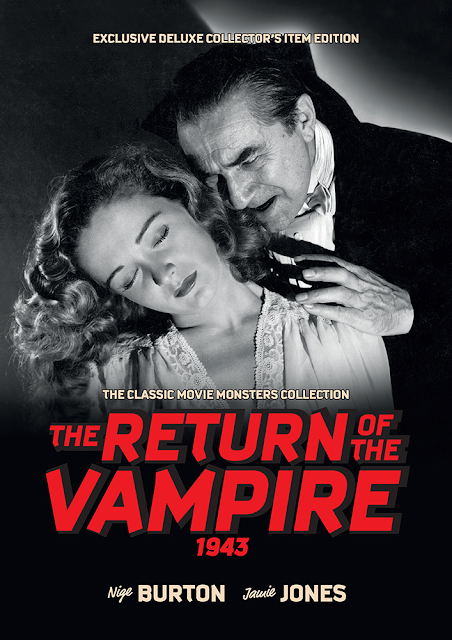
THE RETURN OF THE VAMPIRE: A CLASSIC MONSTERS OF THE MOVIES TRIBUTE

Just as Augusto Caminito/Klaus Kinski's Vampire in Venice was once steered as a sequel to Werner Herzog's Nosferatu, the same applies to director Lew Landers' The Return of the Vampire, a 1943, British production that began as a sequel to Tod Browning/Bela Lugosi's Dracula

Like Vampire in Venice, Return of the Vampire is, for all intents, a stand-alone, though as with the former, it doesn't take much to tweak one's view to draw a correlation between a stylish knockoff and its inspiration. 

Writers/researchers Nige Burton and Jamie Jones are quite thorough in this Classic Monsters of the Movies edition, acknowledging Columbia Pictures' concern that Universal Studios might sue if a Return of Dracula entered production (considering Lugosi's link to the latter and of course, his most famous role), thus causing the Bram Stoker designation to be dropped.

Burton and Jones also discuss Return of the Vampire's  cast, which the authors assess with mercurial opinion: Lugosi as the undead Armand Tesla; Matt Willis as his eloquent, werewolf-Renfield, Andreas Obry (brought to full-fur life by makeup artist, Clay Campbell); Frieda (The Alligator People) Inescort as the firm and empirical Lady Jane Ainsley; Roland Varno as the Jonathan Harker-ish John Ainsley, Nina (Cry of the Werewolf) Foch as the Mina/Lucy-ish Nicki Saunders; Gilbert (Dracula's Daughter) Emery as Van-Helsing surrogate, Dr. Walter Saunders (and Lady Jane's guide in the ways of the occult); Ottolla Nesmith as the doomed governess, Elsa; Miles Mander as the assiduous but cynical Sir Frederick Fleet; and as his fidgety backup, Leslie Dennison as Detective Lynch and William Austin as Detective Gannet.

The story, conceived by Griffin Jay, Randall Faye and Kurt Neumann, is well outlined and often excoriated by the authors. 

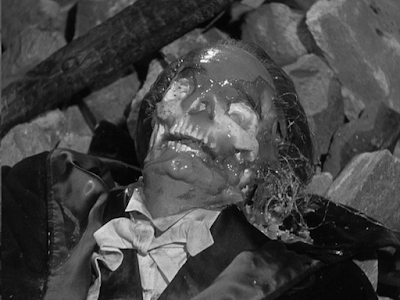
As a helpful reminder, the movie starts with an eerie 1918 prelude, depicting Tesla's bloodthirsty stalks and ultimate destruction by Dr. Saunders' stake; then phases to a WWII bombing of Britain by the Nazis, which strikes Priory Cemetery, whereupon the vampire is disinterred from his tomb. Tesla soon charms those he meets, under the alias, Hugo Bruckner, but Lady Jane's suspicion unravels the aristocrat's secret. Meanwhile, Tesla reinstates his partner, Andreas, re-summoning his lycanthropy, but (as in the past) allows him to retain the means of speech (quite a revolutionary turn for the genre, unless one considers Werewolf of London). From there, grand, creepy mayhem unspools (churned in no small part by L. William O' Connell's chilling cinematography and Mario Casteinuovo-Tendesco's saturating score), as Tesla enslaves Nicki, culminating in a climax wracked by fear and betrayal.

In my estimation, Return of the Vampire holds its own with Universal's best, and it's easy to see how it inspired Edward D. Wood Jr.'s endearing, Lugosi offshoots. I give Burton and Jones credit for analyzing the movie, citing its high points and alleged slips. In the end (and no matter the critique), one will come away from their work appreciating this underrated gem. (FYI: As insightful bonuses, the authors present a short but satisfying Lugosi bio and flavor their text with trivia, quotes and gorgeous graphics, which make the package a cinema-buff essential.) 


Purchase The Return of the Vampire tribute magazine at  

https://www.classic-monsters.com/shop/product/the-return-of-the-vampire-1943-ultimate-guide-magazine/

Friday, February 14, 2020

ADARKAH IANQU'S DAUGHTER OF NIGHT


The implied vampires rise in Adarkah Ianqu's somber, electronic voyage, daughter of the night


The resurrection starts with the song of reintegration, after a corpse crawls from a coffin and feeds upon your supple, pale neck.


Step by step, the demon seeps deep into your soul, doing to you what Dracula did to Mina and Lucy, consuming your mind and heart with a long, gargled purr. 


You become one with the parasite that consumed you. Your hunger prevails until the agony of nothingness in unveiled.


You realize there's little left to feed upon, and so you, the daughter of night, revisit the decaying flowers in the old cemetery, a place in which death becomes your revamped life, stashed among the dank, moonlit mausoleums.


You are now a solitary entity, cold and cruel, a seropositive monk, for all intents and purposes, waiting for your fangs to spring, for your song, your reintegration to ascend, in hopes of adding another to the living-dead ranks. 


Your ravenous revival calls at
https://adarcahianku.bandcamp.com/album/the-daughter-of-night.

Friday, September 13, 2019

SCARY MONSTERS #114: WARY OF WEREWOLVES, HOWL-O-WEEN SCARETACULAR


Prepare for a howlin' good time with Scary Monsters #114: a special Wary of Werewolves, Howl-o-Ween Scaretacular, ushered by Scott Jackson's mega-morphing cover of Oliver Reed, Leon the Lycan, from Hammer Studio's "Curse of the Werewolf" (and the back-view collage is pretty darn ferocious, too). 


Inside, one will find a revelry of one's furry favorites: "Werewolf of London"; "The Wolf Man"; "Frankenstein Meets the Wolfman"; "Return of the Vampire"; "An American Werewolf in London"; "Cry of the Werewolf"; "Legend of the Werewolf"; "The Beast Must Die"; "Wolfblood"; and many more, along with the stars who've made them classic: Henry Hull; Lon Chaney Jr.; Matt Willis; and of course, the aforementioned, Mr. Reed. 


In addition to its bestial spread, there's a stunning, forty-year tribute to Svengoolie (Son of, that is) by Dave Fuentes.  (Sven and his trusty, rubber chicken are still going strong, thanks to Me-TV, where Saturday nights are all the more special, thanks to Sven's gags and insights into the films we hold near and dear to our frightful hearts.) Kudos to Scary Monsters for bestowing this enduring horror host such a splendid salute.


Issue #114 also contains interviews with exploitation legend, Sam "Drac vs Frank" Sherman (conducted by Andrew Rausch) and monster designer, Norman "Hellboy" Cabrera, (conducted by Dr. Gangrene). For spooky accompaniment, there are juicy tidbits on Ray Bradbury; Al Lewis; Peter Cushing; Rondo Hatton; Jerry Warren; plus Tom Weaver's "Scripts from the Crypt"; Halloween memories; and new, horror fiction. Way cool!!!


Order Scary Monsters #114 while the going's good and hairy: 
https://www.mymoviemonsters.com/store.php/mymoviemonsters/pd9761892/_scary_monsters_magazine_114__wary_of_werewolves_halloween_issue_now_shipping.

Wednesday, February 12, 2014

Monster Team-Up Reflection #3: Return of the Vampire


I got to chatting with some friends about my blogs, about "Flask of Eyes", about monster team-ups. It's the in-thing with me now, and sometimes I'll get requests to go down conversational memory lane, especially if a film is a favorite among those with whom I'm conversing.

As such, I was asked not just to converse about, but to do a blog overview of 1944's "Return of the Vampire": an indisputable monster team-up, featuring both a vampire and werewolf in what could very well be that year's answer to the allegedly proposed Universal "Wolfman vs Dracula", which if there was any serious hope of filming it, may have been a tad redundant in wake of this particular production.

Directed by Lew Landers, who had previously helmed the Lugosi/Karloff 1935 Poe-inspired classic, "The Raven". "Return" is worthy of inclusion in any Universal monster-movie collection, except that it wasn't produced by Universal, but rather Columbia Pictures, with the initial intent that it be a "Dracula"/"Dracula's Daughter" sequel, but due to copyright entanglements, it was revamped (pun intended) into just something very reminiscent of such.


In this instance, Lugosi plays Armand Tesla/Hugo Bruckner (that latter being his cover) every bit in the style of his classic count, for that was always the intent. In fact, one can simply bend one's brain and pretend that both names are aliases for Dracula, and if so, this certainly predates the concept of Jonathan Rhys Meyers' Drac as Alexander Grayson (in NBC's recent "Dracula" series) by a good seventy years!

Regardless of name, Lugosi is in top, parasitic form (just as he is in Browning's "Mark of the Vampire" and later in "Abbott and Costello Meet Frank", though in that instance, clearly with an air of levity). He deftly plays his part with the traditional Dracula finesse, exuding eloquent menace. On this basis alone, "Return" becomes a veritable Dracula movie, and along with the splendid black-and-white cinematography and Universal-like story structure, reaches a level of respectiabilty that it may have missed if not for Lugosi's regal presence.

Embellishing Lugosi's performance is Matt Willis, whose engaging and sympathetic Andreas Obry proves a most fascinating lycanthrope: a hybrid of Chaney's Larry Talbot/Wolf Man and Henry Hull's Wilfred Glendon/Werewolf of London. Like the former, Willis sports a densely haired make-up (reminiscent of Jack Pierce's design for Chaney and arguably an unintentional forerunner to the larger-crowned look of Michael Landon's Teen Wolf); however, Willis' Andreas speaks as Hull's lycanthrope did, being not so much animalistic, but instead sharply cognitive and in his own special way, alluringly whispery. Unfortunately, it's never explained, in the context of film's mythology, whether this is a natural feature of lycanthropy, or if Lugosi's Tesla has simply granted Andreas the human attribute via his mesmeristic powers. (Andreas can also remain a werewolf in daylight, if Tesla so chooses, or so that's the implication.) Nonetheless, that Andreas verbally converses with his "master" is hands-down one of this psuedo-sequel's most endearing qualities and undoubtedly distinguishes it from being merely a well-intended Dracula knock-off.

The plot has two vampire resurrection points: one during WWI, the other during WWII. These war-time elements would have given this would-be Drac a more modern flair to audiences at the time of release, and yet either backdrop has little bearing on the ultimate plot, which unfurls as follows: Via a flashback/prologue in England during WWI, Tesla is currently on the bloodthirsty prowl, assisted by his werewolf henchmen, Andreas. Ultimately, Tesla is found and staked to death by Van Helsing-like Dr. Saunders (Gilger Emery) and the lovely Dr. "Lady Jane" Ainsely (Frieda Inescort). (Hey, I wonder if this Lady Jane is the namesake for Victoria Smurfit's in NBC's "Drac"--oh, well, just something else to frivolously ponder.)

Twenty-three years pass from the point of Tesla's execution and Andrea's release from his spell, and upon Saunders' death, his notes on the Tesla affair are discovered by the astute Sir Frederick Fleet (Miles Mander) of Scotland Yard, who assumes Saunders and Lady Jane killed a mere mortal--not an evil, supernatural being--in misguided desperation. As such, Lady Jane, who is now helms a respected British clinic, may be tried for murder. Andreas, who has been seemingly cured of lycanthropy, ironically acts as Lady Jane's faithful assistant.
As Fleet's investigation progresses, the Nazis bomb Britain, including the cemetery where Tesla is entombed. As such, his body is found and the stake in his heart, which is assumed to a consquence of the raid, is removed, thus resurrecting him. With this, Tesla resumes his blood-thirsty ways (ultimately going after Lady Jane's son and his bethrowed, who Tesla once nibbled upon when she was a little girl), but under the guise of Dr. Hugo Bruckner (a name stolen from a scientist who has fled a Nazi concentration camp). Tesla ultimately mesmerizes Andreas, thus reactivating his lycanthropy, againn using him as his conniving henchmen. It is now up to Lady Jane and Sir Frederick (who gradually comes to doubt Bruckner's credibility) to halt Tesla's reign.

To learn precisely how the rest of the story unfolds, you'll just have to watch the movie, for it seems unjust of me to spoil the story here, or you can simply visit those sites that detail the entire plot, if you wish. I will say this, in the end, Andreas does have a poignant moment of clarity, prompting him to rebel against his "master", in one of the film's most memorable sequences. (The final frames also smack a tinge of  end of  Universal's "Son of Drac" from the year prior.)


I wonder how the initial rough draft(s) of "Return" played out, and if the prologue was different than filmed: maybe more a throw-back to Tod Browning's '31 film (or even "Drac's Daughter"), as opposed to a WWI intro. Indeed, there came a point, when the execs at Columbia realized they weren't going to officially sequelize Dracula, and as such, I'm certain a fair sum of related similarities to the Universal approach were abandoned during the rewrite(s). (It also seems obvious that Armand Tesla was a nod to Siberian inventior, Nikola Tesla, and as such, much of the film's scientific references are inspirationally linked to such and may not have been plot devices otherwise.)

If Universal had truly followed up "Frankenstein Meets Wolfman" with a technicolor "Wolfman vs Drac" sequel, as some claim was once the ardent plan, I doubt it would have mirrored "Return" on all levels. It seems unlikely that Talbot's reaction to the Count would have been as comopliant as Andreas', and that Talbot in wolf form would certainly not have vocalized, but in the vast, imaginative configuration of things, who knows? Anyway, we can only speculate and pretend how an actual "Wolf vs Drac" script would have handled such a teaming. (I'm actually quite curious to see how Philip J. Riley's alternate-history script to "Wolf vs Drac" tends to the concept, or is it, as some believe, truly a bonafide Bernard "Mummy's Curse" Schubert script? The fun debate goes on...)

At any rate, official or unofficial (sequel or stand-alone), "Return" is a fine, stylish entry for anyone who appreciates Lugosi/Dracula and vampires/werewolves in general. If you've never had a chance to experience it, especially if you're a Universal monster fan, trust me--it's well worth sinking your teeth into!