Sunday, August 31, 2014

Flask of Eyes Update #2

Received my very final draft for "Flask of Eyes" from Damnation Books CEO, Kim Richards. Made quite a few changes (and some more soon thereafter). Sure do hope my weird tale clicks, that folks fancy it. I won't lie: I'm excited yet a trifle nervous about the whole affair.

Anyway, the printing date is gradually nearing: looks like November. Will share more details as they arrive. 

Don't have the official cover yet, but here's another substitute image I "borrowed", just to commemorate the moment with some "Night Gallery"-ish flair. Enjoy...

Sunday, August 24, 2014

I saw the Assault on Arkham...


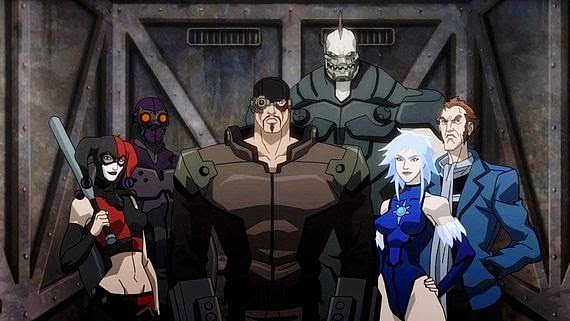
"Batman: Assault on Arkham" is one helluva fine animated feature, and unique, not because it teams villains (that's certainly nothing new), but because its criminal sect is forced on a questionable jaunt that may actually lead to a positive outcome. 

Directed by Jay Oliva and Ethan Spaulding, and written by Heath Corson, "Assault" is based on the popular "Arkham" video-game series. Putting that tidbit aside, the standing story is taut and edgy, its style smacking of Frank Miller, Guy Ritchie and any number of recent heist/mission-fueled tales.


The ensemble is recruited by Amanda Waller, a governmental Ma Barker/Parker type with a history of gathering talented, unsavory foes for furtive sprees. In the case of her current rogues, she has implanted tracking/explosive devices in them, geared to explode if they dare stray: a measure similar to that used to keep Snake Plissken in line. 

The group is fancifully labeled the Suicide Squad and consists of Black Spider, Captain Boomerang, Deadshot, Harley Quinn, KGBeast, Killer Frost and Shark King. Per Waller, they are to enter Arkham, where the Riddler is stationed (after having been nabbed once again by Batman) and retrieve his stored cane, which is allegedly equipped with a thumb drive containing all of Waller's recruits. (The Riddler apparently planned to plant the info on the Internet before being apprehended.)


A number of mishaps occur in the process, allowing Quinn to enter the asylum first, which means she has a greater chance of encountering the Joker, with whom she now holds a rift, but really, how long is such likely to last?

In the process, we learn that the Joker has, in fact, installed a bomb, which would annihilate a large portion of Gotham's citizenry. Can the fiend be stopped? Does the Riddler possess the skill to detonate the device? Such profound questions permeate "Assault" and effectively perpetuate its escalating tension. 


Adding to the story's gleeful dementia are supporting appearances by Bane, Commissioner Gordon, the Penguin, Poison Ivy, Two Face and a cool utilization of Mr. Freeze's ice-ray gun.

In that the villains never truly go good, they are graphically ruthless in their attacks, particularly on the Arkham staff, which squashes any sympathy they might otherwise gain. The film is also further adult-oriented for its surprising but satisfying nude scenes of Frost and Quinn. 


Though the Dark Knight significantly figures into the plot, the Squad remains the essential focus: a unique and successfully rendered twist, which is likely to be extrapolated once "Assault" catches on (case in point: the proposed, live-action Spider-man villain-heist film). 

Running under 90 minutes, "Assault" is fast-paced yet remarkably character-driven: overall, probably the best direct-to-disc, animated feature to surface in years, which is saying a lot, since there have been several other exemplary examples from both DC and Marvel. If it had been extended to live-action, it surely would have been a theatrical blockbuster. 

Nonetheless, though its variables may be unorthodox, "Assault" never forgets to distinguish good from bad. At its heart, it still promotes an ethical stance, and for that, admirably fits the superhero genre to a tee: a most satisfyingly complex hybrid, if ever there was.


Friday, August 22, 2014

I saw a Giant Spider...


"The Giant Spider" is the most recent venture from filmmaker Christopher R. Mihm, who specializes in such '50s monster-movie salutes as "Cave Women on Mars", "House of Ghosts" and "Monster of Phantom Lake". "Giant Spider" is his answer to "Earth vs the Spider" and "Tarantula", and like those endearing, drive-in classics, it's shot in black-and-white, with only a color title image in the vein of "Them!", accompanied by a catchy tune in the style of "The Blob".

Mihm's favorite leading man, Daniel Sjerven stars as reporter Howard Johnson (ha, ha): a Clark Kent-ish type who's also reminiscent of the monster-chasing characters portrayed by Richard Carlson and John Agar. Johnson is an all-around good guy, who loves his girlfriend/fiance, Zita, portrayed by Shannon McDonough, who sports a Polish accent in homage to the foreign beauties of "Giant Gila Monster" and "Killer Shrews".


Johnson learns of the giant spider via an urgent lead, discovering the mutant is on a bee-line trek into Phantom Lake County and will pass right through the local drive-in theater and from there, the barn where Zita is graciously setting up a community dance. Oh, my!

The spider is hungry, or so the evidence conveys, which is further detailed in a briefing where former Mihm movie characters congregate to speculate on what caused the specimen to become so large. They consist of Dr. Vincent Edwards (yep, we're talkin' Ben Casey, for those in the know), Dr. Gabriel and Dr. Hackett (played by Michael Cook, James Norgard and Billie Jo Konze respectively), who spill all the unsavory beans. This doesn't settle well with General Castle (you got it--another swell tribute), robustly played by Mark Halder, whose character was previously introduced in "House of Ghosts" and whose primary focus here is to see the monster dead. However, will military weaponry penetrate the spider's powerful skin, or is there a more effective way to do it in? It's up to Johnson to risk his life in pursuit of that alternate method, which results in an electrifying "War of the Colossal Beast" inspired climax.


Interspersed among the events are subtle, inside references to Mihm's prior productions and loads of quirky characters, including an initially disbelieving drive-in owner, played with engaging chagrin by none other than Mihm. There's also funny, elongated dialogue exchanges, setting the story ever more in tune with our beloved, low-budget '50s entries.

"Giant Spider", in the latter regard, also atmospherically boasts the ambiance of "It Conquered the World" and "Teenagers from Outer Space". It's also lovingly padded with Army stock footage, which at times gives it an Ed Wood feel. Additionally and above all, it exudes an admirable, old-fashion let's-get-it-done sensibility, even if the general is blatantly, though good-naturally, politically incorrect in his zeal to save lives.


The spider effects are expertly rendered, most consisting of a projected tarantula (in actuality, Mihm's son's), but always looking smooth and seamless. A puppet, used in close-ups, is creepily detailed and consistently mounts the amusing tension, invoking similar shots from "Black Scorpion".

Indeed, "Giant Spider" nails the '50s drive-in, horror scene so much so that I wonder how it may have played straight: betcha it would've worked. Nonetheless, like Mihm's other films (or the "Lost Skeleton of Cadavra" movies, which take the same tongue-in-cheek approach), its humor is only ever affectionate, which should please fans ardently devoted to the giant insect/arachnid sub-genre.

This one's certainly worthy of cult status, and as it gradually makes the rounds, it should further establish Mihm as one of the best, modern "B-film" directors around. He's adoringly fashioned a product that most insightful aficionados will not only enjoy viewing, but (like myself) be damn proud owning. 

Thursday, August 14, 2014

Monster Team-up Reflection #17: Frankenstein vs the Creature from Blood Cove


One of the most acclaimed, but often still inexplicably overlooked, monster team-up films of the past decade is "Frankenstein vs the Creature from Blood Cove". Written, directed and produced by William Winckler (who has a strong supporting role in the yarn), the 2005 brew is a heavy mix of horror-movie styles, trending not only on Universal turf, but touching on the carefree likes of "Frankenstein Meets the Space Monster", "Beach Girls and the Monster" and "Horror of Party Beach". 


In essence, "Frank/Creature" presents an unofficial matching of Mary Shelley's famed giant (designed with Jack Pierce style in mind) and the Creature from the Black Lagoon (aka, the Gillman). As it stands, despite its obvious homages, Wickler's black-and-white opus emerges as his own specialized recipe: like "Star Wars: A New Hope", a hodgepodge of many movies seamlessly blended to the point of seeming originality.


The film starts with the Creature's unruly escape into the sea, vainly pursued by Dr. Monroe Lazaroff (Larry Butler) and his assistants (Alison Lees-Taylor and Rich Knight, the latter of whom also supplied the excellent make-ups). The Creature, we learn, was concocted based on Dr. Frankenstein's documented techniques, but due to the specimen's unruly behavior, Lazaroff decides to trek to Frankenstein's homeland, Shellvania, to locate the legendary scientist's Monster and resurrect it to determine how he might improve upon his own variation. 

Shellvania, as it turns out, is an ominously dangerous place, for no sooner does Lazaroff locate the Monster's grave that he and his assistants are pursued by a daylight-roaming werewolf (portrayed by Corey Marshall, who also plays the Creature, with Butch "Eddie Munster" Patrick in a cameo when the wolf reverts to human form). 


Once the wolfman is slain, the Frankenstein Monster (Lawrence Furbish) is disinterred and transported to the doctor's California beach house. It's there that the Monster is revived with yet another revealed purpose: tracking and killing terrorists, with the prototype Creature intended as the first of a Navy Seal type militia to fortify the plan (which will now hopefully be controlled like the Monster via acute, hypnotic suggestion). 

Though Lazaroff's plan is zealously noble, it's quickly dashed, for the escaped Creature returns to the shoreline, senselessly slaughtering a string of folks, most of whom are curvaceous women. In desperation, the doctor decides (though only after his assistants' urgent pleas) to unleash the Monster to immobilize his wayward demon.


The task initially proves arduous for the Monster, due to the Creature's comparable strength and poisonous claws, but the intrepid giant perseveres and in the end, an all-out beach brawl ensues, with only one of the fabricated behemoths left standing. 


Bridging (and often interacting within) the monster sequences is a girlie-mag troupe, consisting of camera-ace Bill Grant (Winckler) and his two assistants (Dezzirae Lee and Gary Canavello) who, upon fleeing the Creature after an initial shoot, are nonetheless ordered by their superior to return to the cove to photograph yet another lovely lady. The second jaunt results in even further mayhem, with a Creature attack resulting in the model's grisly death. When the frantic trio flees for safety, it inadvertently arrives at Lazaroff's lair. The poor folks then learn that not only is the famed Monster alive and well, but that the madman is responsible for the amphibious fiend.

Such interludes allow ample tributes to unfold. The lab sets invoke the quaint ambiance of those from "Brain that Wouldn't Die" and "Teenage Frankenstein". The beach scenes are also nostalgically staged, appearing culled from the early '60s. Perhaps this is because the otherwise modern tale comfortably settles itself into an older mindset. At times, it even dares to reach back into the likes of "Bride of Frankenstein", Hammer lore and shamelessly lifts "Swan Lake" from Tod Browning's "Dracula" as its commencing theme. 


It must be noted: "Frank/Creature" isn't shy about being corny, but never becomes condescendingly silly. It also makes decent use of inside-jokes, a recurring appearance by Frankenstein's ghost (again Marshall), plus various supporting roles and cameos, including the aforementioned Patrick, porn-star legend Ron Jeremy; science-fiction author David Gerrold; Troma honcho Lloyd Kaufman; and George Lindsey, Jr. (yep--Goober Pyle's son) as the girlie-pic publisher. 

For monster team-up connoisseurs, this one's clearly tailor-made and received at least some well deserved exposure when horror host, Mr. Lobo aired it some Halloweens ago. For those unfamiliar with such crossover novelties, the film will still satisfy with its brisk pacing, chilling costumes and (for those with a lustful eye) undressed women. 

Too bad Winckler hasn't done another along these lines. If anything "Frank/Creature" once more proves the monster-rally formula still seeps appeal and with imagi-movie mergers now all the rage, the present seems more than opportune for yet another ghastly resurgence!


Saturday, August 2, 2014

I saw the Guardians of the Galaxy...


"Guardians of the Galaxy" is the latest Marvel movie adaptation to emerge this summer. It's based a Dan Abnett/Andy Lanning creation, about a group of gallant misfits, who against seemingly insurmountable odds, surprisingly rise to the occasion.

In James "Dawn of the Dead '04" Gunn's film version, the group starts off less than stellar, with its hero stealing an alluring orb, only to learn the item possesses planet-destroying properties. To prevent the orb from getting into the hands of an intergalactic madman, they must try to put personal concerns aside (a difficult task, considering how passionate they are about them) and go on the run.


Gunn and Nicole Pearlman's script ushers in plenty of action, yet brews constant interaction among its leads, making the story both compelling and humorous.

Among the Guardians are Peter Quill (Chris Pratt), ersatz Star-Lord, a sentimental gent of alien descent; Drax (Dave Bautista), a warrior seeking revenge for his family's murder; Gamora (Zoe Saldana), an attractive, green assassin; Groot (Vin Diesel), a lanky "Lord of the Rings" Ent-ish entity; and Rocket Raccoon (Bradley Cooper), a mutant critter with human attributes. 


Along for the ride are Yondu (Michael Rooker), a blue rogue who acts as Quill's questionable father figure; Taneleer Tivan, the Collector (Benicio del Toro), an curator of unusual commodities, some even living; Rhomann Dey (John C. Reilly), a gracious soldier; Korath (Djimon Hounsou), a tenacious tracker; Nebula (Karen Gillan), a surrogate sister to Gamora, with a pretentious allegiance to Marvel legend, Thanos (Josh Brolin); and of course, the main villain, Ronan, the Accuser (Lee Pace), a frightening Sakaaran leader who agrees to seize the orb in exchange for Thanos' pledge to destroy those he perceives as enemies. 


This collective spree doesn't pretend to be perfect, nor does its members wish to be. However, for all their flaws, they are shrewd enough to draw the line and pick sides. Distinguishing the Guardians from the others is their willingness to go the extra mile to do good, which firmly defines who they are and who we, the audience, can applaud. Their different backgrounds also give the film a "Star Wars"/"Star Trek" feel, demonstrating how those of varied origins can conscientiously coexist. 


Quill is, of course, the yarn's stand-out hero, and a bumbling one at that, but admirable for his ability to lead. In some respects, he comes across as a carefree Han Solo: initially a tad self-centered, but soon seeing the necessity of putting others before himself.

Salanda, previously computerized for "Avatar", presents a similar demeanor. Sporting enticing, old-school make-up, she resembles, for all intents and purposes, a "Star Trek" Orion slave girl, though more inclined to fulfill her mission than indulge in lusty trysts. 

She doesn't immediately warm up to Quill, but eventually recognizes his sincerity: a most important plot turn, for often in these sorts of makeshift groupings, friction can prevail between/among characters to the point of irritation. In Gamora and Quill's case, any burgeoning disrespect is quickly squashed, granting the audience a chance not only to get to know them, but actually to like them.

Cooper's Rocket Raccoon, on the other hand, is the film's crassest and cleverest novelty: an equivalent to the sidekicks of past imagi-movies, like the "Star Wars" droids or "Clash of the Titan'"s Bubo the Owl. However, despite his CGI'd confinement, he emerges far more humanized than cartoonish, and if not for his scrawny form, might be seen as recklessly cavalier and heroic and Quill. Similarly, his interaction with Diesel's protective Groot (who expresses impressive variance through a mere looping salutation) contrasts well with the mutant's cantankerous attitude, thus creating a realistic, affably empathetic banter found in most long-time friendships.

Arguably, Bautista's Drax is as equally endearing: at one moment maddeningly incensed and the next warmly naive, particularly in his misinterpretation of metaphors.


Of those on the "dark side", Pace's Ronan is appropriately intimidating: in many respects, the film equivalent to Darth Maul/Vader, but with greater, misguided zeal. Additionally, Del Toro's Collector enhances the film's sinister angle with weird, serpentine gestures and scrutinizing stares. (Too bad his part wasn't made bigger.) 


By the time "Guardians" concludes, one will have easily embraced its breezy ambiance and quirky characters as one might that of L. Frank Baum. Heck, the movie even shamelessly amps up the fun with  '70s/'80s tunes (courtesy of Quill's deceased mother), but then its overall feel is unquestionably a throwback to productions from that time frame:.Glen Larson's "Battlestar Galactica" and "Buck Rogers in the 25th Century" immediately come to mind, plus "Heavy Metal--the Movie". 

Whether "Guardians" spawns its own franchise or connects with its colorful, cinematic counterparts is yet to be seen, but as it stands, the film has great potential to make a lasting impression on the pop-cultural scene. It's now merely up to the filmmakers and of course, the ticket-buying public to ensure its longevity.

Saturday, July 26, 2014

I saw Hercules (once more, in new form)


When I reviewed the Renny Harlin/Kellan Lutz "Legend of Hercules" in Jan '14, I honestly didn't give a hoot if the critics (or even the general public) fancied it. I just wanted to see a new sword-and-sandal flick and basically got what I expected. This has also been my attitude toward Brett "X-Men: Last Stand" Ratner's take on the hero, and history has essentially repeated itself (surprise, surprise, the critic's ain't kind), though the Ratner film is considerably larger and more special-effects laden than the Harlin effort. 


This new entry, simply called "Hercules", is based on the late Steve Moore's acclaimed comic, "Hercules: the Thracian Wars" (adapted for the screen by Ryan J. Condal and Evan Spiliotopoulos) and enlists the expressive Dwayne "the Rock" Johnson as the "Son of Zeus". In this particular retelling, classic mythology seamlessly blends with modern, cinematic sensibilities. In this regard, though the film is relegated to ancient Greece, its underlying vibe is often contemporary, particularly when enhanced by its streamlined, CGI'd trimmings and use of the vernacular.

The story initially focuses on samples of Herc's twelve labors: an enduring part of the legend, even if such generally gets bypassed on screen (the Luigi Cozzie/Lou Ferrigno version perhaps being the most meticulous in catering to it). At any rate, in the event one had any doubt of his formidable stature, these fleeting excursions (though seemingly implied exaggerations) quickly establish Herc's renowned, physical attributes.


The story then picks up years later, with a more cynical Herc, who though typically affable, is haunted by the mysterious deaths of his wife and sons (a disturbing plot element which stems from his actual origins). He also sustains himself as a mercenary, hired ultimately by the Thracian King Cotys (John Hurt), through his enchanting daughter, Ergenia (Rebecca Ferguson), to ward off an enigmatic tyrant, Rhesus (Tobias Santlemann), who some claim is a centaur with the ability to recruit men via mental means.

Though one might still assume the task an effortless one for our muscular hero, Rhesus' foreboding image alone makes the task a threatening gamble. Thankfully, with a little help from his intrepid friends, including the intuitive Amphiaraus (Ian McShane), Herc tenaciously meets the challenge head on, while attempting to rekindle the unswerving honor he once exuded before his family's demise. 

Johnson is naturally impressive in the towering lead: a capable thespian, having accomplished great variance in his characterizations, from family adventures ("Journey 2: Mysterious Island") to action thrills ("The Scorpion King"). Perhaps the latter is where he best excels, and on that basis, this tale suits him well.


On the essential character-actor side, Hurt and McShane both shine (which should go without saying): their combined presence bringing an air of sophistication to the production, justly capping Herc's brawls with beasts (the three-headed Cerberus, a lightning-fast hydra, a mammoth lion and boar, but are they spectral or real?), plus a slew of relentlessly fierce, though inevitably outmatched human contenders. 


On the beauty side, Ferguson remains perpetually pleasant, as does Herc's amazon companion, Atalanta (Ingrid Bolso Berdal): neither of whom ever becomes an amorous hindrance. In contrast, the film is populated by many ugly and rough-edged types, who add just the right dash of menace to the proceedings. 

Like the graphic novel upon which it's based, this retelling is unique compared to most Herc incarnations: his lion headgear being the most visual distinction. Also, there is a question as to whether Herc is just an amazingly strong guy or in fact, the demi-god most perceive him to be. The film also twists matters in distinguishing who is good and bad, and it's up to Herc and his friends to come to terms with such, relying on their faith and convictions to do so.


On this basis, Ratner's movie shouldn't be compared to the recent Harlin/Lutz version, or for that matter, the Steve Reeves and Reg Park classics, let alone Sam Raimi/Kevin Sorbo's "Legendary Journeys". This one, at best and most, is a homage to them all and yet radically deviates from them, propping a humanistic view over the supernatural.

Do yourself a favor and just go with the flow with this one. The film certainly has all the required ingredients for sure-fire fun: a larger-than-life champion, magnificently choreographed battle scenes, offbeat characterizations and eye-popping creatures. If you have an opportunity to view it (and you're not inclined to side with high-brow pretentiousness), you're likely find both your time and money well spent. 

Sunday, July 13, 2014

An Alternate Reality #2: I saw the Apes at Dawn...


By its very nature, "Planet of the Apes" has always offered parallel possibilities to our own known reality and even from out its own initial five-movie mythology. 

When Cornelius and Zira (along with the tragic Milo) traveled back in time, their offspring (ultimately to adopt the name Caesar) rose to power in the alternate '90s, the implication was that he'd not only plant the seeds of ape dominance, but was possibly altering events to create a future unlike what we see in the '68 classic. The original series' "final chapter", "Battle for..." certainly insinuates this notion, and the acclaimed, but short-lived '74 television series further solidifies the idea (along with an animated counterpart which premiered roughly a year later).


Tim Burton's 2001 reboot also offers an alternate origin, but it was 2011's "Rise of..." (a loose retelling of the fourth film, "Conquest of...") that carried the concept through a steadier course. Now a sequel to that venture, "Dawn of..." has emerged, further enhancing the alternate track of possibilities. 

Directed by Matt ("Let Me In") Reeves, "Dawn" is in many respects derivative of "Battle", with apes and humans facing off to determine who will reign supreme. "Battle", however, deals with burgeoning human mutants (forerunners to those seen in "Beneath") and ultimately, calculated, militaristic maneuvers. "Dawn" is far more subtle, playing upon a genetic fluke (as outlined in "Rise") which has perpetuated the species divide, and despite valiant efforts from both sides, the situation nonetheless results in "Fort Apache" type bloodshed. 


Andy Serkis again portrays Roddy McDowall's legendary Caesar, and just as McDowall's version led a major simian mount in "Battle", so does Serkis', though from a slightly different vantage. Also, in "Dawn'"s case, the apes are considerably less evolved than those in the original movies, and in computerized form, often realistically bestial. Nevertheless, like their earlier incarnations, they are capable of keen thought, riding horses, and of course, speech.


That apes and humans can readily communicate naturally leads to interaction, but not all humans are inclined to believe that apes can reason. Dreyfus (Gary Oldman) sees them as a threat if crossed: his character subtly reminiscent of "Conquest/Battle'"s Governor Kolp (Severn Darden) and "Escape'"s Dr. Hasslein (Eric Braeden). In other respects, he's essentially a good man, whose stance is really forced upon him, for he can't help but sense the inevitability of ape control.


On the other hand, humans like Malcolm (Jason Clarke) and Ellie (Keri Russell) fully subscribe to species coexistence (and see no viable way around such if they want to access electricity for their camp), but how can they initiate a peaceful outcome when certain apes not only mirror, but accentuate Dreyfus' view? Caesar's "general", Koba (Toby Kebbell), for example, has no empathy for humans, due to the scientific torture they forced upon him and from this, becomes a chimpanzee counterpart to Claude Akins' Aldo ("Battle'"s most abrasive gorilla), and therefore, more friend than foe to Caesar.


Beyond this mounting friction, much of "Dawn" concentrates on Caesar's compassion for humans and his need to nurture his spouse, (Judy Greer), son (Nick Thurston) and cutely CGI'd newborn. He also furthers his position as leader by reinforcing bonds among trusted friends, such as the faithful orangutan, Maurice (Karin Konoval): an equivalent to Paul Williams' Virgil from "Battle". Such relationships let Serkis mold Caesar into a well rounded character, arguably on a par with McDowall's complex interpretation. 


Like its predecessors (or as evidenced in some of the finest "Alien Nation", "Star Trek" and "Twilight Zone" efforts), "Dawn'"s script (by Mark Bomback, Rick Jaffe and Amanda Silver) ripples of sociology and loads of irony. It doesn't parallel our existing society in the way the '68 film so deftly did in its time frame (due mainly to Rod Serling's insightful take on Pierre Boulle's text), but still manages to make us ponder our own current state of affairs and the ultimate shape of things to come. It also simultaneously suggests how we might interact with others on a global scale (an easier-said-than-done prospect), but also how we might survive within our more immediate confines (an admirable start, at the very least). 

"Dawn", however, unlike "Battle", doesn't insinuate a harmonious horizon, but at least implies a continuation of concern. For those of us who've followed the original series and its various offshoots over the decades, nothing could be more provocatively finer. Like that which has come before, let the alternate variations morph, circle, overlap and perpetually stimulate. That's the wonder of "Planet of the Apes", and it's most reassuring to know there are filmmakers yet bold enough to perpetuate the tradition.