Showing posts with label Willis O'Brien. Show all posts

Thursday, December 14, 2023

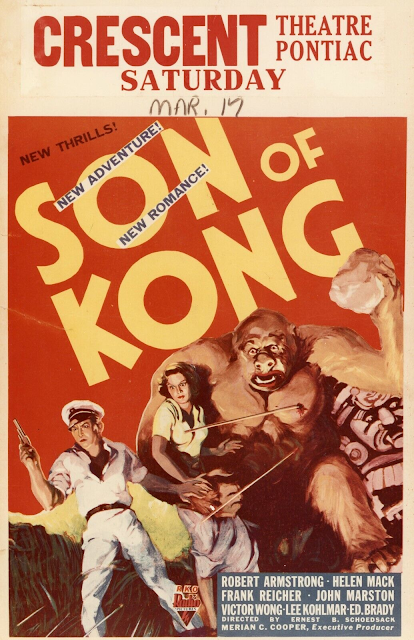
HAPPY 90TH, SON OF KONG

I don't give a hoot what anyone says. Son of Kong is a great sequel, and its 90th anniversary (on Dec 22) is one to commemorate. 

Though rushed into production to capitalize on its predecessor's blockbuster status, Son of Kong, directed by Ernest B. Schoedsack, produced by Merian C. Cooper, scripted by Ruth Rose and scored by Max Steiner, plays like the initial chapter, but with humor and tenderness tweaking the peril. 

Like King Kong, Son of ... also holds a great cast, with Robert Armstrong returning as the guilt-ridden, Carl Denham, along with Frank Reicher as Captain Englehorn, Victor Wong as Charlie and Noble Johnson as Skull Island's Chief. Helen Mack plays Denham's girlfriend-to-be, Hilda (aka "Kid," who does a dandy job singing the catchy "Runaway Blues"), with Clarence Wilson as her ill-fated dad, Steve Clemente as the Witch Doctor, Henry Tenbrook as Tommy, Lee Kohlmar as Mickey, Ed Brady as Red and John Marston as the dastardly Nils Helstrom, whose sights are set on an island treasure.   

The stop-motion animation by Willis O'Brien and Buzz Gibson brims of nuance and character, more than holding its own with the original, even if the same ferocity is absent. Even so, the salty-furred Little Kong's fight sequences would make his dad proud. (My personal favorite occurs when he wrestles a cave bear.) 


I believe what makes Son of ... so endearing is its moral core, which demonstrates that selflessness and sacrifice are paramount paths to survival. In this respect, Son of ... twists the original's premise with a stroke of heartfelt redemption, leaving one sad yet satisfied by the story's end. 

(Re)watch Son of ... this December to (re)experience the warmth, pathos and power of a sequel that, though smaller in scope, delivers a huge punch.  

Wednesday, March 1, 2023

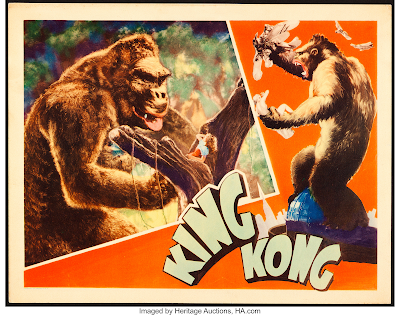
KING KONG: 90 YEARS OF CLASSIC FURY

A classic, monster movie reaches its 90th-anniversary on March 2: King Kong!

Everyone knows the fable. It's part of Americana and global folklore, and its juxtaposing parts are far too amazing, far too thrilling to fade from the pop-cultural consciousness.  

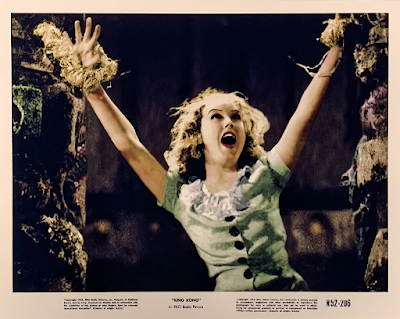
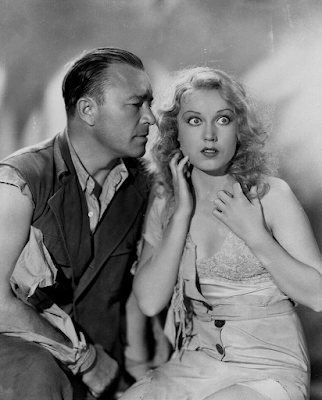
Kong's grab of Ann Darrow is both surreal and sensual; his fight with the T-Rex, thrilling beyond belief; and his ascent to the top of the Empire State Building (where he swats at a squadron of biplanes with his wee lady nearby), one of the most imaginative moments ever to kiss celluloid. 

The movie is also a unique retelling of Gabrielle-Suzanne de Villeneuve's Beauty and the Beast, injected with Sir Arthur Conan Doyle's The Lost World, though wrought with enough harrowing suspense to set one's hair on edge from beginning to end, thanks in no small part to Max Steiner's pulse-pounding score, and jammed with allegorical insinuations that prompt discussion to this day. 

King Kong is the brainchild of directors/producers Ernest B. Schoedsack and Merian C. Cooper. Cooper conceived the story with Edgar Wallace, James Ashmore Creeland and Leon Gordon, though Schoedscak's spouse, Ruth Rose (an Ann Darrow prototype in her own right) is said to have had the most influence on the tale's construction. (She went on to script Son of Kong, released later the same year, and in 1949, Mighty Joe Young.)

The cast is as perfect as one could hope, with the drop-dead gorgeous Fay Wray as the curvy, fair-haired Ann Darrow; Robert Armstrong as ambitious-to-a-fault moviemaker, Carl Denham; Bruce Cabot as heroic first mate, Jack Driscoll; Frank Reicher as practical Captain Englehorn; Nobel Johnson as an adamant Skull Island chief; Sam Hardy as Denham's concerned, business buddy, Charles Weston; and Victor Wong as the affable ship's cook, Charlie.

Willis O'Brien brought Kong to life through stop-motion animation, from models sculpted by Marcel Delgado. Unlike the fast-as-hell CGI characterizations that often populate movies today, Kong is nuanced, from his facial twitches to his bodily sways and punches: a credible, multilayered entity with tons of personality to spare. If one should ever have the good fortune to see the enormous ape on the big screen (as I have), one will understand why he holds no equal. (But even in small-screen samplings, the proof in the pudding can't be denied.) 

I love Kong with all my savage heart and soul. Though his 90th mark isn't as significant as his 100th will be, any cause to celebrate him, and the movie that made him a cinematic legend, is enough for me to say, "Happy Anniversary, my big, hairy pal!" You've aged well, Kong, and without any question, like vintage wine, you'll continue to grow ever greater with the progression of time. 

Thursday, July 25, 2019

HAPPY 70TH, MIGHTY JOE YOUNG OF AFRICA!!!


Sure, I could've waited five more years to commemorate the anniversary release of one of the greatest great-ape movies ever made, but the 70th mark (this July 27th) seemed as good an excuse as any to praise its virtues. 


"Mighty Joe Young" is the brainchild of "King Kong" and "Son of Kong'"s creators and participants: director Ernest B. Schoedsack; writer Ruth Rose; producer Merian C. Cooper (abetted by the legendary John Ford); brackish actor Robert Armstrong; puppet maestro Marcel Delgado; and stop motion animator Willis O'Brien. It's also the first feature film to employ the titanic talent of Ray Harryhausen, who was inspired by O'Brien to excel in the animation field. (Pete "the Black Scorpion" Peterson, an amazing animator in his own right, also worked on this fantastic feature.)


"Joe'"s format is similar to "King Kong", though with more warmth: that is, a sprinkling of "Son of ..." seasons it.


For those unaware, Joe is a ultra-humongous gorilla, adopted when a baby by Jill Young, played as a child by Lora Lee Michel and for the film's bulk, by Terry Moore. The two hold an impregnable, sibling-like bond, which becomes most evident when a group of fortune seekers comb Africa to capture beasts for an extravagant, Hollywood show. 


Among these seekers is Armstrong's Max O'Hara (a chip off the old, Carl Denham block), Frank McHugh's Windy and a congenial cowpoke named Gregg (Jill's ultimate love interest), played by western veteran Ben Johnson. Though Gregg cautions the lass against his boss' misguided intent, O'Hara convinces Jill that she and Joe could live a better life by headlining his palatial nightclub.


The nightclub scenes may seem impractical (i.e., dangerous for the vulnerable yet short-fused Joe and O'Hara's unprotected patrons), but what enfolds brims of wild whimsy. The highlights depict Joe propping Jill upon an ornate platform as she keys "Beautiful Dreamer" (his favorite song) and a tug of war which pits Joe against a queue of strongmen, led by former heavyweight champ, Primo Camera and Phil Oalfsson's Super Swedish Angel. 


Such moments shine high if only for their permeating pathos, which overflows with heart, soul and heaps of humanity, especially from the expressive Joe. Armstrong's O'Hara is also pivotal in delivering the latter, taking the Denham dynamic of "Kong" and "Son of..." into a single, movie arc, performing first as Joe's exploiter, but in the end, as one of the affable ape's supreme supporters and saviors. 


"Mighty Joe Young" is a film that can and will appeal to any age group and within any period in which it's viewed. Few movies can make that claim, which is why fantasy connoisseurs consider this fish-out-of-water adventure a classic. 


If you're the sort to visit my blog, you likely own a copy of this marvelous movie; so go on and give another whirl. You'll find it holds up with the best of the best: every ounce the sweet, beautiful dream you've long recalled and treasured. 

Monday, March 31, 2014

Monster Team-up Reflection #12: The Ghosts of O'Brien's King Kong vs Frankenstein (King Kong vs Godzilla...and beyond!!!)


A number of folks have requested that I fashion an overview of "King Kong vs Godzilla" (or at least a sampling of some influential Toho pictures), and I probably should have plunged into such after composing my "Frankenstein Meets the Wolfman Influence" post: a prelude, for all intents and purposes, to my "Monster Team-up Reflections" series. Well, sorry it's taken me longer than expected, but at long last I've whipped up something in the spirit of my earlier post, catering to a particular faction of the giant-monster/Kaiju scene.

Anyway, as most of you know, Toho Studios, along with innovative director, Ishiro (Inoshiro) Honda, patterned its team-ups after Universal's, but the way such propserously emerged actually came via a "rip off" of a Willis O'Brien vision. Without such, the enduring success of Toho's monster franchise, particularly the ongoing Godzilla ventures, may not have become what history has otherwise dictated...


The genesis of all this is legendary: stop-motion-animation genius, Willis O'Brien, planned a sequel to "King Kong", beyond "Son of Kong", with the favored concept being "King Kong vs Frankenstein" (sometimes referenced as "King Kong vs Prometheus" or "King Kong vs the Ginko"). In essence, the story would have commenced with the discovery of a new Kong, while in the heart of Africa, a great grandson of Victor Frankenstein was constructing his own giant, simian-like specimen, made from various animal parts. Both creatures were to end up on display and promoted in the style of the original Kong, but ultimately would break loose and brawl in San Francisco. (O'Brien's striking illustrations give one a strong impression of how the Frankenstein counterpart would have appeared and how the battle would have unfolded.)


Evidently, O'Brien failed to attain Hollywood backing for his wondrous idea, and so producer, John Beck (who allegedly also helped flesh out the "Kong vs Frank" storyline), trekked to Japan on behalf of O'Brien to see if Toho might be interested in financing it. From there, something shady occurred. The "Kong vs Frank" proposal was suspiciously swept under the rug, only to resurface shortly thereafter in Honda's monster-costumed "King Kong vs Godzilla" ("Kingu Kongu tai Gojira"). Supposedly, O'Brien and Toho settled out of court on the matter, though no distinct details can be readily found regarding the resolution, with the film being released after O'Brien's death.

Though it's disheartening that O'Brien's concept never graced celluloid, thanks to Toho it clearly didn't die on the vein, as "King Kong vs Godzilla" proved to be the studio's most successful picture (and still stands as such to this day based on ticket sales alone). The film also resurrected the latter monster's city-stomping career prospects, for "Godzilla Raids Again" ("Godzilla's Counterattack", "Gigantis, the Fire Monster") proved a tad lackluster at Japanese theaters, even though it's truly a well constructed sequel (and, in fact, officially launched Toho's monster-vs-monster formula).


Toho temporarily toyed with the notion of immediately sequelizing its mega hit, under the title "Continuation: King Kong vs Godzilla", but the revamped O'Brien idea instead morphed into other similar formats, with a long-running Godzilla series following, and Kong ultimately entering "King Kong Escapes" (aka, "King Kong's Counterattack"): a spy-styled, action yarn, based on the popular RB cartoon show, which pits the titanic ape against a robot version of himself (a formidable adversary who was clearly the blueprint for Godzilla's later, mirroring foe). Nevertheless, that Kong faces a man-made adversary similar to himself  (whether in this case by accident or plan) thematically connects yet again to O'Brien's design.

Meanwhile, the idea of a super-sized Frankenstein continued to manifest through Toho, with the creature initially being considered as a Godzilla opponent (though Toho opted instead for the first Godzilla/Mothra entry). What arose was Honda's highly successful "Frankenstein Conquers the World" ("Frankenstein vs Subterranean Monster Baragon"), where the preserved, radioactive heart of the Monster grows into a colossus, just as a giant, four-legged reptile, Baragon, coincidentally awakens, leading to an inevitable battle of the behemoths.


In the story, the jumbo Frankenstein faces a left-fielded demise (whether in the U.S. or Japanese editions, where some differences otherwise distinguish the endings). This led to two mammoth monsters spawning from the remnants of the original's flesh, in Honda's "War of the Gargantuas" ("Frankenstein's Monsters: Sanda vs Gaira").

Dubbing obscures the first entry's link in the U.S. cut, but the Japanese version clearly embraces (albeit subtly) the prior chapter: one Frankenstein offspring (Sanda, the brown) being good, the other (Gaira, the green) being bad, and as was the intended case of "Kong vs Frank", the apish Kane and Abel eventually battle, though as much due to philosophical dispositions as instinctual ones. (Allegedly, Toho fleetingly considered pitting Godzilla against one of the Gargantuas in '78: a throwback to Toho's original intent of having Godzilla battle a Frankenstein.)

After the success of Peter Jackson's Kong remake, website sources reported that a writer named Rock Baker was pitching a variation on O'Brien's concept to Universal, but such was promptly rejected: the angle, in this instance, making the Monster a mutated man who grows, in the "War of the Colossal Beast"/"Conquers the World" vein, to towering, violent heights, only then to confront a new Kong. (Oh, how I'd love to read the script for this one, let alone feast my eyes on an extensive O'Brien outline, if such ever even existed, which alas, seems unlikely.)

I must confess, more than a "Kong vs Godzilla" remake (which Toho fleetingly considered in the '90s) or even the long-awaited "Godzilla vs Gamera" movie (which sooner or later must be made), a variation on O'Brien's vision would be a treat-and-a-half to behold, but hey, one can't blame one for dreaming. The best and most one can hope for is now relegated to the imagination, but mark my words: O'Brien's concept will some day become reality, and when that day comes, it's bound to send ripples of jubilation through every giant-monster aficionado's heart!


In any event, it's indisputable that O'Brien's dream has already blossomed in ways he could have never imagined. Without its genesis, one can only speculate how prolific and profitable Toho would have become and how many terrific men-in-monster-suit ventures may have otherwise passed us by.