Showing posts with label Richard Matheson. Show all posts

Monday, March 13, 2023

THE INCREDIBLE SHRINKING MAN: A CLASSIC MONSTERS OF THE MOVIES TRIBUTE

Classic Monsters of the Movies presents a wondrous overview of one of cinema's science-fiction greats: The Incredible Shrinking Man.

The Incredible Shrinking Man was scripted by Richard (I Am Legend) Matheson (with Richard Alan [The Trap] Simmons), based on Matheson's powerful, imaginative novel, and directed by Jack (The Creature from the Black Lagoon) Arnold. 

From a metaphoric vantage, there's so much to learn and embrace from this staggering fable, which commences with a woeful turn of events, in which our protagonist, Scott Carey, is cloaked by a mysterious mist out at sea, to a massive struggle for survival in his basement against a spider and an ending that ranks as both ironic and euphoric. 

This deluxe, 36-page salute, by authors/researchers Nige Burton and Jamie Jones, covers many production platforms, including the film's star, the identifiable Grant Williams, as well as the beautiful Randy Stuart who portrays his compassionate wife, Louise, among other splendid performers who add so much credibility to the the shrinking man's incredible predicament.

The Incredible Shrinking Man's effects are detailed also, fortified by sterling, photo reproductions and blocks of trivia, highlighted by essays on Mr. Arnold, who brought us so many significant, science-fiction entries in the 1950s, and Mr. Matheson, who was only just beginning his prolific career. 

For those who love this movie (and Lord knows there are many!), this satisfying collectible cannot be missed. Order today at 

https://www.classic-monsters.com/shop/product/the-incredible-shrinking-man-1957-ultimate-guide-magazine/

Sunday, March 20, 2022

Collection Recommendation: Mr. Lobo's Cinema Insomnia (The Last Man on Earth)

Mr. Lobo's Cinema Insomnia presents (courtesy of oldies.com/DVD) the first film version of Richard Matheson's I Am Legend: The Last Man on Earth, starring the priceless Vincent Price. 

This 1964, low-budget submission was directed by Ubaldo Ragona (and for certain segments, Sidney Salkow) in Italy from a script by Matheson (under the name, Logan Swanson), which was revised by several writers throughout the progressing production. The results generate an unmistakable, pre-Night of the Living Dead vibe, but then that's no surprise, since the novel influenced George Romero/John Russo's flesh-feasting classic.

Last Man's locale also gives the outing an uncanny-valley feel, in that Italy stands in lieu of the U.S., but it all works to the story's surreal, black-and-white benefit. To boot, Price's nuanced performance as the anguished Robert Morgan enhances the nightmarish atmosphere. (There's nothing that pulls quite at the heartstrings than an erudite, family man who's forced to become a woeful vampire slayer.) 

To balance the unfolding tragedy, Mr. Lobo visits with the smitten Miss Mittens, as well as a brigade of lust-ridden ladies led by Sara Dunn's Queen of Trash, who intersect the dark venture with Valentine's Day amore, not to mention silly (and on occasion, scary) segments and endearing (if not demented) trailers: a satisfying, juxtaposing blend from beginning to end.

Add this essential Mr. Lobo's Cinema Insomnia installment to your collection at

https://www.oldies.com/product-view/1170D.html

Sunday, February 8, 2015

Time Travel Time #11: Somewhere in Time


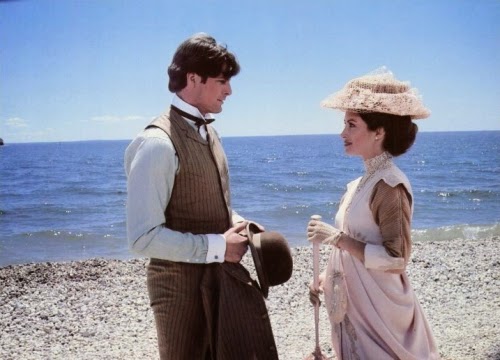
"Somewhere in Time" is a 1980 time-travel opus, adapted by Richard Matheson from his novel, "Bid Time Return", and directed by Jeannot Szwarc ("Jaws 2"/"Supergirl"). It stands as not only a fine fantasy yarn, but a touching love story, admired by many for its heartfelt execution. Unlike most love stories, it progresses with conflict and intrigue, while including characters determined to overcome seemingly impossible obstacles to consummate their love. 


Like Rod Serling's "Walking Distance", "Somewhere" doesn't include a time machine and commences humbly enough with young playwright Richard Collier (Christopher Reeve) meeting an elderly woman (Susan French) after the premiere of his first play. She gives him a pocket watch (a most symbolic gesture, considering the story's context) and requests "Come back to me": a vague, but passionate plea that remains in Collier's memory.

Years later, during a creative crisis, Collier flees his posh apartment to find refuge at Michigan's quaint Grand Hotel, at Mackinac Island: a quaint spot ideally suited for placidity. Once there, he wanders into the hotel museum and spots an alluring portrait of a women taken in 1912: an actress named Elise McKenna (Jayne Seymour). The portrait mesmerizes Collier, and he begins to obsess over it, feeling not only an amorous connection to the woman, but the belief that he has met her before.


He researches McKenna's life and learns that she was, in fact, the now deceased woman who gave him the watch. He also learns that she was fond of a book on time travel, penned no less by his former professor, Gerard Finney (George Voskovec): the character's name a tribute to Jack Finney, acclaimed time-travel (and "Invasion of the Body Snatchers") author.

Collier touches base with Finney, hoping to gain personal insight into the subject matter. Finney informs Collier that, yes, time travel is possible and can be accomplished through the sheer power of one's mind. The professor explains how he traveled back (albeit for a short duration) to Venice 1571 via such concentration. He explains that, to succeed in such an endeavor, one must immerse oneself in the proper atmosphere and restrict present-day reminders from one's surroundings, focusing exclusively on the time period one wishes to visit.


Collier takes the professor's advice and strips his lodgings of all modern attributes, except for a recorder which loops his voice to hypnotize him into thinking it is, in fact, the past. He also purchases a vintage suit and coinage, so that if he does travel back, he won't appear conspicuous to the inhabitants of the time.

In that his initial attempt fails, he searches for proof that he did, in fact, make the trip at some point and locates a 1912 guest book, in which his signature does appears. Inspired, he tries again and this time, awakens in the designated year (and the precise time of McKenna's visit to the hotel) and proceeds to scope the premises for her. 


The two cross paths soon thereafter: their rapport initially reserved but promising. However, he faces a frustrating obstacle. McKenna's manager, William Fawcett Robinson (Christopher Plummer), is an overly protective type, not wishing any man to court her, claiming that such will certainly derail her career.

His objections in no way stop Collier and McKenna from becoming more acquainted. She becomes smitten by the young man's gracious ways and their relationship blossoms. At one point, it even leads to Collier being present during the taking of the photograph which so enchanted him.


The burgeoning affair outrages Robinson, and after one of McKenna's performances (where she confesses her love to Collier via an impromptu soliloquy), the older man arranges Collier's kidnapping and ushers McKenna away from the hotel. Collier escapes his bonds, and the couple meets again, but not without further consequence: a subtle, unforeseen turn that could keep them forever separated. 

Reeve is excellent as Collier, bringing a dash of his gallant Superman portrayal to the character. Seymour is equally endearing as she embraces her fish-out-of-water suitor. Plummer, on the other hand, is a realistic villain: not over-the-top, but sophisticated, cunning, and in his own way, woeful. 


Matheson and Szwarc especially deserve credit for their efforts, with the former's script playing like an extended, top-notch "Twilight Zone" and the latter's direction smooth and ethereal. Seasoning these elements is John Barry's score: a joy to absorb, and one that many consider his best. The score is also enhanced by Sergei Rachmaninoff's "Rhapsody on a Theme of Paganini", which stands as the film's overriding theme.  

Upon its release, "Somewhere" made little impact at the box office and was generally scorned by critics. It was only through cable and VHS rentals that it gained acknowledgement, proving that if a film is of quality, its audience will inevitably grow. 

While other romantic movies have long since fallen off the map, "Somewhere" has mounted in fame, growing more popular with each subsequent generation: an indisputable sign of a classic. Discover or revisit it this Valentine's Day. You (and your significant other) will surely succumb to its charms!