Showing posts with label Christopher Reeve. Show all posts

Saturday, September 21, 2024

I saw Super/Man: The Christopher Reeve Story

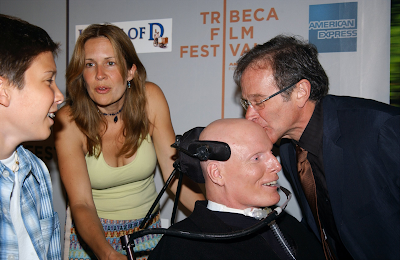
Super/Man: The Christopher Reeve Story, directed by Ian Bonhote and Ettedgui, who cowrote with editor Otto Burnham, presents a look at the versatile actor's life, with special emphasis on his love of family, and his family's love of him, intensified by the equestrian accident that rendered him paralyzed. The movie commences with this upsetting event, and its consequences bracket the entire film. (In truth, much of the movie is told from the vantage of Reeve's children, Alexandra, Matthew and William, and they deserve tremendous credit for the content's most insightful portions.) 

Of course, to do Reeve justice, his fruitful career must be acknowledged, in particular the way in which Superman: The Movie transformed him into a pop-cultural sensation. Though the documentary references the period, it uses it mainly as an undercurrent to Reeve's later, physical struggles, for as much as Kal-El had to overcome Kryptonite, so did the man who portrayed him, albeit on debilitating, terrestrial turf. 

Alas, this tactic forces the film to bypass the majority of Reeve's creative work (along with any related commentary), above all, Somewhere in Time and his earliest exposure through the soap opera, Love of Life. (In the Gloaming, which Reeve directed, gets the most attention, perhaps as much as his Superman movies combined.) A substantial sum of the archival footage comes and goes, blurring the likes of Richard Donner, Johnny Carson, David Letterman, Jay Leno, Carol Burnett, Jimmy Carter and Ronald Reagan, though Robin Williams, Glenn Close, Brooke Ellison, Jeff Daniels, Susan Sarandon and Gae Exton (Reeve's first "spouse") do receive adequate exposure. (Still, Richard Lester, Gene Hackman, Marc McClure, Valerie Perrine, Sarah Douglas, Terence Stamp, Jack O'Halloran, Pamela Stephensen, Annette O'Toole, Annie Ross, Jane Seymour, Jeannot Szwarc, Anthony Hopkins, Michael Caine, Morgan Freeman, Daryl Hannah, John Carpenter, Mark Hamill, Tom Welling [for whom Reeve held great fondness] ... Michael Keaton [Reeve's Speechless costar] are still with us and could have been interviewed, even briefly, and so why not? Also, why so little of Margot Kidder? Archival footage of her recalling Reeve does exist, and it should have been included. Instead, we get smug, cackling cameos and talking-head commentary from political pundits, who for the most part, offer flat, obligatory views on Reeve without any convincing, I-knew-the-man sentiment. Gosh, thanks a million, CNN, but to a higher degree, shame on you, DC!) 

Even with this misguided approach, Dana Reeve (Chris' ever devoted wife) and Robin Williams compensate for much of political pandering, as we watch their unflinching support drive Reeve to fight on and inspire others to do the same. In turn, we see how Reeve's selfless efforts led to life-affirming, medical procedures and behavioral perspectives that have helped those burdened by spinal-cord hindrances. (Ilan Eshkeri's heroic score performs a palatial service, in this respect, channeling John William's euphoric, orchestrated style to tie Reeve's artistic achievements to his impassioned campaigns, solidifying the valiant link with marked dignity and honor.) 

Though flawed, Super/Man: The Christopher Reeve Story is still an affecting gem that the actor's fans, and anyone who admires those with the strength to rise above the odds, will appreciate and revisit during times when all seems too bleak to bear. Moreover, the movie lets audiences know the essentiality of Reeve's legacy and how impactful any person can be by following his humanitarian example. 

Tuesday, August 1, 2023

Collectible Time: LIFE's Superman (The Comics, The Films, The Cape/The Man of Steel at 85)

I reviewed amedia360's The Story of Superman magazine in April; now, LIFE has released its own edition, Superman: The Comics, The Films, The Cape (The Man of Steel at 85), which emphasizes the significant phases of Jerry Seigel and Joe Shuster's brainchild, with extra-special attention to Richard Donner's 1978 Superman: The Movie, with Christopher Reeve as DC's titular hero and Margot Kidder as his spunky galfriend, Lois Lane. 

In addition to the Donner blockbuster, Superman II - IV are reviewed, along with Bryan Singer's homage, Superman Returns, with Brandon Routh; the radio show; the animated incarnations; the cliffhangers with Kirk Alyn; The Adventures of Superman with George Reeves; Lois & Clark: The New Adventures of Superman with Dean Cain and Teri Hatcher; Superman & Lois with Tyler Hoechlin and Bitsie Tulloch; Jeannot Szwarc's Supergirl with Helen Slater and Faye Dunaway; the Broadway musical, It's a Bird, It's a Plane, It's Superman with Bob Holiday; and Zack Snyder's somber, cinematic retelling with Henry Cavill as The Man of Steel, along with Batman v Superman and the Justice League offshoots. Unfortunately, the Superboy series, led by John Newton and Gerard Christopher, gets the cold shoulder, but at least Smallville and its headliner, Tom Welling, are spotlighted. 

The supporting performers who made (and yet make) the aforementioned adaptations so memorable are referenced, too: Gene Hackman, Ned Beatty, Valerie Perrine, Marc McClure, Glenn Ford, Marlon Brando, Tommy Bond, Jack Larson, Jackie Cooper, John Hamilton, Phyliss Coates, Noelle Neill, Terence Stamp, Sarah Douglas, Jack O'Halloran, Richard Pryor, Robert Vaughn, Mark Pillow, Mariel Hemingway, Amy Adams, John Shea, Lyle Talbot, Michael Rosenbaum, Annette O'Toole, Kristin Kreuk, Erica Durance and many more!

As a appealing buffer, the issue delves into classic, comic storylines, which helped shape Superman into a perennial icon. 

And as a further treat, the edition bursts with stunning stills, comic-book covers, posters and behind-the-scenes outtakes (particularly from Superman: The Movie and The Adventures of Superman), certain to leave fans in utter delight. 

LIFE's Superman: The Comics, The Films, The Cape is a gratifying collectible for both Earthlings and Kryptonians alike. Purchase it at your local supermarket or drugstore before supplies go up, up and away! 

Wednesday, March 1, 2023

Collectible Time: Superman I & II Poster/Lobby Cards

Mel and I recently leapt on a Christopher Reeve Superman kick, and as is her way, my dear friend has commemorated the revisitation with five promotional reproductions. 

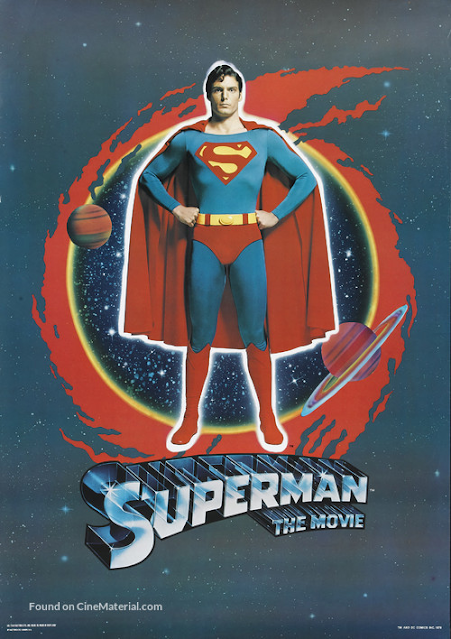
The first is a 11" x 17", British poster of Reeve with hands on hips and Jupiter and Saturn captured along a fiery swirl. The color scheme here is most pleasing and the design's smart simplicity satisfying.

Next up is a quartet of Superman II 11" x 14" lobby cards, two of which sport the movie's title at the bottom margin.

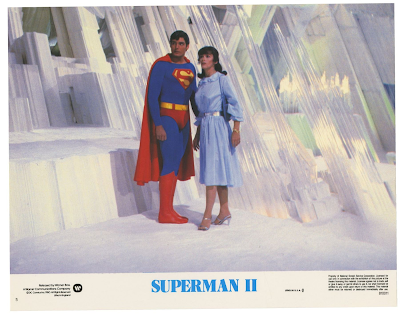
The first up shows Reeve and as Lois Lane, the lovely Margot Kidder, stationed in Kal-El's stunning Fortress of Solitude, with the second depicting Reeve combatting colossal Jack O'Halloran's Non, atop a car. 

The third submission, which is as much a traditional movie still as a lobby card, flaunts Sarah Douglas as the domineering Ursa, as she peers down at Peter Whitman's befuddled deputy. 

The fourth card/still includes all three Kryptonian villains, with Terrence Stamp's ruthless General Zod at the center, Ursa to the left of him and Non to the right. 

These reproductions are super-neat (pardon the pun), emblemizing not only two of my favorite superhero movies, but the special bond Mel and I shared when re-watching their theatrical cuts.

Thank you, Mel, for uplifting my spirits by further entrenching another awesome, movie-viewing memory. 

Thursday, November 15, 2018

SUPERMAN '78: A 40TH ANNIVERSARY, REMASTERED, THEATRICAL REVIVAL!!!


Folks can debate till the cows come home what the best, big-budget superhero picture is, but no one can deny the impact and enduring influence of the granddaddy of 'em all: "Superman: the Movie".


To celebrate its fortieth anniversary release, which otherwise takes place December 15, Fathom Events is presenting the remastered movie (original, theatrical cut) on Nov 25, 27 and Dec 3. Its vibrancy in sight and sound has never been as crisp or invigorating: all the more reason to pay a respectful (re)visit. 


Directed by the versatile Richard Donner and scripted (per various drafts) by Mario "The Godfather" Puzo; Robert Benton; and Leslie and Robert Newman, the production became one of the most successful pictures ever made (with inflation tallied, it would still hold its own with current counterparts). In that prior Superman outings (i.e., the Kirk Alyn movie serials and George Reeves' "Superman and the Mole Men") had limited budgets (and were lambasted by shortsighted critics), the filmmakers had the monumental task of proving that a pumped-up version of Joe Shuster and Jerry Siegel's mythology could click on the big screen. Despite the alleged odds, they accomplished a commendable composite of pathos, comedy, love and righteous exploits that left audiences captivated and yearning for more.  


There's no doubt that "Superman: the Movie" flaunted its value via fantastic effects (the flying sequences are still unprecedented), but the production succeeds because it's a passionate labor of love. Those attached to it (even if Donner and producers, Alexander and Ilya Salkind parted on bitter terms) gave it their all, ensuring the film stayed faithful to its DC source. The production was, after all, a representation of American legend, and nothing less than a principled commemoration would do. 


While other superhero movies have tried to rival its success, "Superman: the Movie" exceeds them by unconditionally embracing its moral ideology. For example, this Superman isn't afraid to say that he stands for "Truth, justice and the American way." Try to find that in more recent Kal-El excursions, not to mention any CW/DC series. In addition, our eponymous hero places the same emphasis on both big and small tasks, ranging from rescuing a cat to battling a nuclear-nabbing, Kryptonite-bearing foe.


The movie's mass acceptance made a global star of "Love of Life'"s Christopher Reeve, who injected Kal-El with focused, friendly dignity and painted his Clark Kent in the way of a bumbling, identifiable Cary Grant: two personalities rolled into one to beguile those who might (by accident or plan) curb his compassionate cause. 


Margot Kidder, who established herself in a trio of stellar thrillers, hit even higher ground as the sassy but awestruck Lois Lane. To bracket their acceptance, Kidder and Reeves were accompanied by marquee-value names like Gene Hackman as Lex Luthor; Ned Beatty as Otis; Valerie Perrine as Miss Teschmacher; Glenn Ford as Pa Kent; Phyllis Thaxter as Ma Kent; Jackie Cooper as Perry White; Marc McClure as Jimmy Olsen; Marlon Brando as Jor-El; Susannah York as Lara; Terence Stamp as General Zod; Sarah Douglas as Ursa; and Jack O'Halloran as Non. (One can spot cameos by Larry Hagman; Harry Andrews; Rex Reed; John Ratzenberger; and Noel Neill.) Pretty darn impressive, and all are excellent (if not spot-on) in their roles. 


To further the movie's significance, John Williams' score is extraordinary: his main-title march and "Can You Read My Mind?" being two of the most hummed pieces of cinema history. (In my estimation, the score is William's best, and that's sure saying something, considering his immaculate queue.) 

In addition, "Superman: the Movie" contains what many considered to be the definitive representation of Krypton: regal, ornate and like precarious glass, doomed to crash. 


The movie spawned a blockbuster sequel (shot, for the most part, alongside the first), plus three, complementary chapters (Bryan Singer's "Superman Returns", starring Brandon Routh, included), in addition to a "Supergirl" spin-off, starring Helen Slater. 

If you'd like to catch the Man of Steel's '78 adventure again (or for the first time) on the sprawling screen, here's your chance; if not, the HD Blu-ray is available for purchase. And if you can't swing either format, dig into your collection, pull out an old, faithful copy (no matter what the cut) and celebrate one of the best of the best, four decades after it touched your heart, lifted your spirits and indeed, made you believe a man can fly. 

Sunday, February 8, 2015

Time Travel Time #11: Somewhere in Time


"Somewhere in Time" is a 1980 time-travel opus, adapted by Richard Matheson from his novel, "Bid Time Return", and directed by Jeannot Szwarc ("Jaws 2"/"Supergirl"). It stands as not only a fine fantasy yarn, but a touching love story, admired by many for its heartfelt execution. Unlike most love stories, it progresses with conflict and intrigue, while including characters determined to overcome seemingly impossible obstacles to consummate their love. 


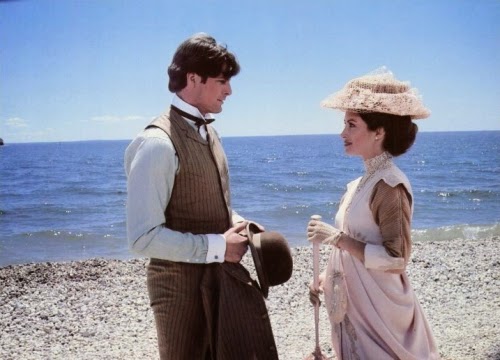
Like Rod Serling's "Walking Distance", "Somewhere" doesn't include a time machine and commences humbly enough with young playwright Richard Collier (Christopher Reeve) meeting an elderly woman (Susan French) after the premiere of his first play. She gives him a pocket watch (a most symbolic gesture, considering the story's context) and requests "Come back to me": a vague, but passionate plea that remains in Collier's memory.

Years later, during a creative crisis, Collier flees his posh apartment to find refuge at Michigan's quaint Grand Hotel, at Mackinac Island: a quaint spot ideally suited for placidity. Once there, he wanders into the hotel museum and spots an alluring portrait of a women taken in 1912: an actress named Elise McKenna (Jayne Seymour). The portrait mesmerizes Collier, and he begins to obsess over it, feeling not only an amorous connection to the woman, but the belief that he has met her before.


He researches McKenna's life and learns that she was, in fact, the now deceased woman who gave him the watch. He also learns that she was fond of a book on time travel, penned no less by his former professor, Gerard Finney (George Voskovec): the character's name a tribute to Jack Finney, acclaimed time-travel (and "Invasion of the Body Snatchers") author.

Collier touches base with Finney, hoping to gain personal insight into the subject matter. Finney informs Collier that, yes, time travel is possible and can be accomplished through the sheer power of one's mind. The professor explains how he traveled back (albeit for a short duration) to Venice 1571 via such concentration. He explains that, to succeed in such an endeavor, one must immerse oneself in the proper atmosphere and restrict present-day reminders from one's surroundings, focusing exclusively on the time period one wishes to visit.


Collier takes the professor's advice and strips his lodgings of all modern attributes, except for a recorder which loops his voice to hypnotize him into thinking it is, in fact, the past. He also purchases a vintage suit and coinage, so that if he does travel back, he won't appear conspicuous to the inhabitants of the time.

In that his initial attempt fails, he searches for proof that he did, in fact, make the trip at some point and locates a 1912 guest book, in which his signature does appears. Inspired, he tries again and this time, awakens in the designated year (and the precise time of McKenna's visit to the hotel) and proceeds to scope the premises for her. 


The two cross paths soon thereafter: their rapport initially reserved but promising. However, he faces a frustrating obstacle. McKenna's manager, William Fawcett Robinson (Christopher Plummer), is an overly protective type, not wishing any man to court her, claiming that such will certainly derail her career.

His objections in no way stop Collier and McKenna from becoming more acquainted. She becomes smitten by the young man's gracious ways and their relationship blossoms. At one point, it even leads to Collier being present during the taking of the photograph which so enchanted him.


The burgeoning affair outrages Robinson, and after one of McKenna's performances (where she confesses her love to Collier via an impromptu soliloquy), the older man arranges Collier's kidnapping and ushers McKenna away from the hotel. Collier escapes his bonds, and the couple meets again, but not without further consequence: a subtle, unforeseen turn that could keep them forever separated. 

Reeve is excellent as Collier, bringing a dash of his gallant Superman portrayal to the character. Seymour is equally endearing as she embraces her fish-out-of-water suitor. Plummer, on the other hand, is a realistic villain: not over-the-top, but sophisticated, cunning, and in his own way, woeful. 


Matheson and Szwarc especially deserve credit for their efforts, with the former's script playing like an extended, top-notch "Twilight Zone" and the latter's direction smooth and ethereal. Seasoning these elements is John Barry's score: a joy to absorb, and one that many consider his best. The score is also enhanced by Sergei Rachmaninoff's "Rhapsody on a Theme of Paganini", which stands as the film's overriding theme.  

Upon its release, "Somewhere" made little impact at the box office and was generally scorned by critics. It was only through cable and VHS rentals that it gained acknowledgement, proving that if a film is of quality, its audience will inevitably grow. 

While other romantic movies have long since fallen off the map, "Somewhere" has mounted in fame, growing more popular with each subsequent generation: an indisputable sign of a classic. Discover or revisit it this Valentine's Day. You (and your significant other) will surely succumb to its charms!