
My favorite "House of Frankentstein"/"House of Dracula" knock-off is "Assignment Terror" (aka, "Los Monstruos del Terror" and "Dracula vs Frankenstein", though the latter shouldn't be confused with the Sam Sherman/Al Adamson drive-in staple of the same name).
For the record, "Assignment Terror" is a German, Italian, Spanish co-production, directed by Tulio Demicheli, Hugo Fregonese and Eberard Michensner) and written by Paul Naschy (under his real name, Jacinto Molina), under the working title, "The Man Who Came from Ummo". It was released in '70, but made its U.S. debut via syndicated television.
It was also the first Naschy sequel released after "Mark of the Wolf Man"/"La Marca del Hombre Lobo" (with a more immediate, alleged French follow-up never reaching actual circulation.) Nonetheless, "Assignment Terror" swings Naschy's Waldemar Daninsky character back into action, delivering him into a modern world (graced by a hip, jazz score), and (joy of joys) surrounded by fellow monsters.

The story is actually not only a monster gathering (or rather an impression of their legendary counterparts), but includes a plot that could have been spliced from Edward D. Wood's "Plan 9 from Outer Space" and Joseph M. Newman's "This Island Earth": Extra-terrestrials from the Planet Ummo wish populate Earth and promptly resurrect three, brilliant scientists to assist with the scheme. The catch is: the scientists will first re-animate a group of monsters (and from there, evidently, make more of the same, after the creatures' physiological constitutions have been thoroughly evaluated) to ensure the invasion's success.
-screenshot.jpg)
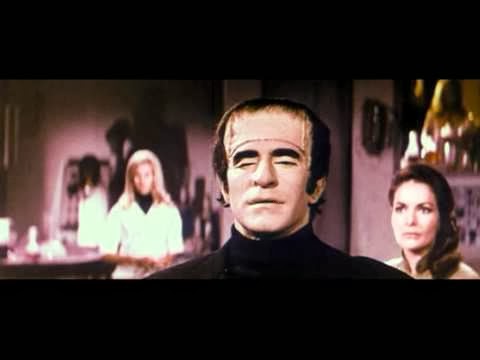
On this basis, Naschy's anti-hero werewolf, Walemar Daninsky, is resurrected purely through scientific means, along with a Frankenstein Monster, in this instance named the Franken-Science Monster (interestingly enough, portrayed in most part by Naschy, or is it really Ferdinando Murlo? You got me), a mummy named Tau-Tet (Gene Reyes), and a vampire named Count de Meirhoff (Manuel de Bilas). (Reference to a golem is made earlier in the story, which as it stands, comes off as a lead-in to the Franken-Science Monster's genesis, but in truth, funding dissipated on the production, and so the clay creature was dropped from the plot, along with some potential, alien craft footage.)

For cinema traditionalists (particularly Universal fans), it may be nice to know that the monsters are essentially represented as one might expect, featuring only subtle changes, with Naschy's Daninsky again resembling Lon Chaney Jr.'s famous lycanthrope; the Franken-Science Monster having a distinct Karloffian flair; while the Tau-Tet's face is gray-skinned and dark-eyed, with de Meirhoff sporting a slightly modern Barry Atwater/"Night Stalker" flair.
Playing the lead scientist/alien confidant, Dr. Odo Warnoff, is none other than Michael Rennie (known to film fans as Klaatu in the original "Day the Earth Stood Still" and the mechanized time-traveler in "Cyborg 2087"), who adds an irrefutable element of class to the proceedings, while further enhancing the film's permeating science-fiction angle.
During the yarn, Daninsky and one of the scientists (Maleva Kerstein, who resembles the lovely lady in the film's primary poster) become smitten with each other, which does momentarily slow the pacing, and the proceedings are ultimately investigated by a police inspector (Craig Hill), but in the end, all hell expectantly and thankfully breaks loose, leading to the various crossings of the monsters, though not actually between the Franken-Science Monster and de Meirhoff (as one of the alternate titles would otherwise suggest). Hands-down, the best confrontation is between the Daninsky and Tau-Tet, which concludes in a most memorable way. In truth, it may be the film's best moment.

Some claim "Assignment Terror" would have been better off without the alien-invasion concept, and indeed, it could have merely revolved around Warnoff gathering the monsters for an evil, earth-bound crusade. On the other hand, the invasion backdrop does spice the tale, allowing it not only to pay homage to Universal monster flicks, but to '50s science-fiction jaunts. On this basis, it's really too bad that the budget didn't allow for more insight into Planet Ummo, since it's largely dialogue, and some occasional high-tech, Kenneth Strickfaden-type equipment, that stands in lieu of such.
Also, its proves disconcerting that Rennie's voice is apparently dubbed, when the need was utterly unnecessary for the American version, as does the scientists subplot, which ultimately goes nowhere. There's also a carnival-front motif at the film's start, which could have been atmospherically effective if stretched, but for whatever reason, was inexplicably shortened.

Overall, "Assignment Terror" does at least take itself seriously, and its script (even though awkwardly altered along the way of filming) certainly shows Naschy's love for classic monsters.
Sam Sherman, who had a chance to help distribute the film more effectively, chose instead to alter "Mark of the Wolf Man", so that it became "Frankenstein's Bloody Terror", due to a contractual agreement to deliver a Frankenstein movie, thus relegating this particular team-up film almost to obscurity. Though Sherman evidently didn't find "Assignment Terror" engaging, the film nevertheless possesses the right exploitative elements to have surely done well on the U.S. theatrical circuit. (Of course, its wider release may have only proven competition for Sherman's own "Drac vs Frank", which was soon to dominate the drive-in scene.)

Incidentally, a Spanish-language edition can be presently found on YouTube, and though it isn't graced by subtitles, one shouldn't have too much trouble following the story, even if one doesn't wish to view the English-dubbed edition first. Indeed, in its purest form, "Assignment Terror" should have absolutely no trouble entangling one into its masterfully macabre web, but in either form is highly recommended and should surely satisfy.


