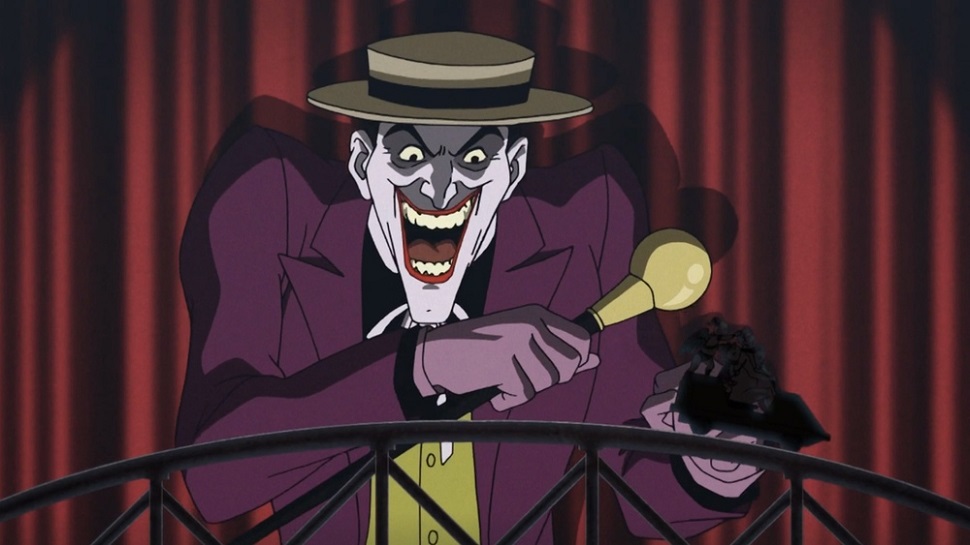
Before I saw "The Killing Joke" (dished up now as an apparent "Suicide Squad" warm-up), I read it: that is, I purchased Alan Moore and Brian Bolland's '88 graphic novel. At the time, the publication was all the DC rage: a mere year before Tim Burton's "Batman", which incorporated the novel's concept of how the Joker biochemically came to be.
The novel is considered a classic. As such, it seems strange that it's taken this long for an adaptation (animated or otherwise) to reach film.
Nonetheless, the time has finally arrived, and as with the "Dark Knight Returns" two-part animated adaptation, the big question is, does "Killing Joke", the movie, live up to its comic-book foundation? I'm happy to report--heck, yes!!!
That the film, directed by Sam Liu and adapted by Brian Azzarello, adheres to the original source is to its advantage, though it also offers an affluence of additional footage: a sort of mini-film within itself, but that's all right. Once the story gets rolling (and alas, it does take a spell), it successfully sways between terror and poignancy, just as the original story does.
Beyond the spirited (and unique-to-the-film) Batgirl, prologue, we're finally introduced to the Joker, who's presented as an aspiring comedian, struggling to provide for his family, but turns to crime (of the Red Hood sort) to compensate for his monetary failures. However, just prior to his first, big job, he learns that his wife and unborn child were killed in a home mishap. Their deaths lead to his complete, mental breakdown and to supplement his psychological alteration, he falls into some toxic goo, and well, you know the skin-bleaching rest.
As in the novel, the movie focuses on Batman's intent to unravel his foe's origins. He visits Arkham to get the nitty-gritty (and to prevent the strong chance that one will likely kill the other someday). However, he finds a decoy in the Joker's place. Yes, the Clown Prince of Crime has escaped once again, with mayhem naturally ensuing, this time with Commissioner Gordon and his daughter, Barbara (Batgirl, of course) becoming casualties of his spree: the latter shot and the former placed in a carnival "arena", where the Joker intends to prove (primarily to Batman) how fast madness can consume one.
The novel concludes on a demented, but gleeful note, and the film mirrors this celebrated turn. The movie's style, however, is more in tune with the '90s Batman animated series: not religiously so, but close enough to appeal to those who've yearned for a return to that style of cartoonery. Also, from the '90s series, Kevin Conroy and Mark Hamill are back as Batman and Joker respectively, which solidifies the tense, sentimental feel. (Ray Wise and Tara Strong also do a swell job vocalizing the Gordons.)

Gordon's sideshow-based torture is undoubtedly what earned "Killing Joke" a R-rating. Personally, though, I didn't find the intensity anymore over-the-top than in other "adult" oriented, DC animated features, but perhaps the extended, insinuated nudity is what confirmed this one's designation. All the same, sissified kids won't handle any of it very well, but I don't see it proposing a problem for those youngsters whose parents actually discuss such in-depth content with them. Heck, as hard-hitting as "Killing Joke" may be, it's still a worthy morality tale: more good for the soul than bad.
It's also a damn good character study and an appeasing escape after those "Son of Batman" in-fighting offerings. Sure, it's grim and borderline sadistic, but it's still traditional Batman, with the conflict flowing just the way it should for this particular hero and villain. No matter how one slices it, whether on the printed page or on the screen,"Killing Joke" hits the maniacal mark.
With the advent of Marvel's "Age of Ultron", I thought it fitting to reminisce on another superhero team-up effort, even though its story is rather unconventional, transcending even the various parallel universes we typically find in comic-book mythology. The film is Zack Snyder's 2009 "Watchmen", based on the classic '80s Alan Moore/Dave Gibbons DC comic-book epic, as adapted to the screen by David Hayter and Alex Tse.


Though superhero adventures by their very nature are "alternate reality", there are some that carve further niches into the concept, like Frank Miller's "The Dark Knight Returns" and Christopher Nolan's Batman trilogy, which co-exist with other Caped Crusader offshoots and retellings. However, Moore's story takes the parallel-universe concept one step beyond even the latter, planting an alternate universe that both mirrors the DC and Marvel golden-and-silver-age worlds, but becomes an intricate foundation all unto itself. In other words, "Watchmen" is its own niche, existing in a contemplative crevasse, separate from any series: a place where the Vietnam War falls in U.S. favor, Richard Nixon is re-elected beyond the allowed designation...and superheroes are as sad, scarred and flawed as we everyday folks.
In a surprising gesture of faithfulness, the film actually mirrors its the graphic novel upon which it's based. Also, like the novel, the film (i.e., any of its various versions) makes a staunch statement on freedom and rights: Orwellian and Huxley-esque in the bold way it analyzes its socio-political views.
The main heroes are sprung from an original, alternate '40s league called the Minutemen, which includes such groundbreaking figures as the Batman-inspired Nite Owl/Hollis Mason (Stephen McHattie); Silk Spectre/Sally Jupiter (Carla Gugino); and Comedian/Edward Blake (Jeffery Dean Morgan): an odd cross between Captain America and the Joker, who for the sake of any cause, desires that proverbial last laugh.
Comedian, we learn, also became part of the later-day Minutemen, the Watchmen, which include Nite Owl II/Daniel Dreiberg (Patrick Wilson); Silk Spectre II/Laurie Jupiter (Malin Akerman); the god-like Dr. Manhattan/Jon Osterman (Billy Crudup); the golden "uberman" Ozymandias/Adrian Veidt (Matthew Goode); and the tireless crusader from whom the story is conveyed, the mysterious Rorschach/Walter Kovacs, (Jackie Earle Haley), based upon Steve Ditko's legendary characters, Mr. A and the Question. Last but not least, we have Moloch (Matt Fewer), a woeful villain, who due to no fault of his own, becomes part of their plight.
When Comedian is murdered, the authorities investigate, but so does Rorschach, and what he uncovers is more monumental than he could have conjectured.
It appears an "Architects of Fear" scam (you "Outer Limits" fans will appreciate the reference) has been implemented: a trick to frighten Earth's factions into forming an alliance against a common foe. It's a noble notion on the surface, except that it's a lie. Rorschach watches, waits and collects the clues, building up toward the revelation, but his mission is sidetracked when he's falsely accused and imprisoned for Moloch's death.
The next generation Night Owl and Silk Spectre venture to break Rorschach out (after revitalizing their sense of cause via a trip in "Archie", the former's aircraft, and along the way saving some folks from a burning building). From there, the secrets and lies unfurl. The consequences aren't pretty, and the conspiracy stays concealed to the public until the adventure's end, deposited in a publisher's "crackpot" bin.


There's insightful interaction among the various characters throughout this basic structure, which reflects the most sophisticated science-fiction writings (think Arthur C. Clarke meets Joseph Stefano). The most poignant of these interludes centers on Dr. Manhattan's after he flees to Mars (once his radioactive shell is said to have infected people with cancer). In this distant realm, the deity ruminates on the process of time (in "Slaughter House Five" fashion), but despite such pensive plot bridges, the importance of revealing (or rather concealing) the truth remains a constant, overriding component.
In truth, the heroes' very existence teeters on an ongoing distinction between right and wrong. The heft of such falls upon Rorschach's shoulders, but they all participate in it, even Comedian, whose connection to the "Architects" plot leads to his downfall. Also, that the heroes have been stripped of their command, that their aliases have been jeopardized (with Rorschach defying it all, by still wearing his shape-shifting mask), only adds to the copious, dystopian desperation.
In our current age, when the truth is habitually obscured, when bad antics are rewarded or excused, when belligerent countries are appeased and virtuous ones condemned, "Watchmen" resonates more than ever. In this regard, its alternate-reality view might be more in tune with our own than many of us would care to confess.
"Watchmen" is also the foundation upon which any serious superhero vehicle should be based: a vessel for stirring not only adventure, but thought-provoking concepts and scenarios. It doesn't require a sequel (any more than "Citizen Kane" does), for any extension of the established tale might spoil its sincerity and moral stance.
Though several cinematic incarnations of the story exist (including a recommended "motion comic" of the novel), Snyder's original theatrical version is, in its own concise right, adequately designed to extend the yarn's influence and make us ask not only "Who watches the Watchmen?", but who watches any of those we've chosen to rule our lives; and why are we so foolish to grant them this continued, reckless distinction, when they've emerged as imperfect as ourselves?