Showing posts with label Mark Hamill. Show all posts

Thursday, October 12, 2023

I saw The Fall of the House of Usher 2023

Netflix's The Fall of the House of Usher (eight-part) miniseries, created by Mike (The Haunting of Hill House) Flanagan, smacks of Alan Birkinshaw's 1989 adaptation (the one with Oliver Reed and Donald Pleasence) and the director's 1991 Masque of the Red Death (the one with Herbert Lom and Frank Stallone), in that it's modernized and multi-referenced, though because of its serialized format, it rolls for the most part as an Edgar Allan Poe revamp of Dallas or Dynasty, planted in beleaguered NYC. 

For Usher 2023, the clan consists of more than brother and sister, its many relatives in charge of the deceptive Fortunato Pharmaceuticals, helmed (of course) by the four-million-buck, cognac-savoring Roderick Usher, who resides in his dilapidated, childhood home, taking machoistic delight in smelling its rot. 

We learn that, one by one, this media-manipulating, crime family has fallen ... killed, that is, by some clandestine catalyst, in one classic, terror tale at a time, leaving one to wonder how and why. Are these ghastly deaths the result of an alleged, Usher mole; basic, vicious vindication; common karma; or something far deeper, far darker? 

The cast consists of Bruce (Nowhere Man) Greenwood as family patriarch, Roderick (a role which commenced with Frank Langella, until a particular accusation struck); Graham Verchere as younger Roderick; Mary McDonnell as Madeline Usher; Willa Fitzgerald as younger Madeline; Ruth Codd as Juno Usher; Henry Thomas as Frederick Usher; Rahul Kohli as Napoleon Usher; Samantha Sloyan as Tamerlane Usher; Crystal Balint as Morelle Usher; Sauriyan Sapkota as Prospero Usher; Kyleigh Curran as Lenore Usher; Annabeth Gish as Eliza Usher; Kate Siegel as Camille L'Espanaye; T'nia Miller as Victorine LaFourcade; Carla Guigno as the ubiquitous Verna (rearrange those letters and see what emerges); Katie Parker as Annabel Lee; Robert Longstreet as William Longfellow; Michael Trucco as Rufus Griswold; Carl Lumbly as C. Auguste Dupin; Malcolm Goodwin as younger Auguste; and Mark Hamill as ex-explorer, Arthur Pym, or the "Pym Reaper," as he's been coined, an unscrupulous attorney for an unscrupulous corporation.   

As one may infer from the hefty list, there's much intermingling of other Poe people and their fated events (beyond even Roderick's brats) to string the concept along, leaving the Usher fable a wraparound that anchors the rest. 

That the family, which deals in things more simulated than sincere, meets its comeuppance feels right, but in the same vein, that its members are so self-serving makes it near impossible to embrace them. For the long stretch, a little more sympathy (i.e. more immediate humility) could have been invested, and beyond those few, tender moments that the reflective Roderick grants, there's never an earnest attempt to employ such. Then again, perhaps the pervading, callousness is apt. Regardless of any reinterpreted novelties (as the artsy Spirits of the Dead taught us), Poe should never be cheery and bright.  

Outside the Poe nods, this new Usher is an elongated murder mystery and therefore, a borderline Ten Little Indians meets Friday the 13th, though Murders in the Rue Morgue always played that prophetic card, I guess. 

If Netflix and Flanagan were so inclined, Dupin (if he returned to his humble, detective roots) could head his own series, investigating weird cases, ala Carl Kolchak, stalking fiends per clues in peculiar, purloined letters, but I've a hunch the chosen, soap-opera approach (rubbed by the founding season's Faustian flecks; sporadic, Roger Corman psychedelia; and obligatory, socio-political lament) will permeate, shaping this Usher as more of an extended competitor to Dark Shadows, Twin Peaks and Penny Dreadful than any other presumptuous derivations. 

Saturday, November 10, 2018

HAPPY 25TH ANNIVERSARY MASK OF THE PHANTASM!!!


On Christmas Day 1993, the first, full-length Batman animated feature occupied theaters. Though it wasn't the financial success of Tim Burton's live-action, Caped Crusader movies, "Batman: Mask of the Phantasm" still made a favorable impression on those who viewed it. Over the years, the film's reputation has only grown, making it one of the most applauded submissions in the Dark Knight's decades-spanning canon.


On November 12, 2018, for one night only, Fathom Events will once more project "Mask of the Phantasm" upon theater screens to mark its 25th anniversary release. 


Written by Alan Burnett, Paul Dini, Martin Pasko and Michael Reaves; and directed by Bruce Timm and Eric Radomski, "Mask of the Phantasm" sprung from the popularity of the WB's "Batman: the Animated Series", though granted greater depth than the show's half-hour slots could generally contribute. The movie remains of particular interest to fans for its origin segments of Batman and the Joker, which hold their own with subsequent, acclaimed retellings.


Like Burton's '89 film, "Mask of the Phantasm" depicts Gotham via symbolic dilapidation, as Batman is accused of a string of mobster murders. Though Joker dominates the backdrop and the film's finale, the actual murderer is a spectral, blade-clubbed vigilante named the Phantasm, who Bruce Wayne comes to discover is an individual near to his heart. The reveal may not be that huge a surprise, but the poignant way in which it's rendered has rarely been matched in any Batman movie, whether animated or live action, not to mention the printed page. 


Shirley Walker's soaring score is on a par with Danny Elfman's memorable orchestrations, and the movie makes effective, extended use of Kevin Conroy's Adam West-esque vocalization, as well as Mark Hamill's Blue Meanie-mimicked Joker. (Dana Delany, who would later enliven Lois Lane on WB's "Superman: the Animated Series", acts as the haunted Andrea Beaumont, with Efrem Zimablist Jr as Alfred Pennyworth; Robert Costanzo as Harvey Bullock; Bob Hastings as Jim Gordon; Hart "Supergirl '84" Bochner as Arthur Reeves; Abe Vigoda as Salvatore Valestra; Dick Miller as Chuckie Sol; and Stacy Keach as both the Phantasm's commanding voice and Beaumont's gangster-tied father, Carl.)


Many believe that "Mask of the Phantasm" would have been as effective via live action. That's understandable, considering the story's engrossing execution. The concept defines the Dark Knight's complex, atmospheric essence, capturing the character's Bob Kane/Bill Finger foundation through the cynical, Neal Adams '70s and those later, pensive phases of Frank Miller and Norm Breyfogle. There's no question that, if any DC animated entry should strike one as good, it's because "Mask of the Phantasm'"s sophisticated influence has, in one way or another, paved the way. 


There's no denying that "Mask of the Phantasm" is and always will be the epitome of what Batman was meant to be, could be and will forever be: an anguished, poetic blueprint that fans, creators and eager idealists continue to relish and revere. 


Revisit "Mask of the Phantasm" when you can, if not on the big screen, then on VHS or disc in the privacy of your home. The movie has more than demonstrated its noteworthy status and if for that reason alone, deserves a revived period of dutiful devotion.  

Thursday, December 14, 2017

I saw the Last Jedi...


I've said it before, and I'll say it again: "Star Wars" works best when it adheres to its John Carter, Buck Rogers and Flash Gordon roots. When it deviates from that, it becomes something other than the original intent: case in point, the prequel trilogy. 


"Force Awakens" pleased many fans by recapturing the old, George Lucas feel (though some critics claimed perhaps too much so, becoming more of a "New Hope" remake than a veritable sequel) and "Rogue One" (though a deep, somber vision) dared to capture (and basically succeeded) "The Empire Strikes Back" mystique. All signs looked promising, therefore, for producer J.J. Abrams and writer/director Rian Johnson's "Episode XIII: the Last Jedi" to continue the recharged spree, but hints that things might go awry surfaced some months ago in a couple enigmatic trailers. 


Is "Last Jedi" a fumble or on-course success? To be quite frank, it's a bit of both and neither, becoming an odd, unorthodox chapter that in one sense embraces tradition and in another, spits straight in its eye.

I won't spoil the plot, though many have speculated correctly as to what some of its elements might be, but I will surely confirm that it concentrates on Luke Skywalker (Mark Hamill), Ben Solo/Kylo Ren (Adam Driver) and Rey (Daisy Ridley). In this cozy, "family" affair (but don't hold your breath for a trustworthy reveal of Rey's lineage), we must come to terms with who's good, bad, and somewhere in-between, with various "surprises" installed in a somnolent attempt to give the memorialized "Empire" a run for its money. If the truth be known, this chapter is destined to break a few hearts, but when all else fails, we can at least count on the strength of its characters to snuff the discourse...right?


Alas, yes and no, and much of the blame goes to the new kids on the block. Rey is presented as far too perfect, too annoyingly preordained for us to empathize with her. Let's face it: Luke had a golly-gee, farm-boy, "I wanna make good against the odds" vibe that made him identifiable, but Rey is a blatant champion (and was pretty much so even in "Force Awakens"), leaving one little choice but to focus on the wayward Kylo, though he's not all that much better.

As "Force Awakens" villain, Kylo's temperamental and remorseful swings made him one of that installment's best features, but in "Last Jedi", his impetuous ambivalence has diminished. Ren, though still bad, has become downcast compared to his previous outing. Therefore, whether he champions the dark side or rejects it becomes of little dramatic concern or at best, confusing.


To make the film's character brevity even more agitating, Finn (John Boyega), who proved a respected underdog in "Force Awakens", is as monochrome as his young counterparts. (Man, it would have been swell to see him develop into something more than a something-already-close-to-better.) Though he does bumble some for tradition's sake, it's really his friend, Rose Tico (Kelly Marie Tran) who reinstates his air of levity. Alas, the duo's energetic escapades seem more disjointed than relevant to the plot. 


Who then (if only for complexity's sake) rises to the occasion? Why, it's none other than good ol' Jedi Master Luke. He's not the guy we once knew, and yeah, he might possibly be the sorrowful last of his kind, but he's seasoned enough to make his moments shine, and contrary to his cameo in "Force Awakens", he's given ample opportunity to dominate the scenes in which he's featured. 


Much of the credit for Luke's depth goes to Hamill, who layers his mature Skywalker with influential, Ben Obi Wan Kenobi contemplation, though with a threatening dash of fatherly Vader. Hamill has always been an underrated actor and for better or worse, forever linked to Luke, but in the case of "Last Jedi", his iconic presence sure does save the day...well, aesthetically, that is. (Again, I'm being respectful here not to give too much away.)


As expected, various established and more recent supporting characters revolve around our principles, like Supreme Leader Snoke (Andy Serkis); C3PO (Anthony Daniels); R2D2 (Jimmy Vee); Chewbacca (Joonas Suotamo); Poe Dameron (Oscar Issac); "DJ" (Benicio Del Toro); General Hux (Domhnall Glesson); Admiral Holdo (Laura Dern); Captain Phasma (Gwendoline Christie); Paige Tico (Ngo Thanh Van); and (maybe, just maybe) an adored, little, green guru from chapters past. In addition, we're given a heavy supporting appearance by Carrie Fisher as General Leia Organa, but most of the character nostalgia takes a backseat to the exotic locales; crimson trimmings; and fervent, spaceship roars. (On that note, where the hell is Billy Dee Williams? I've no real gripe in seeing a cutie-pie Porg occupy the Millennium Falcon, but gee whiz, wouldn't it have been cool if Lando Calrissian had sat in Solo's seat?)


By the time the interminable credits roll, "Last Jedi" can only be taken as a lofty, ideological bridge between chapters, with the line between right and wrong, light and dark, Resistance and First Order blurred at best. It in no way reflects Edgar Rice Burrough's straight-and-narrow narratives, let alone Hollywood's classic, moral-based serials. In other words, it's not true-blue "Star Wars", but then (as the jaded would be quick to point out), what is anymore? (I'd argue that "Guardians of the Galaxy" comes damn close, but that's another topic for another time.)

Perhaps when viewed as part of the three-trilogy saga, "Last Jedi" won't seem so conspicuously cumbersome, but for now, it looks like Lucas' mid-trilogy, tried-and-true formula has been yet again trampled. Don't get me wrong: It ain't bad (not by a long shot), but it sure ain't what it used to be or could have been; and damn it all to hell, didn't Abrams and Disney promise to give us old-timers what we crave? 

Tuesday, July 26, 2016

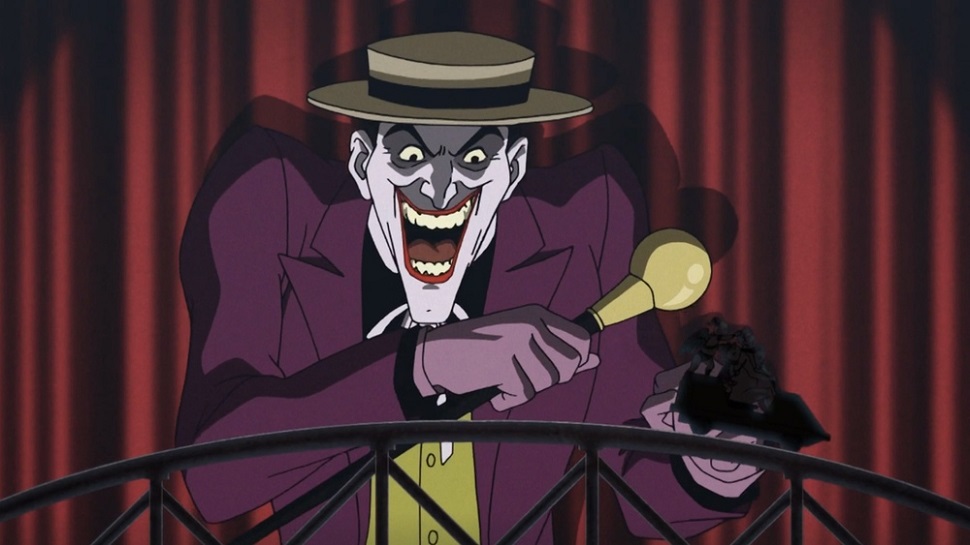
I saw the Killing Joke...


Before I saw "The Killing Joke" (dished up now as an apparent "Suicide Squad" warm-up), I read it: that is, I purchased Alan Moore and Brian Bolland's '88 graphic novel. At the time, the publication was all the DC rage: a mere year before Tim Burton's "Batman", which incorporated the novel's concept of how the Joker biochemically came to be. 


The novel is considered a classic. As such, it seems strange that it's taken this long for an adaptation (animated or otherwise) to reach film.

Nonetheless, the time has finally arrived, and as with the "Dark Knight Returns" two-part animated adaptation, the big question is, does "Killing Joke", the movie, live up to its comic-book foundation? I'm happy to report--heck, yes!!!


That the film, directed by Sam Liu and adapted by Brian Azzarello, adheres to the original source is to its advantage, though it also offers an affluence of additional footage: a sort of mini-film within itself, but that's all right. Once the story gets rolling (and alas, it does take a spell), it successfully sways between terror and poignancy, just as the original story does. 

Beyond the spirited (and unique-to-the-film) Batgirl, prologue, we're finally introduced to the Joker, who's presented as an aspiring comedian, struggling to provide for his family, but turns to crime (of the Red Hood sort) to compensate for his monetary failures. However, just prior to his first, big job, he learns that his wife and unborn child were killed in a home mishap. Their deaths lead to his complete, mental breakdown and to supplement his psychological alteration, he falls into some toxic goo, and well, you know the skin-bleaching rest.


As in the novel, the movie focuses on Batman's intent to unravel his foe's origins. He visits Arkham to get the nitty-gritty (and to prevent the strong chance that one will likely kill the other someday). However, he finds a decoy in the Joker's place. Yes, the Clown Prince of Crime has escaped once again, with mayhem naturally ensuing, this time with Commissioner Gordon and his daughter, Barbara (Batgirl, of course) becoming casualties of his spree: the latter shot and the former placed in a carnival "arena", where the Joker intends to prove (primarily to Batman) how fast madness can consume one. 

The novel concludes on a demented, but gleeful note, and the film mirrors this celebrated turn. The movie's style, however, is more in tune with the '90s Batman animated series: not religiously so, but close enough to appeal to those who've yearned for a return to that style of cartoonery. Also, from the '90s series, Kevin Conroy and Mark Hamill are back as Batman and Joker respectively, which solidifies the tense, sentimental feel. (Ray Wise and Tara Strong also do a swell job vocalizing the Gordons.)


Gordon's sideshow-based torture is undoubtedly what earned "Killing Joke" a R-rating. Personally, though, I didn't find the intensity anymore over-the-top than in other "adult" oriented, DC animated features, but perhaps the extended, insinuated nudity is what confirmed this one's designation. All the same, sissified kids won't handle any of it very well, but I don't see it proposing a problem for those youngsters whose parents actually discuss such in-depth content with them. Heck, as hard-hitting as "Killing Joke" may be, it's still a worthy morality tale: more good for the soul than bad. 


It's also a damn good character study and an appeasing escape after those "Son of Batman" in-fighting offerings. Sure, it's grim and borderline sadistic, but it's still traditional Batman, with the conflict flowing just the way it should for this particular hero and villain. No matter how one slices it, whether on the printed page or on the screen,"Killing Joke" hits the maniacal mark.