Showing posts with label Jeff Buhler. Show all posts

Friday, October 6, 2023

I saw Pet Sematary: Bloodlines

Paramount+'s Pet Sematary: Bloodlines, directed by Lindsey Anderson (Chaos Walking) Beer, who cowrote with Jeff (Pet Sematary '19) Buhler, is a prequel to either the latter parenthesized or (if one so chooses) the 1998, Mary Lambert take on Stephen King's bestseller, not to mention Lambert's 1992, Pet Sematary Two, all of which pull from W.W. Jacobs' perennial "The Monkey's Paw." 

This chapter takes place in 1969 and focuses on Jud Crandall's early years before he uttered the profound adage, "Sometimes, dead is better." 

Crandall, portrayed by Jackson White, is a young man who should have been drafted, but hasn't been, perhaps because his dad, played by Henry Thomas, has set it up so that his son can instead join the Peace Corps. That leaves locals a tad suspicious, if not resentful of the lad, in particular David Duchovny's Bill Baterman, whose son, Jack Mulhern's Timmy, died in Vietnam. Even so, the former soldier is seen walking about the Baterman estate, acting (to say the least) peculiar. (Pet Sematary fans are familiar with the Baterman story, since it figures into King's novel and impacts the adaptations.)

Crandall becomes most concerned about his old friend, after Baterman's dog mauls his girlfriend, Natalie Alyn Lind's Norma, getting little reaction from the pallid vet. Crandall shares the grisly episode with his pal, Forest Goodluck's Manny Rivers, who assumes Baterman's reputed nonchalance a result of war fatigue. 

The excuse doesn't hold up, for Ludlow's Mi'Kmaq burial ground is well known to its elder residents, even if preferred unmentioned. In addition to Timmy's dad, Jud's dad knows its sordid history, as does Pam Grier's Marjorie, Matt Holland's Benson and Christian Jada's Sheriff Anderson. They decide to snuff the accursed residue, but Baterman's resurgence has prodded things a little too far, as Manny's sister, Isabelle Star LaBlanc's Donna (a maker of ominous, Mi'Kmaq masks) discovers.
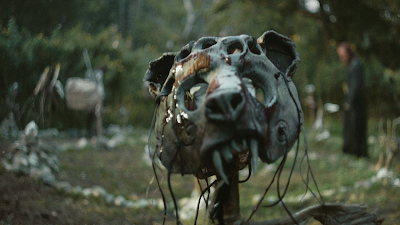
The ensemble's valiant efforts lead to a temporary fix at best, as Bloodlines creates a Faustian force that beckons what came before and projects what will come again. In fact, to drive this echoing motif home, the prequel holds a flashback, depicting how explorer Karl Graboshas' Commander Williams came upon the indigenous madness in 1674. (The segment would have made a fascinating feature on its own accord and could yet be expanded.)

When all is said and done, Bloodlines feels like Bob Clark's Deathdream, another "Monkey Paw" variant about a slain Vietnam vet resurrected through a mother's misguided prayers. As such, there's great regret at the story's heart, which taps straight into King's message: Secrets are cloistered for only so long; the same applies to evil.  

Saturday, April 6, 2019

I saw Pet Sematary Retold (Again)...


Long before Stephen King became a blathering, political pundit, he wove yarns to inspire and scare: some original, others derivative. 


"Pet Sematary" is one of the latter: a variation of W.W. Jacobs' Faustian fable, "The Monkey's Paw", where animals (and on occasion, people) rise from the grave, all with vexing consequence.


The novel is so gripping that one might claim that no movie version could ever do it justice. There was hope that George A. Romero might have pulled it off, but as with other proposed, Romero/King projects, the prospect slipped through the cracks, leaving Mary "Urban Legends" Lambert to grasp the directorial reigns.

Lambert's '89 adaptation doesn't capture the full extent of the book's ominous atmosphere, but on the whole, it shares its essential content and for television connoisseurs, offers Denise Crosby (in what was her most high-profile part since "Star Trek") and Fred "Herman Munster" Gwynne as the supportive but wary Jud Crandall: a role for which the actor should have won an Oscar.


Considering these successful attributes, there's no logical cause to have remade "Pet Sematary" (any more than there was for Lambert to sequelize her film in '92), but why redo any film? When it comes to repeated tries, maybe "...dead is better". 

For me, accepting a "Pet Sematary" remake is like accepting any knockoff of "Monkey's Paw" (that includes Bob Clark's emotive "Deathdream", Robert Kurtzman's raffish "Wishmaster" and Rod Serling's mordant "Man in the Bottle") or any "Frankenstein", "Jekyll and Hyde", "Dracula" or "Carrie" (ha, ha) that have come over the years. It's a matter of how well the product is rendered. Some retellings work; some don't. 


In this instance, the line between new and old is slim: A child dies in a most violent way and after being buried in a accursed burial ground, crawls forth to...shoot, you know the rest. In this regard, the new film, directed by Kevin Kolsch and Dennis Widmyer, and adapted by Jeff  Buhler and Matt Greenberg, is sure as hell no revisionist "Curse of Frankenstein". On the other hand, it does offer one wise, character twist, which sets it apart from Lambert's version, while still sticking to King's story structure.


For the most part, the remake's characterizations are comparable to those of the first, ringing of poignancy and culpability. The performers include Jason ("Planet of the Apes"/"Terminator") Clarke as Louis Creed; Amy ("Alien: Covenant") Seimetz as his wife, Rachel; scene-stealing Jete Laurence as his daughter, Ellie; the versatile John Lithgow as Jud Crandall; Obssa Ahmed as the spectral Victor Pascal; Alyssa Levine as sorrowful Sister Zelda; and Hugo and Lucas Lavoie as wee Gage. (For the record, four kitties comprise Church, the famed, resurrected cat, each projecting cuddly and/or perturbing results.)


Though Clarke is excellent as the anguished father, it's Lithgow who holds the heartbreaking horror together: a man who understands evil and yet succumbs to it. As with Gwynne's portrayal, it's easy to see through Lithgow's eyes. Of course, when it comes to King characters, Crandall is one of the most tenderhearted: a weathered everyman, who might as well be one's uncle or grandpop. That he's identifiable makes the prodigious premise credible. 


Though conceptually redundant, "Pet Sematary '19'"s staging is as vigorous as it's repugnant. No matter the moment (no matter how horrid the death), one dare not turn away. And yet does the remake's deft execution validate it? 

Perhaps not, but I do believe that King's tale, like the short story that inspired it, is destined for the ages. This version won't be the last, for as with any significant horror literature, the insatiable urge for cinematic revisitation will subsist.  Besides, for better or worse, sequels and revivals of "The Dead Zone", 'The Shining" and "It" are but a recapitulated heartbeat away.