Showing posts with label Clive Barker. Show all posts
Showing posts with label Clive Barker. Show all posts
Saturday, November 19, 2022


Saturday, November 5, 2022

Friday, October 7, 2022
I saw Hellraiser Reconfigured...

I've relished the Hellraiser saga from the start, from Clive Baker's novella, The Hellbound Heart, the 1987 Barker-scripted/directed kickoff and all of its ensuing cinematic, fan-fiction and comic-book installments. Word of a remake intrigued me, though didn't seem necessary, but then I figured, if its manifestation rekindled Hellraiser's multidimensional mythology (and how could it not?), I'd be wise to welcome it.
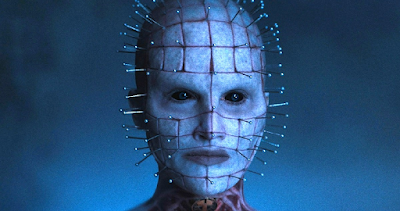

I needn't rehash Barker's premise; we all know the Faustian gist. For this renewed event, the catch is that the Leviathan-subjected Pinhead is a woman, played by trans-actor Jamie (The Neon Demon) Clayton. (For the long haul, the character [the symbol] has been portrayed by Doug Bradley and then Stephan Smith Collins and Paul T. Taylor.) The gender change doesn't feel like an obligatory, "woke" one. The slant recalls the novella, where the Cenobites (in particular their non-pinheaded chieftain) exude a transformed, feminine flair, even if their sexual designation remains ambivalent.


Barker acts as a producer on this adaptation, which means he's bestowed his blessing for it to be made. Luke Piortowski and Ben Collins wrote the screenplay (culled from a springboard woven with David S. Goyer); David (V/H/S) Bruckner is its director.

The remake doesn't hold the avant-garde aura of Barker's original (this one comes too far down the line for that), but the filmmakers still give their chapter a lush kick that exceeds most Hellraiser sequels (the best portions of which have come from screenwriter Peter Atkins). This is important to note since many hold the sequels in high regard, and I'm not ashamed to say I'm among them, favoring the first three (yes, that includes Bloodline), as well as the last two (yes, that means Revelations and Judgment).

Like the first film, the redux holds a Hammer-fied (magisterial, blood-anointing) verve; its Ben Lovett score even captures Christopher Young's addicting doom, while only kissing the original's orchestration. The Lemarchand Lament Configuration also performs an essential, multiformat role in the recommenced summonings, demonstrating that playing with fire gets one burnt, i.e. hooked, but then maybe getting hooked is enticing if one desires such an eternal sting.


Though Clayton's high priestess carries the important interludes (and looking most ethereal within Eli Born's ominous cinematography), the rest of the cast equally warms the fable's pot to a swell, surreal simmer: Odessa A'zion as Riley (the perplexed "heroine"); Brandon Flynn as Matt; Drew Starkey as Trevor; Adam Faison as Colin; Aoife Hinds as Nora; Hiam Abbass as Serena; Goran Visnjic as Roland Voight; and as Pinhead's Cenobite companions, Jason Liles as The Chatterer; Vakusin Javanovic as The Masque; Zachary Hing as The Asphyx; Selina Lo as The Gasp; and Yinka Olorunnife as The Weeper. (I was hoping for an Uncle Frank among the thrill-seeking ensemble, but the neo principals, in particular the charismatic, puzzle-curating Voight, allude to the famed pervert's yearnings, which is better than nothing and more than serves the sadistic splurge.)


I commend Hulu for inserting this revival into Barker's lasting franchise, for this laudable reboot could (and should) birth another grim queue and maybe carve an in-depth, alternate backstory for Pinhead. (The Marvel/Epic graphic-novel series holds many macabre notions begging for such reinvention; why not comb that fruitful source? Trust me, it would be a sure-fire win if only [ahem] configured.)

Wednesday, December 19, 2018
Collectible Time: Rock Rebel/Universal Monsters Pillow and Mezco Hellraiser III/Pinhead Cube for Christmas
Brett Turner has hit the mark again, with a couple, magnificent Christmas gifts sent straight from his exotic homeland of Canada...

Rock Rebel's 14" x 14", Universal Studios pillow spotlights Karloff's Frankenstein Monster, who's surrounded by Lancaster's Bride; Chapman's Gill-man; Lugosi's Dracula; Chaney Jr's Wolfman and Kharis. What a breathtaking collage, and it adorns both sides of the velvety black fabric. (I'm most fond of how Chaney's personas are positioned opposite each other.)
This classic-horror novelty would please any Universal Monsters fan. I'll cherish it for years to come...

As a creepy bonus, Brett added a Mezco Toyz's "Hellraiser III: Hell on Earth"/Pinhead Lament Configuration. This puzzle b(l)ox/Rubik's Cube measures 2.25" and is graced by lurid images of Doug Bradley's iconic, demonic character, aka Captain Elliott Spencer, including a cropped version of the film's famous (NYC backdrop) poster.
Brett knows how huge a "Hellraiser"/Clive Barker fan I am, so anything regarding such was certain to strike a grateful nerve. However, do I dare tinker with this piece and risk Cenobite transformation, not to mention an anguished outcome of the Uncle Frank kind? Hmmm...
Whatever my fate, I'm grateful to dear ol' Brett for his exquisite presents. (God bless and Merry Christmas, my friend!!!)


Rock Rebel's 14" x 14", Universal Studios pillow spotlights Karloff's Frankenstein Monster, who's surrounded by Lancaster's Bride; Chapman's Gill-man; Lugosi's Dracula; Chaney Jr's Wolfman and Kharis. What a breathtaking collage, and it adorns both sides of the velvety black fabric. (I'm most fond of how Chaney's personas are positioned opposite each other.)
This classic-horror novelty would please any Universal Monsters fan. I'll cherish it for years to come...

As a creepy bonus, Brett added a Mezco Toyz's "Hellraiser III: Hell on Earth"/Pinhead Lament Configuration. This puzzle b(l)ox/Rubik's Cube measures 2.25" and is graced by lurid images of Doug Bradley's iconic, demonic character, aka Captain Elliott Spencer, including a cropped version of the film's famous (NYC backdrop) poster.
Brett knows how huge a "Hellraiser"/Clive Barker fan I am, so anything regarding such was certain to strike a grateful nerve. However, do I dare tinker with this piece and risk Cenobite transformation, not to mention an anguished outcome of the Uncle Frank kind? Hmmm...
Whatever my fate, I'm grateful to dear ol' Brett for his exquisite presents. (God bless and Merry Christmas, my friend!!!)


Saturday, November 3, 2018
COENOBIUM: WHEN YOURS TRULY COMPOSED HELLRAISER FAN FICTION

In the early 90s, I gave the Clive Barker/fan-fiction scene a whirl. I hadn't reflected much on it until a few days ago when I stumbled upon Hellbound Web's acknowledgement of Coenobium # 4.

The site doesn't offer much on the Coenobium series, detailing the content for only seven of the fifteen-issue, Diane Keating-edited/produced series. Nevertheless, #4's ingredients do, indeed, acknowledge "Mistress...by Mike Housel". (For what it's worth, the Official Clive Barker Resource Website {Clive Barker - Revelations} also references #4, but ignores my contribution. Damn it. Guess "fan fiction" isn't considered prestigious enough...)

In case you're wonderin' (and how couldn't you be?), "Mistress" describes how its titular character was summoned through (what else?) a Lament Configuration. I styled the character's dominatrix semblance after Diana Rigg's Emma Peel and Tura Satana's Varla. I believe there's a healthy smidgen of Maila Nurmi's Vampira in there, as well. (Mistress' body is roughened...darkened to resemble a catsuit; her pretty, pale head tacked with leather strips: a crown of whips, if one will.) Before her demonic alteration, Mistress was a geisha, but then...well, let's just say my wee yarn harbors a "feminist" slant, though I doubt Gloria Steinem would ever endorse it.

The story is more in sync with Marvel Epic's offshoots than "Hellbound Heart" or the novella's related movies, but then, the comic-book content owes everything to those emanating elements, even if Pinhead is at most a recurring guest.

"Mistress" was (as I recall) reprinted by the Clive Barker Appreciation Society around the time I penned its sequel. Alas, I can't say which Coenobium includes "The Ecstasy of Amorphousness". It's not referenced by either Hellbound Web or Revelations. "Ecstasy" was also as much a sequel to my Herschell Gordon Lewis-inspired, self-published Wonderful, Magical, Literary Elixirs story, "Of Summer Urges and Sweet, Balmy Blood".
(For better or worse, "Summer Urges" has since turned controversial. The absurd cause I won't reveal here, but it's suffice to say that it connects to our current, censorious times. I'm certain "Ecstasy" would offend the same hypocritical hyenas if it were re-circulated. "Mistress" probably would, too, along with those plans Barker had for a lascivious Universal Mummy "remake". Same ol' song and dance, no matter what the atmosphere...)

In addition to the "Mistress/Ecstasy" set, I composed the Cenobite narrative, "Let There Be Laughter in Shame" (I favored long, pretentious titles back then; so sue me), which mates the ol' ventriloquist-dummy theme with "The Amazing Colossal Man", per puzzle-box tinkering.
The story exists exclusively on compact cassette. I performed it, with the electronic assistance of my friend, Kenneth Santitoro, for a Coenobium contest and won Grand Prize: a "Hellraiser III: Hell on Earth" press kit, signed by Barker.

Ah well...thought I'd share these hellraisin' tidbits, since my friends and followers do on occasion inquire about my early work.
For a curious hoot, check out the Coenobium scoop at ... http://www.cenobite.com/collect/coen.htm.

(Too bad the fanzine didn't last longer and that an online edition hasn't surfaced with accessible reprints and recent movie/book reviews. There's a huge "Hellraiser"/Barker audience out there. The effort wouldn't be in vain.)

Tuesday, March 6, 2018
I saw Hellraiser: Judgment...

The "Hellraiser" series has been around a long spell, going back to Clive Barker's genesis of the Cenobite concept in his novella, "The Hellbound Heart". That the series went the direct-to-disc route after the fourth installment never bothered me, beyond the fact that I'd have appreciated bigger-screen premieres for each new story, all of which I thought were fine, even if they didn't always measure up to the original quartet. (And I realize that some will go so far to say that things slipped right after "Hellbound: Hellraiser II", but many of those same folks never dared pick up a Marvel adaptation of Barker's mythology, let alone explored how far the series could--and should--go. In other words, some have sorely missed the bloody, potential point).


"Hellraiser: Judgment" is the latest (and tenth) entry in the franchise, written and directed by "Hellraiser" special-effects guru, Gary J. Tunnicliffe, who wrote "Hellraiser: Revelations" and now plays an officious Cenobite called the Auditor. The film also stars Paul T. Taylor as the new Pinhead, who takes the reins from Stephan Smith Collins, who took such from long-lasting legend, Doug Bradley.
Keeping with tradition, this entry doesn't skimp on its demons, which include Mike J. Regan as the Chatterer; John "Feast" Gulager as the Assessor; Joel Decker as the Butcher; and Jillyan "Die Gest" Blundell as the Surgeon. Blundell also acts as one of the Stitch Twins, paired with Lindi Simpson. In clustered form, we also get Andi Leah Powers, Mary Kathryn Bryant and Valerie Sharp as the Jury; and acting as the Cleaners, Diane Ayala Goldner, Molly Nikki Anderson and Christina Parson. (There's also the tall, angelic Jophiel, played by Helena Grace Donald, whose ironic presence ultimately defies and defines Pinhead's fate.)

Though most of the Cenobites act as little more than gruesome garnishing, the real (most visible) leads are terrestrial, but no less interesting for it. They include the brotherly detectives, Sean (Damon Carney) and David Carter (Randy Wayne), who are assisted by the diligent Christine Egerton (Alexander Harris). Heather Langenkamp (Nancy Thompson of sweet, ol' Elm St.) has a marquee-value cameo as a helpful landlady, though the main supporting, female role goes to Sean's forlorn wife, Alison (Rheagan Wallace), who impacts the brothers' relationship as they dissect the heinous acts of a Ten Commandments-motivated serial killer called the Preceptor.
The Preceptor is tied to the Cenobites, of course, whose magnetizing allure brews from an off-the-beaten-track "Old Dark House", which one of the brothers locates with dire, revealing results. Charles Dickens references (catering mostly to "A Tale of Two Cities") weave through (and contrary to what one might think, work to a sensible and symbolic degree), as the sadomasochistic carnage tiers in the most clever and repulsive ways. (The Abominable Dr. Anton Phibes would be most impressed, to say the least.)

This mix makes "Judgment" feel like “Hellraiser” meets “Seven” meets “Silence of the Lambs” meets "American Horror Story: Hotel", with extraterrestrial pages inserted from “Twin Peaks: the Return": a wide hodgepodge for sure, but for the most part, the pieces fit.
Its gory bridges, however, aren't as stylized as what one finds in the initial "Hellraiser" films, where a kind of Hammer Studios sensuality was employed. “Judgment” behaves more like a supernatural variation of “Hostel”, “Saw” and "The Human Centipede", and therefore, holds kinship with H.G. Lewis’ films, though devoid of the ‘60s/’70s nostalgia. This fiendish layering won’t suit every person's taste and for the general squeamish, “Judgment” would be best avoided.

For those who appreciate modern monstrosities, however, the film should invigorate. It stays uninhibited from start to finish, just like many of Barker's short stories and novels: unapologetic and cruel in the way life (and death)'s foibles are displayed. The film is by no means a ground breaker in this respect and doesn't pretend to be. Tunnicliffe simply allows the story to stretch the franchise's familiarity to worthy measure.

I'm relieved, therefore, that the writer/director/make-up artist (and those others involved in the production) didn’t try to reinvent the wheel to the point of insult: “Judgment” doesn’t spit in the eye of its fan base like “Last Jedi”, that is. Even when the Auditor and Pinhead discuss the inadequacy of the Lament Configuration in the age of computerized chills, the story (and accompanying atmosphere) remain pitted in what Barker commenced. Though the tale is current-day, it's still old and weathered in the best, Gothic horror sense. The addition of a clunky, old typewriter as a main feature reinforces this, with the Auditor using the device to cull confessions from those who enter his crusty chamber.

Arguably (when all is said and done), "Judgment'"s creaky, doleful interludes between new and old are what make it cozy, as any insufferable friend's sporadic presence would and should be; therefore, this chapter is a hellraising success, no matter what the ding-dong naysayers may say.
Also, much like "Curse/Cult of Chucky", "Phantasm: Ravager" and the recent "Leatherface", there's no reason why this one couldn't have played theatrically. It, too, has a guaranteed, built-in audience, despite those who've hypocritically denounced the series for its perceived, degenerating descent. To its further advantage, "Judgment" offers a swell, finale that strengthens its subtitle's meaning. If you don't believe me, check it out for yourself, and damn you to sweet, eternal Hell if you should dare disagree.

Sunday, July 12, 2015
Monster Team-up Reflection #24: Clive Barker's Nightbreed

One of the best and most eclectic monster-rallies is the 1990 thriller, "Nightbreed", based on the bestseller, "Cabal", by horror maestro, Clive Barker.
"Nightbreed" was, alas, anything but a hit in its day, though its cult status has grown over the years, to the point where the film has been restored (with once believed lost footage reinserted), matching Barker's directorial specifications. (It is, as should come as no surprise, the restored Shout! Factory edition that the following review is essentially based, but even the rough version conveys the same illustrious meaning and as already stated, was in its own right strong enough to secure devotees.)


The story is really a celebration of monsters, and to those who know and love such creatures, it's a given that they should never be despised, but rather admired, and due to the prejudices aimed at them, pitied: not that any monster worth his salt wants pity. The "Nightbreed" monsters are particularly more apt to fight back than beg for tears: their plight one of courage and justified ferocity.
Aaron Boone (Craig Sheffer) is the story's protagonist: an odd, young man with beckoning visions of a monster haven called Midian. His girlfriend, Lori Winston (Anne Bobby), has encouraged him to seek counseling on the matter through a therapist named Phillip K. Decker (David Croenenberg--yes, the Croenenberg, director of "Scanners" and "Fly '86"; and he even briefly swaps lines with monster-movie icon, John Agar--hot damn). It seems, however, that Decker is far from a compassionate sort; in fact, he's a serial killer coined "Buttonface", who dons a makeshift mask whenever he wishes to slay those he deems impure.


Decker is a monster in his own right, but a modernized kind: a disciple of the mad slashers who were popular in films at the time of "Nightbreed'"s original release. His presence is twofold in this respect: he, indeed, perpetuates the horror genre, but in another way, acts as an antagonist to aficionados of classic, Gothic horror, which by the time "Cabal"/"Nightbreed" surfaced, had taken a woeful backseat to a long string of knife-wielding maniacs.
The doctor is also the reason Boone flees, for the young man knows that Decker plans to pin a series of murders on him, but when our hero ends up in the hospital, he meets Narcisse (Hugh Ross), a disoriented gent who yearns to touch base with the mythical realm.

Narcisse claims he's a creature of the night, and to prove such, rips a portion of skin from his head, revealing the monstrous texture beneath. This convinces Boone that Midian may be more than a figment of his imagination. He flees once more (leaving the maddened Narcisse behind) and reaches his destination: a haunting, graveyard expanse, richly embellished by matte-artist, Ralph "Star Wars" McQuarrie.
Boone plans to hide for a time among Midian's shadows, but then encounters two of its inhabitants, Peloquin (Oliver Parker) and Kinski (Nicholas Vince, known to "Hellraiser" fans as "the Chatterer"). Kinski, whose head resembles a crescent moon, is sympathetic toward Boone, but Peloquin, a devilish looking chap with dreadlock tendrils, wishes to devour him. The best Peloquin manages is to bite Boone's shoulder, but the fateful wound is enough to transform the young man into one of the Breed and much to Peloquin's ultimate dismay, a long awaited savior.

Winston, meanwhile, goes in search of her boyfriend, unintentionally dragging Decker deeper into the strange adventure, while Boone gains favor among the Midians and reunites with Narcisse. Kinski vows to become Boone's mentor, and the tribe leader, Lylesberg ("Hellraiser's Doug "Pinhead" Bradley), consents to such, but further complications await: Decker's intent to purge the Breed attracts the gestapo-like Captain Eigerman (Charles Haid), who ushers a red-neck raid upon the haven, while accompanied by a perplexed detective (Hugh "Phantom Menace" Quarshie) and a downtrodden preacher named Ashberry (Malcolm Smith), who most likely would have figured prominently in a sequel.

All hell breaks loose, leaving Lylesberg to unleash Midian's caged behemoths, the Beserkers, to fight back the aggressors. He also accepts the notion that Boone will lead Midian's persecuted to a new sanctuary. It's from this status that Boone eventually gains a new name: Cabal (a nod to his new link with the struggling sect and their shared quest for freedom).

The film adaptation is also a tour d' force for the senses. In audio scope, Danny "Batman" Elfman's percussive score stirs a distinct tribal flavor. On the visual side (in addition to the aforementioned McQuarrie mattes, along with Robin Vidgeon's vibrant cinematography), Midian's corridors are as alluring as they are nightmarish: in other words, well worth visitation. In fact, one of the film's best sequences features Winston passing a procession of monsters (and their creepy lairs) as she seeks Boone. (Also, the reconstructed pacing is nearly flawless, though I must confess to preferring the original ending, but still, on the whole, the old certainly can't match to the new.)

Decades prior, critics (and even some horror fans) missed "Nightbreed'"s profound message. Most likely, some will still miss it, even with its theme more succinctly presented. That's often the way with works of genius, but just as the original built a following despite its flaws, so surely will the "Cabal Cut".
Barker's works deserve to be read and seen, and "Nightbreed" is one of his finest offerings. It's most inspiring to watch this twenty-five-year-old experiment re-enter the scene and rival the current bigger-budgeted competition with its old-school effects and an old-fashioned respect for monsters in general: a dark gift that any connoisseur of underdog horror will unconditionally accept.

Subscribe to:
Posts (Atom)