That "Unbreakable" and "Split" should blend isn't a stretch. Their link has long been on the wall of writer/director M. Night Shyamalan's cinematic universe, and in this time of live-action, DC/Marvel crossovers, why not a dexterous, subdued variation: a superhero fable filtered through the character-driven irony of "The Twilight Zone"?

With "Glass", named after Samuel L. Jackson's "Unbreakable" trickster, otherwise known as bone-fragile Elijah Price, our crafty filmmaker presents not only the flamboyant, titular terrorist, but Willis' sometimes hooded, though always valiant David Dunn. There's also James McAvoy's dangerous and anguished Kevin Wendell Crumb, abetted by a Horde of ready-to-rise personalities. These characters ultimately connect at Raven Hill Memorial Hospital, probed for a "cure" of their "alleged" abilities, but no matter what motions their psychologist, Ellie Staple (Sarah "American Horror Story" Paulson) takes, the three are destined to keep different yet overlapping goals.
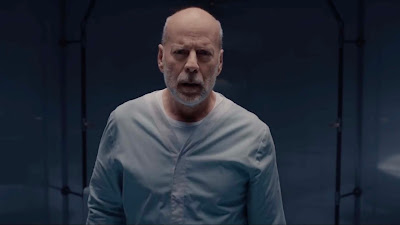
As a result of their fated teaming, the conniving Mister Glass provokes Wendell's inner Beast, realizing that once this impetuous personality has been sprung, a major revelation will come to the world. As part of this unraveling plot, Dunn must squash Wendell's monstrous portion, but it won't be easy with Shyamalan's ingenious, signature foils.
It's not just the writer/director's well crafted concept that makes the movie's heart pound, but its consummate leads: each established in previous chapters, but now like fine wine, richer...more matured. Their interactions resonate with urgency and sincerity, even when projected beyond their scope. In fact, the results of their clashing efforts fall right into the lap of "Split'"s Anya Taylor-Joy's Casey Cooke (Anya Taylor-Joy); Dunn's son, Joseph (Spencer Treat Clark) and Price's mom (Charlayne Woodard): for all intents and purposes, sidekicks to accompany the principals' weird, epic journey.

Like other Shyamalan productions, this one chases the truth, which makes it a morality tale, but then aren't all superhero stories? Shyamalan knows the good-vs-evil deal better than most: how the tipping of the scales can impact lives, whether on a glossy, Hollywood stage or in everyday life. "Glass" emanates from the former, but prospers in the latter, reminding us that the causes of right and wrong, of courage and fear, dwell within the most common crevasses: "Twilight Zone"-ish, indeed.
To further its intent, "Glass" demonstrates that despite what the story's secret-society scholars proclaim, heroes can rise from out any villainous pit: that no matter how horrid the actions, there's always a helping hand (whether plebeian or preternatural) to right the wrong and reassemble the shards. We only need open our eyes to see the evidence, to accept the truth, which is as clear as glass when we at last focus. In other words, "Glass" helps us see the world through a clear, logical lens, even if that lens hangs upside down.
"Glass" will be recalled by most for its clever, identifiable delivery. Granted, we've swallowed the movie's concept many times over, but it's been rarely served with as much labyrinthine sophistication or seasoned uber-humanity.
Terry Gilliam's "12 Monkeys" (adapted from Chris Marker's short film, "La jetee", by David and Janet Peoples) is perhaps more popular now than during its 1995 release, and that's not to say it failed to win favor at its advent. Both fans and critics granted it praise; co-star Brad Pitt was nominated for a best-supporting actor Oscar. It also furthered Bruce Willis as a steadfast box-office draw and proved that offbeat time-travel tales could rake in the big bucks.
Additionally, "12 Monkeys" has been discovered and revisited by viewers over time (enough so now to have spawned a Syi Fyi Channel series). It's not an upbeat film, but because of its interesting complexities, it joins the ranks of "Planet of the Apes ('68)" and "Beneath the Planet of the Apes" as thought-provoking, cataclysmic entertainment.
The time traveler, in this case, is James Cole (Willis), a temperamental convict, who is transported from 2035 (a desolate time where humans are few and only animals roam without protective gear), back to the '90s, to see if he can detect the early phase of a disease that caused a five-billion-death plague. The problem is, the time-propulsion methods are quirky, and Cole's jaunts rarely precise.
For example, he's to travel to Philadelphia '96, but lands instead in '90. During another jaunt, he's dropped into the French trenches of World War I, only to be extracted and finally delivered to his intended '96 post, but once there, what's he to do? Finding the cause of tragedy isn't an easy task, and so he flounders about, connecting the disease's release to a perceived terrorist group, the Army of the Twelve Monkeys, which spreads its insignia throughout the city.
The group is led by Jeffrey Goines (Pitt): a fidgety guy who Cole initially meets at an asylum, where the two are kept for observation. Unlike Cole, however, who's labeled insane due to his time-travel claims, Goines' real affliction is his excitable, philosophical bents and persistent rebelliousness: reactions to the moral stance of his father (Christopher Plummer), a renowned virology expert.
Cole is befriended by Kathryn Railly (Madeleine Stowe), part of a psychology team at the asylum (which includes Frank Gorshin as one of its prominent staff). Railly feels an ineffable connection to Cole, finding his claims strange but compelling. (Spotting his likeness in a WWI photo reinforces her faith in his claims). She adds the love interest to the story, but the couple's bond never distracts from the turmoil.
Cole's mission is further complicated by his memories and dreams, particularly one of an airport scene, where he envisions a harrowing shootout (an element that will figure strongly into events). This reverie, along with unraveling the Twelve Monkeys' actual intent (and yes, there is a twist to it) motives his pursuit (as well as Railly's).
Another character, Dr. Peters (David Morse), an assistant to the elder Goines, also impacts the plot, though his actual purpose isn't exposed until the end.
With some time-travel tales, the implementations lead to changes in once established events (and not always with positive results), such as in Ray Bradbury's "Sound of Thunder"; at other times, such act as a predestined ingredients, as inferred by "Star Trek: Tomorrow is Yesterday". "12 Monkeys" plays upon the latter, but sprinkles it with struggle and despair. In this regard, Gilliam's film isn't so much an essay on time travel (the consequences of trying to alter that which may not be altered), but is rather a study of how many of us try to impact (too often in vain) humankind's progression.
Willis, under Gilliam's somber execution, does an excellent job of invoking empathy and whether our hero succeeds or fails doesn't really matter. That he simply tries to survive his mission makes "12 Monkeys" memorable. It twists the tale with tension, intrigue and above all, forces one to consider one's place in the perplexing configuration of life: a component that many films aspire to attain, but few actually achieve.


