Showing posts with label Cara Delevigne. Show all posts

Thursday, March 30, 2023

An Alternate Reality: I saw Carnival Row 2...

It took forever and a day for Amazon Prime/Travis Beacham/Rene Echevarria's Carnival Row: Season 2 to surface, and for one such as myself (an unapologetic, workin' bloke), longer than usual to view it. There's been a lot discussed on the sequel's content and its Tolkien-esque, steampunked/Industrial Age Burgue, so I see no need to rehash the whole of it, except to say that Carnival Row 2 (like its predecessor) is at times a parallel-history, Sherlock Holmes, turn-of-a-different-century adventure, with murders having occurred among its faeries and the like (i.e., its various, mythology-sprung population). Orlando Bloom's Rycroft Philostate, a human-fae cop, investigates such, with shades of bigotry rising, as he partakes in an amorous relationship with Cara Delevigne's Vignette Stonemoss, a comely, winged lass who ultimately joins a resistance (overthrow-the-status-quo) Black Raven group. 
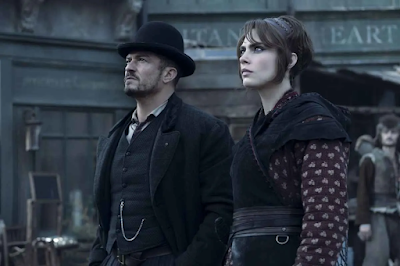
But to me, Carnival Row's crusty core is more a variant of Alien Nation, Planet of the Apes, Bright, District 9, Lord of the Rings, and well, I'm sure you get the drift. In this respect, it insinuates matters that we see around us today, though set in a Twilight Zone-ish mode to make us twist our brains and say, "Hey, oh, I get it."  

The series' most fascinating aspect (and a huge, Season 2 component) is its be-wary-of-socialism/communism motif. David Gyasi's Agreus, a responsible sort of Pan, and his impassioned, human lady, Tamzin Merchant's Imogen Spurnrose, go on the lam because of their "brash" relationship and to find a haven that turns out to be anything but that. It is, in truth, a Fidel Castro (cloaked-for-propaganda) ruse, run by the reputed "freedom fighter", Joanne Whalley's glib, broken-horned Leonora. Miss Spurnrose's brother, Andrew Gower's Erza also finds himself in the conflicting mess of promise and threat, and the results are nothing short of heartbreaking, though for the more astute, likely to incite righteous rage, as any set of lies would and should. 


Other characters and their assigned performers give considerable quality to the marginal problems, even if the entrenched subplots get too bloody garrulous for their own good. Nevertheless, credit must go to the following for lending flavor to the intrigue: Ariyon Bakare's Daris Sykes; Chole Pirrie's Dahlia; Karla Crome's Tourmaline Larou; Arty Froushan's Jonah Breakspear; Caroline Ford's Sophia Longerbane; Indira Varma's Piety Spearheart; Simon McBurney's Runyon Millworthy; Jay Ali's Kaine; Scott Reid's Puck; and others of bourgeois/peasantry, fight-for-the-cause (or better still, against-it) pledges and perspectives. 

Carnival Row (both seasons linked) is pretty damn violent, as well (in particular in the beheading and messy-autopsy departments, and the shifty, EC-brewed Sparas comprise a whole other repugnant deal). As led by Bloom's "Philo", the series spews a profane, tough-guy/yank-the-innards-out slant, which will rub some of today's militant pacifists (ha ha) the wrong way, but those who don't dig pistol-packin' grit, factory-sweatin' grime and courageous, sacrificial death (with shameless carnage of the Tom Savini/Steve Johnson/Herschell Gordon Lewis ilk) should seek their entertainment elsewhere. Carnival Row, even if faerie-drenched, ain't no sissified affair, and thanks to Beacham, Echevarria and co-producer Bloom, its ambiance seems proud of that fact. 

Amazon doesn't intend to extend this series, though I could see fans urging movie follow-ups. Even if it languishes a few years (even decades, by chance), my hunch is that its thought-provoking foundation will spawn a comeback some day. Though Carnival Row may be too superfluous in characterization and ideology to please the current, polarized masses, it offers the seeds for revisited rumination and even greater, fantasy fermentation. (In other words, it holds a loyal enough audience, and that ensures reinspection farther down the sentimental, alternate-reality row.) 

Monday, September 2, 2019

An Alternate Reality: I saw Carnival Row...


Created by Rene Echevarria and Travis Beacham, the eight-episode "Carnival Row" is an unofficial, turn-of-the-century, alternate-reality (is it England?), Amazon companion piece to Netflix's "Bright".


It's a murder mystery, as well as a blending of fantasy worlds (and all the contention that goes with such a crossover), featuring Orlando Bloom's Inspector Rycroft Philostrate (a veteran of a indistinct war, which we visit via flashback), who leads the charge in a city called Burge and faces a slippery slope that's not his own. His love-interest "Watson" (a temporary, downtrodden maid) is an immigrant/refugee faery (one of the "fae folk", that is) named Vingette Stonemoss, portrayed by Cara Delevingne, who's easy on the eyes, as should come as no surprise to anyone who's beheld her. 


The saga's overseer is Chancellor Absolom Breakspear, played by Jared Harris. Breakspear takes heat for the immigration flow, during which perplexing, Jack the Ripper type murders occur. Breakspear's son (Arty Froushan) is kidnapped in the interim, causing the leader further distress. (The role requires a deft blend of pomposity and sympathy, thus giving Harris many scenes to emote as only he can. Fans of the multifaceted actor will be satisfied.) 


The immigrant hangout is called Carnival Row. The humans stationed in the Burge don't care much for the "invasion", which consists of all sorts of amazing races. Tensions naturally rise from both sides. I suppose that's the series' socio-political intent, but for all its infuriated strain, the conflict feels like everyday life: identifiable, even if ugly. 


This may be "Carnival Row'"s best and worst asset. It appears to dispatch an allegorical message about a refugee crisis, but the theme is never fully essayed. With a better defined allegory, "Carnival Row" may have reached the food-for-thought level of "Alien Nation", "Star Trek" and "Planet of the Apes", and there are moments when it comes awfully close, but its lack of consistency turns its angle middle of the road. That there's an overload of subplots doesn't help, either. (Some say the series is attempting to be the next "Game of Thrones". Could be. Who knows?)


Even with its clutter, "Carnival Row" still comes across as sharp and dark. Potterheads will find it as disturbing as "Bright", though nowhere near as intimidating as any given Tolkien chapter. In other words, "Carnival Row" isn't meant for the queasy. (Its violent aftermaths are often on a par with H.G. Lewis and Tom Savini; and there's ample sexual simulation. How ghastly!) At the same time, its steampunk-ish decor is the CGI frosting on the cake and should intrigue most who take a peek. 


There's no doubt that "Carnival Row" is an commendable experiment, which could become all the more engaging if it does, indeed, spawn a second season. (One has been ordered, but that doesn't mean it's clinched, so let's not jump the gun.) 


Right now, the mainstream snoots aren't keen on this one, but who cares what they think? It's the Amazon subscribers who'll determine whether this one continues. I say, why not? Given the chance, it could become the next, big thing. Let's see where it goes. 

Thursday, August 4, 2016

I saw Suicide Squad...


Writer/director David Ayer's “Suicide Squad” is a comic-book refashioning of “The Dirty Dozen”, as is its animated companion piece, “Assault on Arkham” and its competing series, Marvel’s “Sinister Six”, which would have beat “Squad” to theaters if not for “Amazing Spider-man 2’”s embarrassing dissension. "Squad'"s leads, of course, are bad buys, with the hope that somewhere down the misguided line, they’ll do some good, but this gimmick also proposes a head-scratching dilemma: When dealing with villains this iconic, do we really want them to change? Depending on how one perceives it, the result can be either a blessing or a curse.


The story begins in "Batman v Superman's" melancholic wake, with concerns for safety erupting in Kal-El's absence. As a result, government employees Amanda Waller (Viola Davis) and Rick Flagg (Joel Kinnaman, who plays significantly in the film's long haul) dispatch a makeshift (and villain-based) squad to snuff out problems that others are unable or unwilling to tackle. In this instance, we have a demonic plague (triggered ironically by one of the recruits) that's turning a city's inhabitants into "Attack of the Mushroom People" type creatures. The squad, in a nod to Snake Plissken, is forced to quell the infectious spread (of course, with promises offered).


The characters (mostly Batman and/or Green Arrow linked) consist of the sexy yet insane Harley Quinn/Harleen Quinzel (Margot Robbie); the sensitive assassin-supreme Deadshot/Floyd Lawton (Will Smith); the pugnacious Captain Boomerang/Digger Harkness (Jai Courtney); the fiery El Diablo/Chato Santana (Jay Hernandez); the hulking Killer Croc/Waylon Jones (Adewale Akinnuoye-Agbaje); the stealthy Slipknot (Adam Beach); the mysterious Katana (Karen Fukuhara);the mystical Enchantress/June Moone (Cara Delevingne); and of course, our always jubilant Joker (Jared Leto), a crime boss in this instance, who interferes with the mission in hopes of regaining his beloved Harley. (Ike Barinholtz is also on hand as memorable, wise-cracking prison guard.)


Throughout the adventure, there's ample action; a heavy layering of comic-book violence; hit tunes; snappy dialogue; and fascinating characterizations. (The first portion, a flashback lead-in, is reminiscent of "Deadpool'"s early phases in its manic, if not disorienting pace.) Batman (Ben Affleck) and the Flash (Erza Miller) make significant appearances, tying the excitement not only to "Batman v Superman", but the upcoming "Wonder Woman" and "Justice League". 


Performance-wise, everyone excels (and this is the film's indisputable strength), with attention devoted mostly to Leto, Robbie and Smith, who by their characters' designs and generous screen time, can’t help but steal most scenes. Smith, in this regard, is traditionally cordial, despite his character's austere past. In Leto’s case, we’re given the expected, prevailing creepiness: in essence, an extension of what Heath Ledger commenced, with some of Jack Nicholson, Mark Hamill and Cesar Romero thrown in. In Robbie’s instance, it’s a non-stop combination of kooky sensuality and limb-twisting theatrics: her presence potentially iconic on a number of levels.


The film's weird, magnetic nature sets it high on the comic-book adaptation stack, but it also differentiates the film from others of its kind, including “Deadpool”, which still plays up the hero-at-large angle. “Squad” doesn’t have much of a traditional, moral base, therefore. How could it? This relegates the film to a questionable category. Yes, we end up rooting for the principals, but only within its monsters-attack context. We could never hope to elevate these folks above Batman, Flash, Superman and the like, and it's therefore impossible to latch unconditionally onto the group’s nature or cause, especially at those times when they reference their dismal deeds. In truth, these expendables operate for no other reason than to defeat a greater evil, which under any other circumstances, some might very well have joined. 


As a “Clockwork Orange”-meets-“Escape from New York” hybrid, "Squad" succeeds, but as much as it’s an official part of the DC theatrical Multiverse, it’s also a big-time odd-man-out. Don’t get me wrong, I damn well enjoyed the movie, but I’d have preferred these characters making appearances initially in solo Batman films, where good is good and bad is bad. 

On the other hand, we're introduced to individuals, who regardless of their immense flaws, work toward (albeit inadvertently) rehabilitation, with most risking their lives to achieve that goal. That element alone, I suppose, makes "Squad" worthy of appreciation and beyond what some might argue, the film still stands as a morality tale, even if an unorthodox one.