Writer/director Luc Besson's "Anna" is a disguised, fetish film, as are his other productions, "Nikita" and "Angel-A". "Anna" is also in tune with David Leitch's "Atomic Blonde" (see Aug '17): another movie for the Eric Stanton crowd. If one isn't part of that niche, "Anna" won't be of much interest, let alone make much sense.
The story (fashioned by Besson, with help from Martha and Guy Holmes) features our titular heroine in spy intrigue: a long-legged lass played by Sasha Luss, who works for former Soviet insiders during the early '90s, in an attempt to kill a KGB's honcho (Eric Gordon), while mingling with the CIA. Her supermodel looks prove deceptive, getting her into places and close to men one wouldn't be able to otherwise: a veritable Mata Hari with plenty of Emma Peel to spare.
Through her maneuvering between the sides, she meets characters played by action-flick veterans Cillian Murphy, Helen Mirren (resembling Edna Mode), Luke Evans and Alexander Petrov. They manipulate and teach her to administer focused anger and stealthy slays, as she hopes to gain what she desires most: freedom (i.e., an under-the-radar life).
The plot has a catch, though it's easy to unravel, even with all the Tarantino scene-shifting injections. "Anna" is more a contentious travelogue, with the necessary scenery to ogle (more interiors than exteriors), but as striking as the decor is, it's mere dressing. Anna dominates all and in more ways than one.
That a gorgeous gal like Anna can kick ass--that she can beat the toughest guys into submission with her physical attributes--is the titillating novelty. Anna is a praying mantis...a goddess to be worshiped, if one were so inclined to make that choice.
As most of my friends know, I dig this bizarre, old-time sub-genre. Though "Anna" isn't relegated to the time period when Stanton's work reined the underground scene (mainly the '50s/'60s), the film captures the artist's splendor to the sadistic tee.
That "Anna" made it to the big screen in this sexually subdued age is surprising. Because of its unique nature, it won't be a box-office sensation, and the critics are sure to hate it. That makes it all the better in my book. Can't wait to view it again...
I'm surprised that "Child's Play" was remade at this stage of the game. I figured that Netflix would spring a succession of sequels. Shucks, the two that surfaced on the subscription source are worthy of theatrical play.
Even so, a retelling of Tom Holland/Don Mancini's acclaimed '88 terror tale now enters theaters: a restart for what (I'm presuming) its makers believe will be another long run.
Directed by Lars Kleverg, scripted by Tyler Burton Smith and produced by Seth Grahame-Smith and David Katzenberg (of "It" fame), "Child's Play '19" reintroduces Chucky (Mark Hamill, who voiced the character on "Robot Chicken") and a new Andy Barclay (Gabriel Bateman). Chucky is no longer a Good Guy. He's now a Buddi, produced by the omniscient Kalan Company. Also, Chucky '19's look isn't far off from Kevin Yagher's design (with perhaps a tinge of Hamill embedded in the features): a good thing, I suppose.
The remake's format follows the first film's, with a smidgen of "Westworld '73" stuck at its heart. We no longer get Brad Dourif's Charles Lee Ray tossing his spirit into some nearby doll, but rather an electronic personality that gains autonomous cognition, thanks to the programming skills of disgruntled Kaslan employee.
Andy's mom, Karen (Aubrey "Scott Pilgrim" Plaza) has no idea of the danger she's gifted her son, only that the pricey doll was returned to her store as defective. To ensure Chucky's insidious intent, this version is all the craftier when deterring her inspection, adapting and assimilating with meticulous, high-tech care.
Watching "Texas Chainsaw Massacre 2" is also one of Chucky's invaluable, how-to tools. In this regard, like the old, the new Chucky enjoys the fine art of slaying.
As the gruesome deaths pile, Detective Mike Norris (Brian Tyree Henry) investigates. Andy knows full well what's happening, but even with the officer at his disposal, it seems fruitless to tell his neighbor that his toy robot is to blame. Even so, Norris does eventually deduce the farcical worst, but by then the surreal situation is near irreparable.
To seal the gory deal, the film's blood overflows, and yet as much as the set-ups unsettle (and boy, do they ever), they never exude the splattering spunk of "Halloween '18", which rose per careful cause. Though "Child's Play '19'"s execution is competent, it still doesn't or redefine or revitalize the series. It could have played as a direct-to-Netflix entry: ironic, considering my prior claim that the recent sequels are big-screen worthy.
I don't know how successful "Child's Play '19" will be, but I suspect it'll fall into the same ill-fated, retry category as "Poltergeist"; "Fright Night"; "Total Recall"; "Ghostbusters"; "Dirty Dancing"; "Fame"; "The Karate Kid;" and as much as I fancy 'em, "RoboCop" and "Conan the Barbarian".
If, indeed, the film's box-office fizzles (and facing "Toy Story 4" might ensure that), the Chucky saga could come to a halt. It's unlikely that any source (Netflix or otherwise) would then back a "Cult of Chucky" sequel. (Some claim that we could get two competing, Chucky story lines at the same time, as we almost did with Bond in the '80s. SyFy even has a Chucky television series in development, with Mancini on board. Considering the popularity of DC/WB's Multiverse, these prospects might not seem far-fetched, but even so, does Chucky need to be this convoluted?)
Perhaps the lesson here is to let things lie (i.e., not retell), especially if a franchise has demonstrated long-term success. I mean, if the damn doll ain't broken...
The swell thing about the "Toy Story" franchise is how it flows on two planes: Kids and adults alike can enjoy the films.
Now I must admit, I don't know how contemporary children (you know, those trapped in this age of sanitized sorcery and fairy-princess overload) perceive the Disney/Pixar series, though it seems that those who've been weened on it aren't tainted by an accursed sense of innocence.
Innocence, contrary to what the snoots say, is a matter of copping out (or dropping out) with no desire to interact with (or shake up) one's turf. In the metaphorical sense, the "Toy Story" films are about skinning one's knees as one laughs and cries along the way. (Whether one wants to admit it or not, that's the gist of childhood...or should be.) If a favorite toy, like Buzz Lightyear (Tim Allen), Woody (Tom Hanks) or Jessie (Joan Cusak) happens to go along for the Bradbury-esque ride, all the better. (Really, the toys are just the eyes from which anyone might view a youngster's formative years.)
This angle remains installed in "Toy Story 4", directed by Josh Cooley (and scripted by a queue too long to list). This time, though, the idea digs deeper, spurring questions of life's purposes and plans. It also touches upon the importance of being guided (in the parent-child way), so that a young one (whether of flesh or plastic) can grow...become whole.
This philosophical plunging springs from a spork (you heard right) that bright-eyed Bonnie (Madeline McGraw) decorates on her first day of Kindergarten. Forky (Tony Hale), as he's called, struggles with his baffling drives and so runs away to find answers. Woody goes after him (for he claims Forky's loss would break Bonnie's heart). During the arduous, "knee-scraping" exploit, Woody encounters his long-lost gal, Bo Peep (Annie Potts), who inspires the cowboy to consider his own lot in toy life. Get the running idea?
Though Woody's rumination occupies a fair sum of the plot, it never pushes it too far over the philosophical edge. The film's rambunctious nature prevents that from happening, as does its eventual, secondhand shop and carnival settings; then again, maybe the old-time ambiance insinuates a more-or-less sinister (Mr. Dark-type) meaning, if one is so inclined to see such that way...I guess.
If one isn't so inclined, that's okay, too, considering the cheerful diversions dealt by the movie's neighborly (though at times quarrelsome) "newbies". In addition to Hale's Forky (hands down, the most influential), there's Keanu Reeve's Duke Kaboom (Evel Knievel, look out!); Keegan-Michael Key's Ducky; Jordan Peele's Bunny; and Ally Maki's Giggle McDimples.
My favorites of the new participants are actually classic "Twilight Zone" knockoffs: Vincent, the ventriloquist dummy (or make that, dummies, for he's really four) and Christina Hendrick's Gabby Gabby, a neo Talky Tina. They instill a playful eeriness (and sometimes loneliness) that's special to this chapter (as well as establishing some high-end toys for those tykes who might still desire those things).
Even with its earnest elements, "Toy Story 4" is a fun, fast-paced fantasy. In other words, one needn't gain a throbbing brow or sweaty palms from its predicaments to get the most out of it. At the same time, it's a big stretch from the sissified stuff found in other family flicks. If one just goes along for the ride and accepts the fusion of guffaws, bumps and tears, one will be satisfied, no matter one's age.
AC's Femforce #186 has landed...or should I say, taken flight? After all, this one sure does soar.
The latest issue explodes with uplifting stories, covering varying but equally exciting timelines and scenarios, with our fetching favorites in steamy action: Yankee Girl, She-Cat, Synn, Stardust, Nightveil...Ms. Victory, joined by the amazing Etherium Knights and Bill Black's stupendous Sentinels of Justice.
For the sake of the magnificent Yankee Girl, my ultra-talented pal, Mark Holmes tells a tale called "Make a Splash", with super-sultry artwork by Dan Gorman, Jeff Austin and Mark Heike. This time our cheerful champion seeks a stolen, swimsuit-show necklace. You can bet your bottom dollar that Yankee Girl will do everything in her power to retrieve it from the thieves, while delighting readers with her comely traits...
As a spirited companion piece, Holmes gives us a big "Bang for Your Buck", starring Ms. Victory (in one of three adventures to grace this issue) with fantastic imagery by Paolo Bodini and Mark Heike. The Southeast Asia, missile-based thrills are destined to blast one's libido into orbit, as the statuesque goddess springs forth to right a dangerous wrong. If this one doesn't keep one at the edge of one's seat, what will?
To further the Ms. Victory commemoration, Roy Richardson and Mark Heike pit our heroine against terrorists during the sizzling '80s. Heike's excellent artwork captures the tense essence of the time, matched by a fierce sexiness that'll leave one clamoring for more...
Last but not least, Ms. Victory (or perhaps she should be called Miss in this instance?) appears in a racy exploit entitled "A Romp in the Black Forest", scripted and penciled by Gianluca Cerritelli and Mark Heike. For this entry, we get ample, aerial thrills and WWII, Nazi-bashing battles. The patriotic zeal runs high, just as it should, enough to prompt any reader stand up and salute...
Nightveil also occupies a significant portion of #186, represented by a breathtaking Mark and Stephanie Heike cover. The blazing Bill Black offerings will please and provoke with their wild and weird scenarios, fueled by Johannes Vick's incredible illustrations.
Pick up Femforce #186 today at your local comic shop. You'll be ecstatic over the ravishing results.
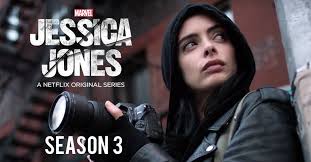
"Jessica Jones": Season 3 is fun to view, but sad, if only for the series' confirmed cancellation. It's not as if it would go on forever (no series does), but to secure interest, Netflix's may have kept its daffy decision secret for a spell. Some folks simply won't watch, now knowing there'll be no more.
Loyalists should be fine with what stands, though. A third season is better than less. The Jones saga is there re-tasting whenever one wishes, along with the other Defenders shows.
Krysten Ritter is also worth the effort, just as she was on "Breaking Bad". (She sure does have that big-eyed, Barbara Steele thing goin' on.) I only wish she had donned some glamour from time to time, but even in a jacket and jeans, she's still stunning.
Ritter's performance rivaled expectations, projecting an image superior to her comic-book counterpart. (How often does that happen?) Season 3 also gave her more to do than Season 2, but that first stretch (if only due to David Tennant's mind-blistering Kilgrave) was the stand-out of the trilogy: a classic, high point in Marvel-adapted history.
I might add that the sister-vs-sister angle was a rousing way to end. (There's even a "Civil War" nod in there, for those who wish to find it.) Rachael Taylor's Trish juiced things up to the max: a veritable Punisher in her own tormented right. I do believe Trish's Hellcat transformation worked to our titular heroine's benefit, building suspense in the proper way.
Anyhow, I'm glad that the farewell remains open, with a particular, sinister voice yet prodding Jones along. No one should shirk their responsibilities, especially superheroes. And though Jones may be unorthodox in attire and command, I'm glad she's not proven the exception to that golden rule.